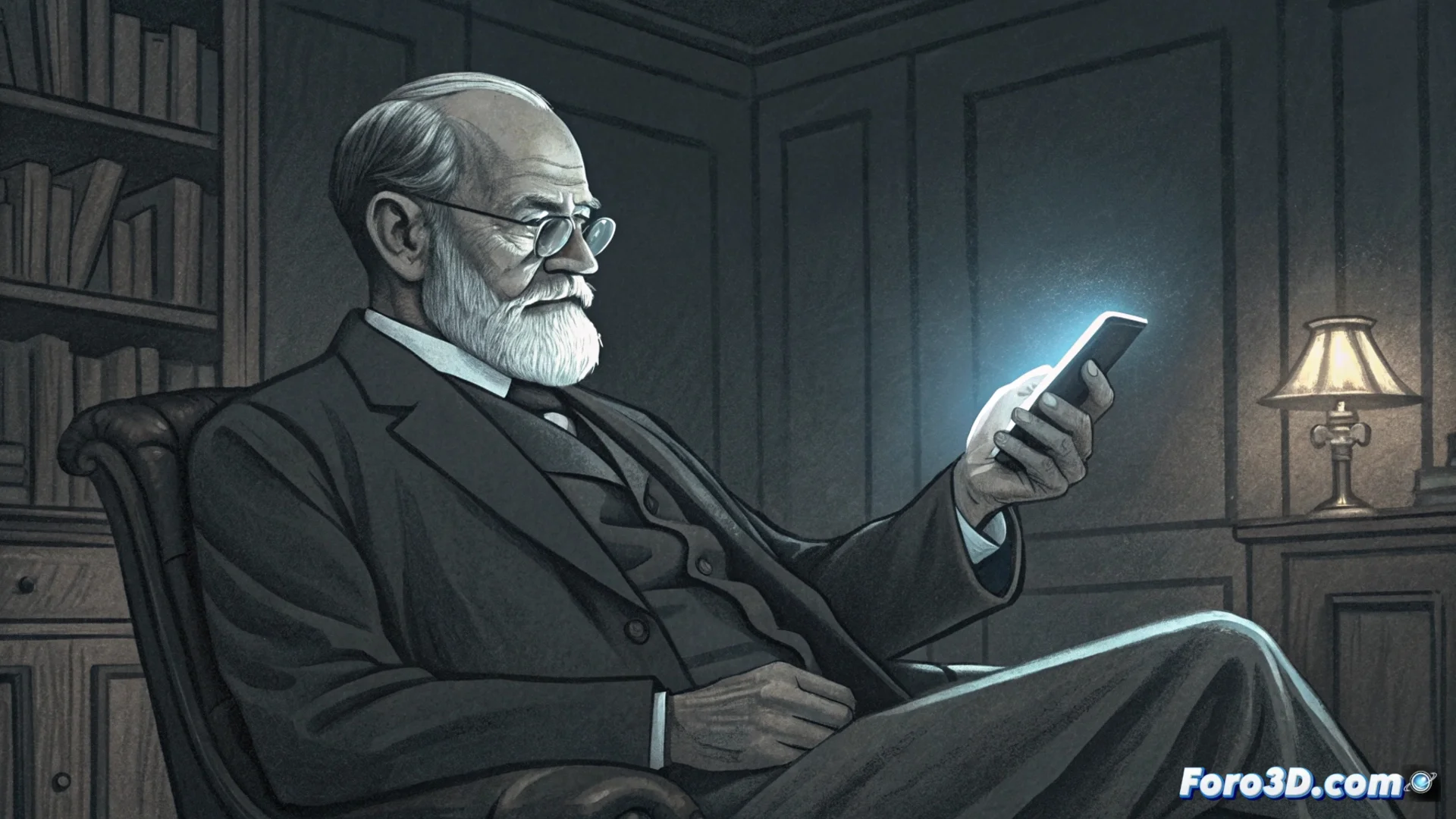
Freud and Social Media Addiction
This text presents an imaginary scenario where Sigmund Freud examines social media addiction and the attention economy in the modern digital environment, applying his psychoanalytic ideas
Freud Sees Online Behaviors as Symptoms of Internal Conflicts
From psychoanalysis, Freud would see compulsive internet use as a sign of unresolved mental disputes. He would interpret the incessant hunt for likes or endless scrolling as a release of Id impulses, facilitated by technology. Platforms would serve as substitutes that fulfill desires quickly but emptily, preventing the individual from facing their true fears. Freud would highlight how app design exploits defenses like repression and the transformation of aggressive or sexual impulses.
Key Aspects Freud Would Analyze:- External validation as an escape from deep anxieties
- The role of technology in mediating drives ⚙️
The platform acts as an object that satisfies desires immediately but superficially.
The Superego Adapts to the Digital World and Produces Guilt
In the attention economy, a digitally adapted Superego emerges. This incorporates social rules of success and visibility that drive social networks, generating continuous guilt for not creating content or lacking popularity. Freud would argue that this situation exacerbates cultural discontent, as no one achieves the online Ego ideal. The fear of missing out on events and sickly comparisons would be seen as responses to feelings of inferiority or emptiness. The screen projects fantasies and neuroses.
Elements That Reinforce Discomfort:- Visibility norms internalized by the Superego
- Comparisons that awaken anxiety and guilt
A Hypothetical Therapy Forces Confronting the Hidden
Freud would apply his approach to reveal the unconscious. He would create an intervention that encourages the user to identify hidden motives behind each interaction. Instead of apps that retain attention, he would suggest a tool that examines usage habits to discover how repeated searches or interactions conceal repressed desires or unresolved disputes. The goal would be a liberation that returns control of the subject's mental energy, captured by algorithms. Imagining an AI report revealing engagement with political tweets as a mask for unresolved Oedipal envy would make him light an extra cigarette. Diagnosing inferiority complexes from Instagram filters or oral fixations from passively watching reels is an anachronistic but illuminating exercise. His influence would suggest that the real unconscious now uses cookies and accepts terms without reading them