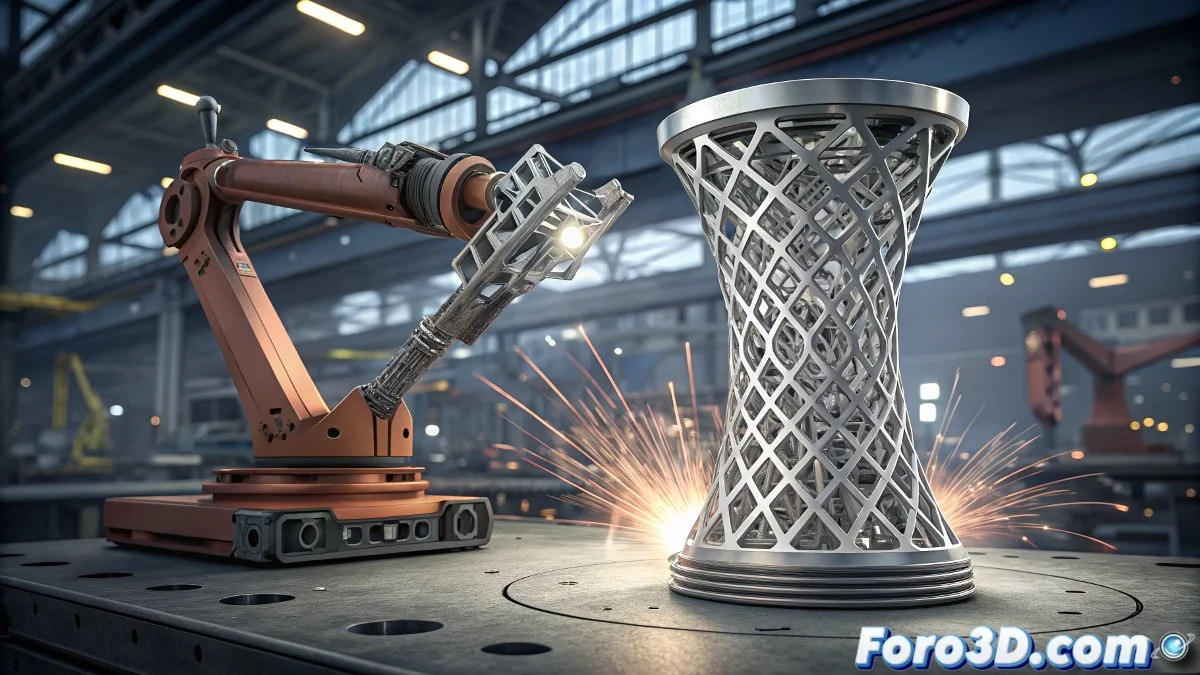
Fraunhofer Research Demonstrates 30% Weight Reduction in Tools Using 3D Printing
The Fraunhofer Institute has published revolutionary results demonstrating how industrial 3D printing can reduce the weight of specialized tools by a 30% while improving structural performance. This research, developed in collaboration with industrial partners, uses generative design and topological optimization to create tools that are not only lighter but also more efficient and ergonomic, marking a turning point in advanced manufacturing. 🏭
Research Methodology and Innovative Approach
The study by the Fraunhofer Institute for Manufacturing Engineering and Automation IPA focused on the complete redesign of industrial tools using topological optimization algorithms that redistribute material only where it is strictly necessary. The process combines finite element analysis with machine learning to identify stress patterns and create internal structures inspired by natural forms, such as beehives and bone structures, that maximize strength while minimizing weight.
Key Technical Aspects of the Research:- Use of generative design software to explore thousands of iterations
- Implementation of advanced topological optimization algorithms
- Analysis of real load cycles using integrated IoT sensors
- Selection of composite materials and advanced metal alloys
- Validation through accelerated fatigue and strength tests
- Ergonomics analysis and reduction of repetitive strain injuries
This is not just about making tools lighter, but about redesigning them from the fundamental principles of physics so that material exists only where it is truly needed to fulfill the function.
3D Printing Technologies Implemented
The research utilized multiple additive manufacturing technologies according to the specific requirements of each tool. From SLM for metals to FDM and SLS for polymers, each technology was selected to optimize the required mechanical properties while maintaining economic viability for industrial production. 💡
3D Printing Technologies Employed:- SLM for metallic tools requiring high strength and durability
- FDM with continuous carbon fibers for directional structural reinforcement
- SLS for nylon components with excellent strength-to-weight ratio
- DMLS for high-performance aluminum and titanium alloys
- Hybrid manufacturing technology combining traditional substrates with optimized printed geometries
- Multimaterial printing for mechanical property gradients
Quantifiable Results and Demonstrated Benefits
The study results show significant improvements that go beyond simple weight reduction. The optimized tools demonstrated better stress distribution, longer service life, and substantial ergonomic improvements that directly impact operator productivity and safety.
Documented Performance Metrics:- Average 30% weight reduction across all tool categories
- 15-25% increase in service life due to better stress distribution
- 40% reduction in operator fatigue in repetitive tasks
- 20% decrease in cycle times due to better handling and balance
- 15-30% savings in material costs despite higher production costs
- 25% reduction in energy required for manual operation
Industrial Applications and Case Studies
The research included multiple real-world application cases in sectors such as automotive, aerospace, and capital goods. Each case demonstrated how additive redesign can solve specific problems that traditional manufacturing methodologies cannot address efficiently.
Successful Implementation Cases:- Assembly tools for automotive production lines
- Specialized clamping devices for the aerospace industry
- Customized measurement and quality control equipment
- Ergonomic handheld tools for manufacturing operators
- Injection mold components with optimized cooling channels
- Assistance devices for workers with reduced mobility
Implications for the Future of Manufacturing
This research from the Fraunhofer Institute establishes a significant precedent for the widespread adoption of 3D printing in industrial environments. The results suggest that we are facing a paradigm shift where design for additive manufacturing can overcome the limitations of traditional methods, opening up previously impossible possibilities.
Trends and Future Developments:- Integration of AI for automatic optimization of existing tools
- Development of digital libraries of optimized tools by application
- Implementation of distributed manufacturing through localized 3D printing
- Advances in composites specifically for tooling applications
- Standardization of certification processes for printed tools
- Expansion to industries such as construction, energy, and medicine
Conclusion: Redefining the Limits of Industrial Design
The Fraunhofer Institute research convincingly demonstrates that industrial 3D printing has reached the necessary maturity to fundamentally transform how we conceive and manufacture tools. The ability to significantly reduce weight while improving performance represents an advancement that transcends simple incremental evolution, laying the foundation for a new era in design and manufacturing where material efficiency and structural performance are optimized simultaneously through the power of additive manufacturing and computational design. ✨