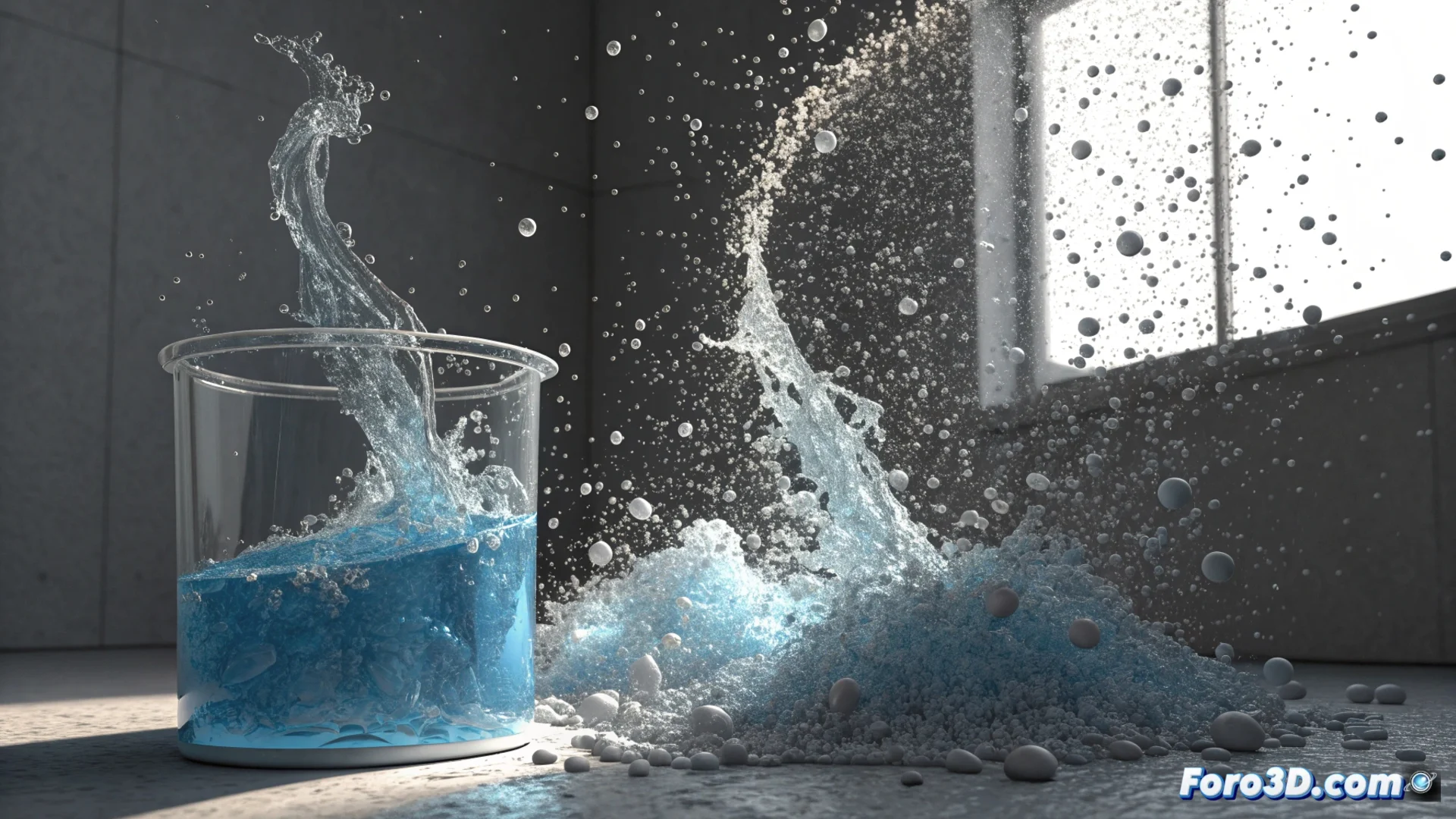
RealFlow Hybrido Combines Particles and Mesh in a Single Solver
In the realm of visual effects, simulating fluids realistically and efficiently is a constant challenge. RealFlow's Hybrido solver addresses this challenge by merging two fundamental techniques into a single integrated system. This allows artists to get the best of both worlds without compromising creative control or physical accuracy. 💧
Two Representations, One Unified Simulation
The core of Hybrido manages two representations of the fluid in parallel. On one hand, it uses a SPH particle-based method to calculate the internal behavior of the liquid, its interactions, and complex phenomena like splashes. On the other, it automatically builds a continuous surface mesh that envelops those particles, generating clean and closed geometry.
Key advantages of this dual approach:- Solves rendering problems: A particle-only simulation can be difficult to integrate into a rendering pipeline, while Hybrido delivers a ready-to-use mesh.
- Maintains physical detail: The mesh alone can smooth too much and lose realism; SPH particles preserve complex dynamics and turbulence.
- Unifies data: Both systems are calculated simultaneously within the same simulation, eliminating the need to combine separate results.
Hybrido processes particles and mesh in parallel, unifying the data and optimizing the workflow from simulation to final render.
Optimizing the Creative Workflow
This integrated method transforms how artists work with fluids. The user defines the simulation parameters once, and the hybrid solver handles calculating the evolution of the particles and the generation of the surface mesh simultaneously.
Artistic control parameters:- Particle resolution: Adjusting this value allows control over the level of detail and the fidelity with which the fluid physics is simulated.
- Mesh generation: It is parameterized to define the degree of smoothing and the final appearance of the liquid surface.
- Time savings: Eliminates the steps of simulating separate systems and then trying to synchronize or combine them manually.
From Simulator to Render, Seamlessly
The final result is a render-ready mesh file that can be exported directly to assign materials, set up lights, and integrate into the scene within the preferred rendering engine. This continuous workflow allows focusing on artistic direction, from the simplicity of a static body of water to the complexity of a breaking wave with realistic foam, all managed by a single powerful solver. 🚀