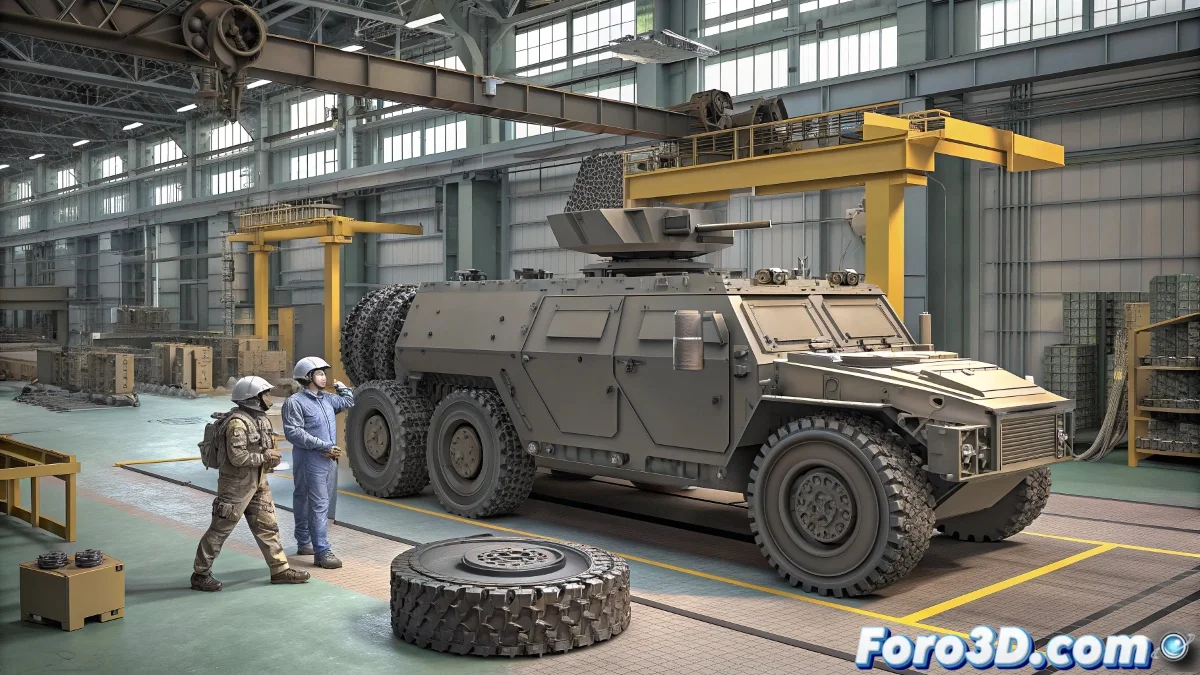
DMC Sets New Record with 90 kg 3D Printed Military Component
The Digital Manufacturing Centre (DMC) has completed the manufacture of its largest 3D printed metal part to date: a 90 kg suspension and differential bracket for the Mastiff military vehicle 🚛. Developed for NP Aerospace as part of the UK Ministry of Defence's TAMPA Spiral 2 project, the part was created using Wire Arc Direct Energy Deposition (DED) technology. With approximate dimensions of 500 mm per side, this structural component was exhibited at DSEi 2025 in London, demonstrating the potential of additive manufacturing in high-demand defense applications. Because in military engineering, size does matter 💪.
Large-Scale Additive Manufacturing for Critical Applications
This achievement underscores 3D printing's capability to produce large structural metal components that were traditionally manufactured through casting or forging 🏭. Wire Arc DED technology enables the creation of these parts without the need for expensive molds or specialized tooling, reducing lead times from weeks to days. Furthermore, this method is not only useful for manufacturing from scratch but also for repairing and machining existing parts, significantly extending their service life. A crucial advantage in environments where spare parts availability can be a matter of national security.
Additive manufacturing reduces lead times from weeks to days, and DED technology also allows for the repair and machining of existing parts.
Strategic Impact on Defense and Logistics
The collaboration between DMC and NP Aerospace highlights the potential of additive manufacturing to improve the availability of military platforms, reducing costs and timelines associated with replacing critical parts. In sectors like defense, where supply chain disruptions can have serious consequences, the ability to produce components locally on-demand represents a paradigm shift. This type of advancement contributes to creating a more agile and resilient supply chain, capable of responding quickly to operational needs without relying on foreign manufacturers or lengthy import processes 🛡️.
Technical Details and Benefits of Wire Arc DED
Wire Arc DED technology uses an electric arc to melt metal wire that is deposited layer by layer, allowing the creation of large parts with mechanical properties comparable to traditional methods. For this specific project, the benefits include:
- Weight Reduction: Topological optimization that maintains strength while reducing mass.
- Rapid Customization: Adaptation of the design for specific requirements without expensive tooling.
- Sustainability: Less material waste compared to subtractive methods.
- Functional Integration: Ability to incorporate complex features into a single part.
Implications for the Future of Defense Manufacturing
This project sets an important precedent for the adoption of additive manufacturing in critical military applications. By demonstrating that it is possible to produce large, reliable structural parts via 3D printing, DMC and NP Aerospace open the door to a new era of manufacturing agility for defense. Future developments could include on-demand production of components in the field, in-situ repairs, and optimized designs that improve the performance of vehicles and systems. The future of military logistics might be closer to a giant 3D printer than to a traditional factory 🪖.
The Irony of XXL Parts
With 90 kg components, engineers will need forklifts instead of desktop printers... although Batman would probably find an elegant way to transport them in his Batmobile 😅.