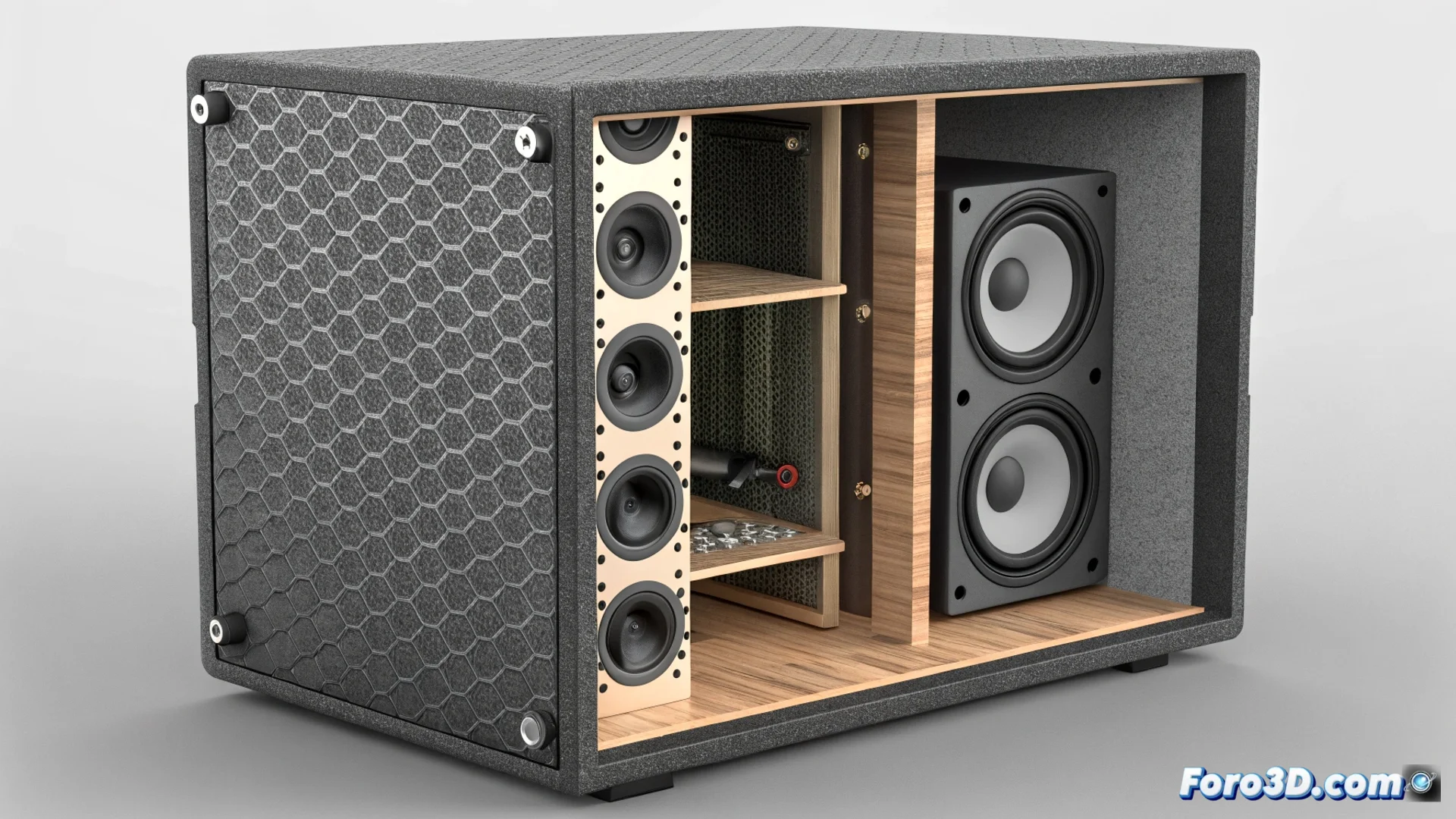
Design Custom Acoustic Enclosures for Speakers with 3D Printing
3D printing technology opens a new path to create custom acoustic enclosures, specifically for bookshelf speakers. This method fuses the internal design, which defines audio quality, with the external shape, which must integrate into the space's decoration. 🎛️
Model the Enclosure to Control the Sound
The first step is to model the acoustic enclosure in 3D design software. The main goal is to optimize its frequency response and suppress resonances that distort the audio. Layer-by-layer manufacturing allows the use of composite materials in a single piece, combining rigidity and vibration absorption capacity. This achieves a speaker that not only sounds precisely but also physically adapts to its location.
Key advantages of the process:- Design integration: Unifies acoustic engineering and industrial design in a single workflow.
- Material flexibility: Allows depositing materials with different properties, such as rigid PLA and flexible TPU, in strategic areas.
- Rapid prototyping: Facilitates testing and adjusting design iterations agilely and economically.
The key is not just to make the speaker look good, but to balance the physics of sound with aesthetics to avoid an enclosure that resonates like a tin can.
Calculate and Optimize the Internal Volume
The internal design is fundamental. The necessary air volume inside the enclosure must be calculated based on the speaker driver's Thiele/Small parameters. To avoid standing waves, opposing parallel surfaces are avoided. Baffles, reinforcements, and the bass port shape (if used) are modeled to rigidize the structure and tune the resonance frequency. All of this is simulated with specialized software before printing.
Critical elements to design:- Internal volume: Calculated precisely for the speaker's parameters.
- Anti-parallel geometry: Design of internal walls that disperse sound waves.
- Structural reinforcements: Internal elements that increase rigidity and reduce enclosure vibration.
Customize the Aesthetics and Select the Materials
The external design focuses on aesthetics. 3D printing allows creating organic, geometric shapes or those that imitate other objects, with complex surface textures. Material selection is versatile: PLA or PETG for the main structure and flexible filaments like TPU for joints or dampers. Printing in multiple stages with different materials allows combining rigidity and absorption in a single enclosure. A finish with paint or dye completes the product customization. 🎨