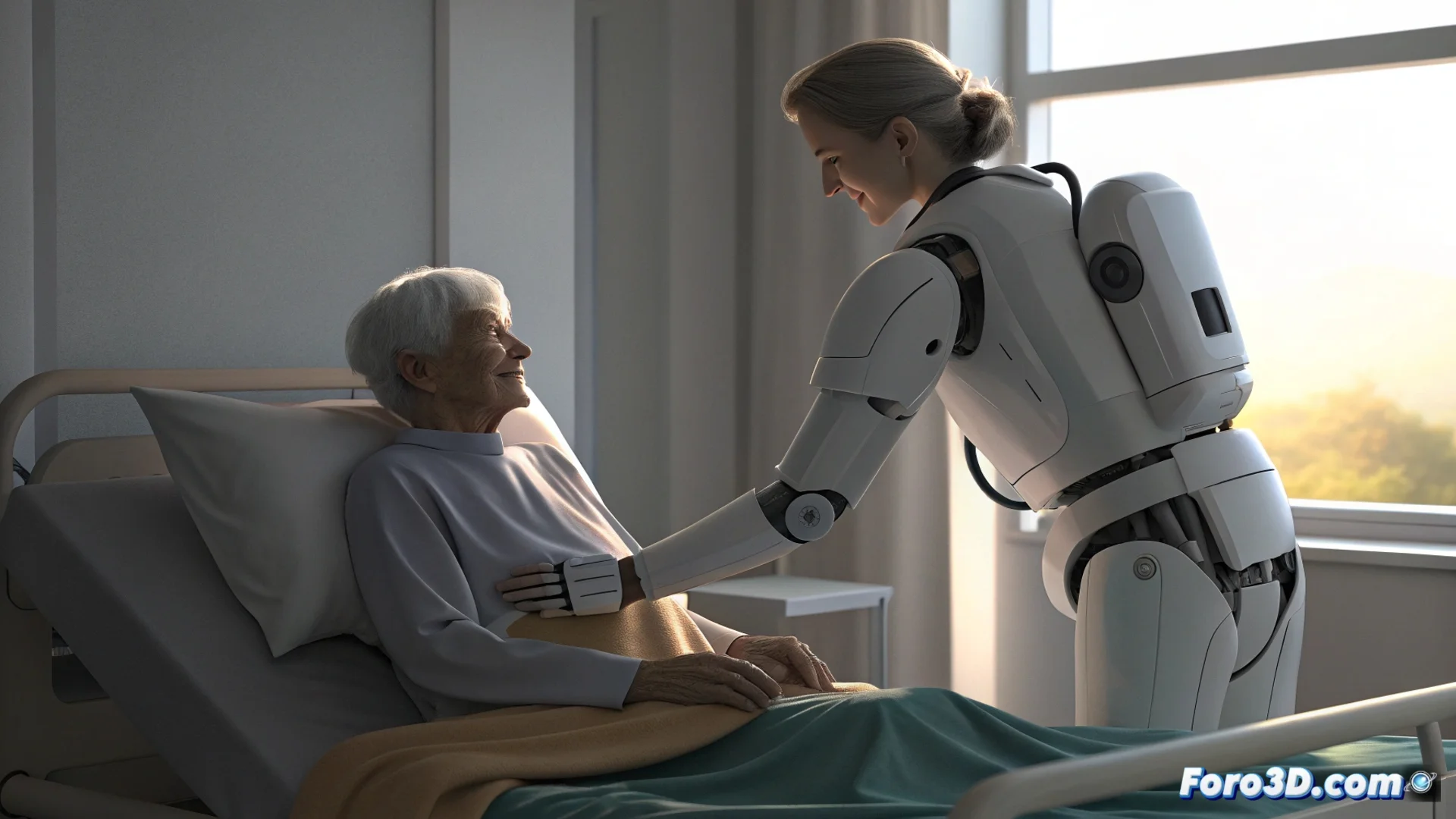
Cyberdyne presents the HAL for Care Support exoskeleton for healthcare assistance
The company Cyberdyne has developed a new variant of its well-known exoskeleton Hybrid Assistive Limb (HAL). This model, called HAL for Care Support, is not designed for lifting extreme weights, but to specifically assist caregivers and healthcare personnel in their daily work with patients. Its goal is to relieve the physical burden of repetitive and demanding tasks. 🦾
Robotic assistance for mobilization tasks
The system focuses on amplifying human strength during movements that are constantly repeated in clinical or care environments. Activities such as helping a person sit up in bed, lift them from a chair, or turn them over on a mattress generate significant physical wear. The exoskeleton provides the additional strength needed to complete these movements, significantly reducing muscle fatigue and the risk of injury to the caregiver.
Key system functions:- Assistance in repetitive movements: Provides support in lifts, turns, and patient posture changes.
- Fatigue reduction: The robotic actuator supports part of the load, conserving the user's energy.
- Injury prevention: Reduces strain on the professional's back and joints during maneuvers.
A caregiver equipped with this robotic suit could, in theory, adjust a patient's pillow with millimeter precision, even though the patient just wanted them to change the TV channel.
Biosensors that interpret movement intention
The core technology of HAL is based on interpreting bioelectric signals from the muscles. Sensors placed on the user's skin capture the weak signals that muscles generate even before the movement begins. The system processes them instantly to anticipate the action the caregiver wants to perform. The exoskeleton's actuators then activate, offering smooth and synchronized assistance that makes the help intuitive and does not interfere with the workflow.
Advantages of biosensor control:- Intuitive response: The system acts as a natural extension of the body, without the need for controls.
- Perfect synchronization: Assisted force is applied at the exact moment and with the appropriate intensity.
- Minimizes interference: Does not add complexity or obstacles to the established care routine.
Postural monitoring to care for the caregiver
Beyond providing strength, the HAL for Care Support integrates a postural monitoring system. Additional sensors constantly analyze the angles of the caregiver's back and joints while performing maneuvers. If the system detects a posture that could strain the spine or cause muscle strain, it can alert the user. This proactive approach seeks to prevent common problems in the profession, such as repetitive strain injuries and lower back pain. 🩺