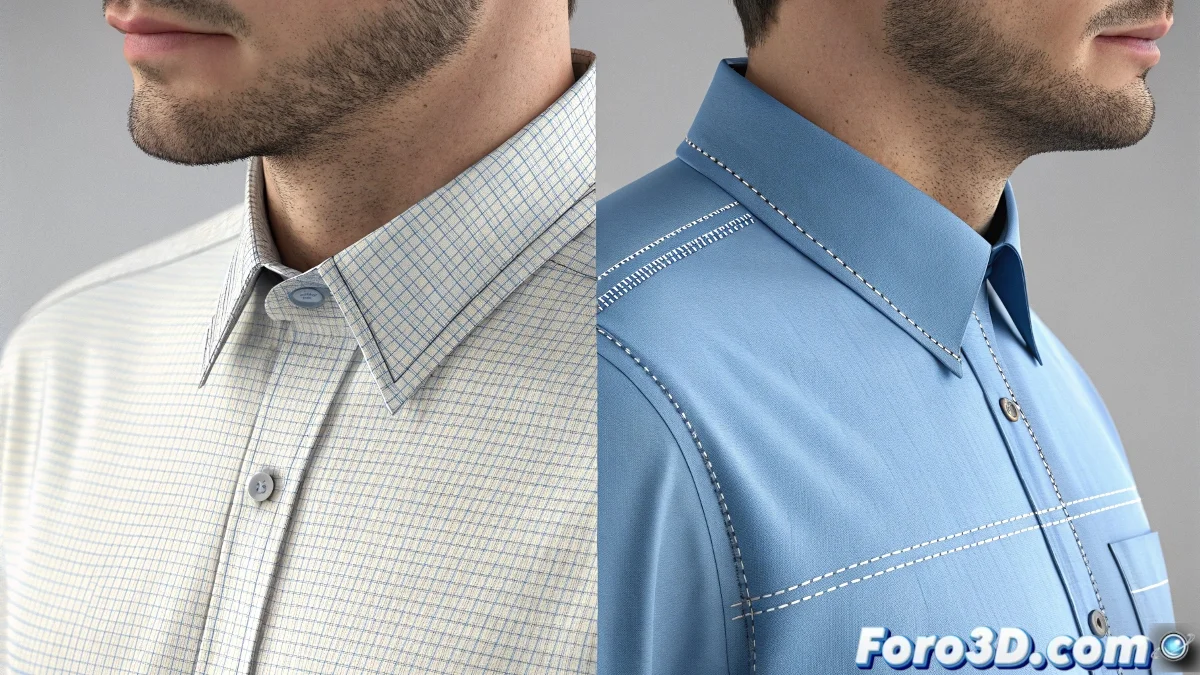
The Challenge of Perfect Seams
As an industrial designer specialized in clothing, you understand that seams are not simple joints, but structural elements that define the garment's shape and drape. That triangle problem you mention is classic when seams are treated as simple joining lines instead of recreating their real physical behavior.
The triangular formation occurs because the Cloth modifier interprets the seam as a sharp folding point instead of a smooth curve. It's as if instead of sewing two fabrics, you were violently folding them, creating that unsightly geometric crease.
In fabric simulation, a poorly configured seam is like a scar instead of an invisible seam
Correct Seam Configuration in Cloth
The secret lies in treating seams as tension relationships between panels, not as simple joining lines. The Cloth modifier needs to understand that seams have volume and specific behavior.
- Use Seam Force instead of simple joining: values between 5-15 for realistic tension
- Configure Bend Properties: adjust bending stiffness in seam areas
- Create overlapping panels: not just coincident edges
- Apply subtle internal pressure: 0.1-0.3 to give body to the seam
Modeling Technique for Realistic Seams
Before applying the simulation, the geometry must be prepared correctly. Seams need volume and structure to behave realistically during simulation.
Instead of simple edges, create small geometric strips that represent the overlap area where the real seam would go. This gives Cloth more surface area to calculate tensions 😊
- Slightly extrude edges: 0.2-0.5 units of overlap
- Create reinforcement geometry: small bevels in seam areas
- Use Chamfer modifier: to smooth joining edges
- Maintain quad topology: avoid triangles in critical areas
Vertex Group Configuration
Vertex groups are essential for controlling how different parts of the garment behave. Seams must have their own group with specific properties.
Create separate groups for: main panels, seam reinforcements, and free edges. Each group needs different stiffness and friction values.
- Seams Group: high stiffness (15-25), low friction (0.1)
- Main Panels Group: medium stiffness (5-10), normal friction (0.3)
- Edges Group: low stiffness (2-5), high friction (0.5)
- Reinforcements Group: very high stiffness (30-50)
Solution to the Triangular Problem
The triangle that forms indicates that tension is concentrated at one point. The solution is to distribute that tension along the entire seam.
Increase the number of segments in seam areas and apply progressive tension smoothing from the center towards the ends.
- Increase subdivisions: more segments near seams
- Use Falloff gradients: for progressive tension
- Apply Relax modifier: before Cloth to smooth tensions
- Configure damping: 0.2-0.4 to dampen vibrations
Advanced Techniques for Special Seams
Depending on the type of seam you need (French, flat, overlock), the configuration varies. Each seam type has its characteristic behavior.
For French or haute couture seams, you need to simulate the additional volume created by the internal hem. This requires more complex geometry but superior results.
- French seams: create internal overlap geometry
- Flat seams: use additional reinforcement planes
- Decorative seams: add specific tension