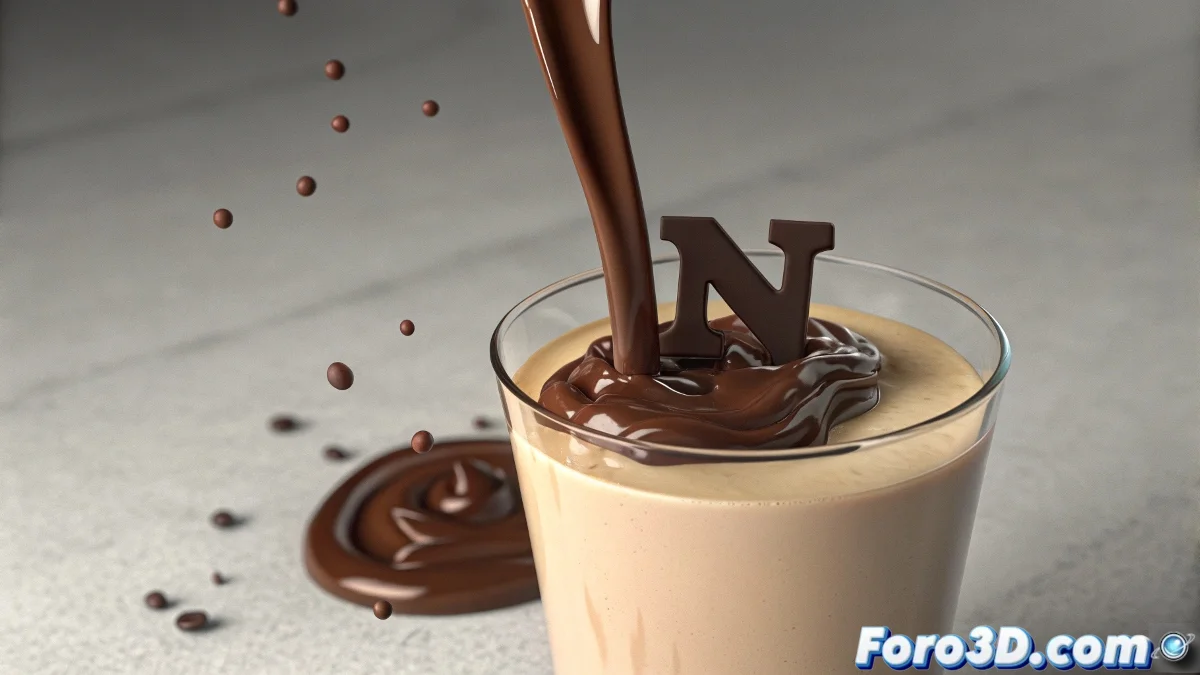
The Art of Writing with Liquid Chocolate
Controlling the trajectory of a chocolate thread in RealFlow to form specific letters is like becoming a liquid calligrapher. The challenge lies in combining fluid physics with artistic control of the trajectory, especially with a thick liquid like chocolate that has its own viscous personality.
To make the chocolate draw a perfect letter N on your frappé, you need to master three elements: the animation of the emitter following the path, the physical properties of thick chocolate, and the interaction with the frappé's surface. Each aspect must work in harmony to create that magical illusion of liquid writing.
In RealFlow, making chocolate write is like teaching honey to dance: it requires rhythm, fluidity, and a lot of patience
Path Setup with Guide Spline
The foundation of your effect is creating a perfect spline that represents the letter N. This spline will be the path your chocolate emitter follows.
- Create spline for the letter N: use Line tool with smooth curves
- Optimize vertices: enough for smooth curves, not too many for control
- Orient correctly: ensure the spline is over the glass
- Path constraint animation: so the emitter follows the spline
Emitter Animation Following the Path
The secret is making the RealFlow emitter faithfully follow the spline at the right speed. Too fast and the chocolate will break, too slow and it will pile up.
Use a Path Constraint on the emitter so it automatically follows the spline. The animation speed will determine the thickness and continuity of the chocolate thread 😊
- Apply Path Constraint: to the RealFlow emitter
- Constant speed: avoid sudden accelerations
- Automatic orientation: so the emitter always faces forward
- Follow and Bank: disable for simple movement
Properties of Thick Chocolate
The chocolate needs specific configuration to behave like a viscous liquid rather than water. High viscosity and surface tension are key.
Configure the parameters so the chocolate maintains thread coherence but adapts to the frappé's surface. It's a delicate balance between fluidity and body.
- High Viscosity: 8-15 for thick consistency
- Surface tension: 10-20 to maintain thread shape
- Medium Density: 2-3 for adequate weight
- Cohesion: 5-10 so the thread doesn't break
Emitter Configuration for Chocolate
The emitter type and its parameters determine the quality of the chocolate thread. You need a constant but controlled flow.
A small Square emitter works best for thin, controlled threads. The emission speed must be synchronized with the path animation speed.
- Small Square emitter: 0.5-1.0 units in size
- Emission speed: 50-100 for constant flow
- Medium Resolution: 60-80 for quality/time balance
- Linear interpolation: for uniform emission
Interaction with the Frappé Surface
For the chocolate to accumulate forming the letter instead of sinking, you need to correctly configure the collision properties.
The frappé surface must have high friction and resistance so the chocolate stays on the surface. Think of the frappé as a semi-solid surface.
- Low Collision distance: 1-2 for precise detection
- High Friction: