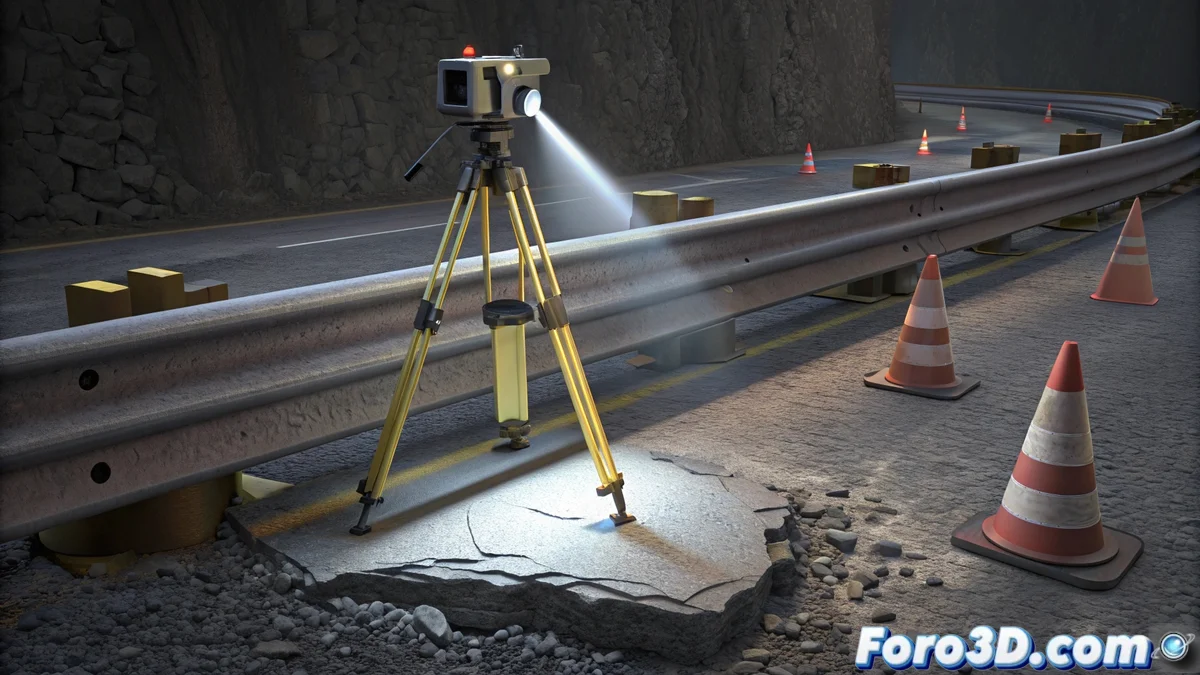
Reconstructing a Hit-and-Run Accident with Reverse Engineering and 3D Simulation
In a hit-and-run traffic incident, physical evidence such as a deformed fence becomes the main witness. Current 3D technology allows for digital reconstruction of the event to identify the offending vehicle, transforming a dent into solid proof. 🚗💥
Capturing the Scene with Millimeter Precision
The process begins with 3D laser scanning of the deformation on the guardrail or fence. Devices like the FARO Focus scanner record the damaged geometry, generating an extremely accurate point cloud. These digital data form the factual basis on which the entire subsequent investigation is built.
Initial Workflow:- Use a 3D laser scanner to document the accident scene.
- Generate a dense and accurate point cloud of the deformation.
- Export the data to specialized software for processing.
The silent imprint on the metal can shout the make and model of the culprit.
Revealing the Vehicle's Shape through Reverse Engineering
The point cloud is imported into a program like Geomagic Design X. Here, the specialist processes and cleans the data to create a solid polygonal mesh of the imprint. The key operation is to digitally invert this mesh, producing a positive volume that is the exact negative of the dent. This reconstructed 3D object reveals the width, height, bumper curvature, and position of elements like headlights.
Steps in the Reconstruction:- Import and clean the point cloud in reverse engineering software.
- Create a closed polygonal mesh of the deformation.
- Apply tools to invert the mesh and obtain the vehicle's positive volume.
Validating the Hypothesis with Dynamic Simulation
With the reconstructed 3D model of the front end, the impact can be simulated. In tools like PC-Crash, experts input parameters such as speed and angle to recreate the crash dynamics. The goal is to verify if the generated model produces a deformation in the barrier that matches the one scanned in reality. This step validates the reconstruction and helps narrow down suspect vehicle models, decisively strengthening the technical evidence.