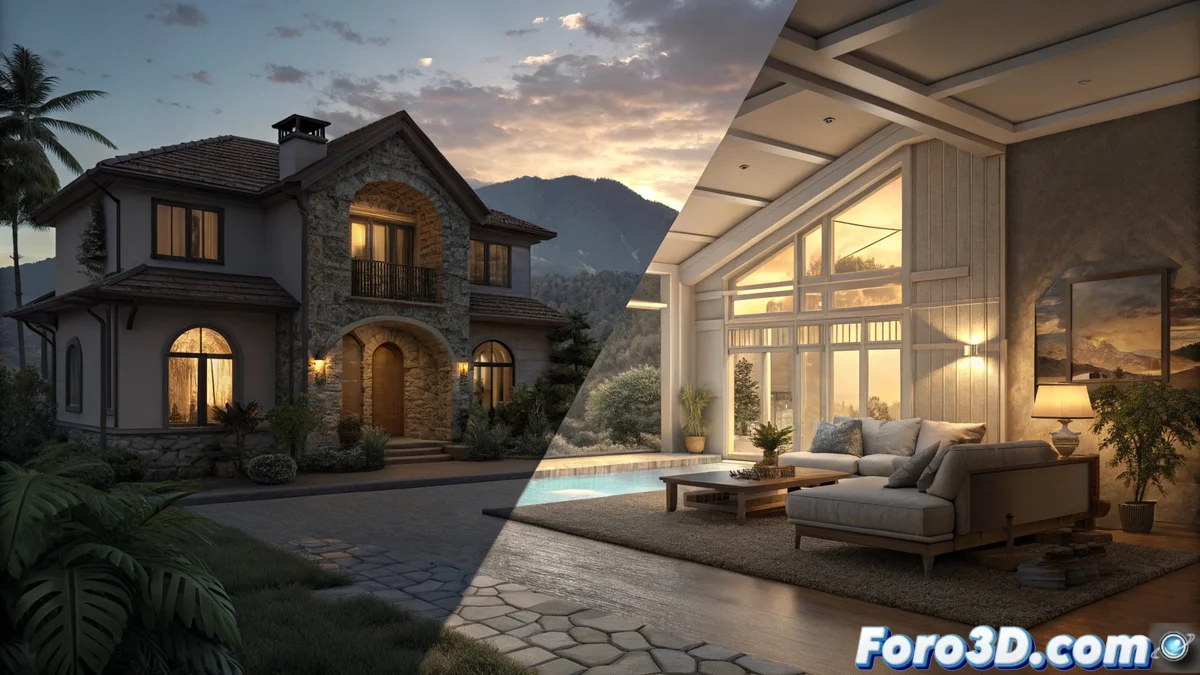
Compare Lighting in ArchiCAD and Revit with Twinmotion
Workflows for lighting in BIM vary greatly between platforms. This analysis contrasts two approaches: the internal engine of ArchiCAD and the external connection used by Revit. Understanding these differences is key to choosing the right tool for each project phase 🏗️.
ArchiCAD and its Integrated Cinerender Engine
ArchiCAD incorporates Cinerender as a native solution for processing light. This engine applies physical simulation principles, using algorithms like path tracing to calculate how light travels. This allows replicating complex effects such as refraction in glass or light dispersion with high precision. The user adjusts parameters like source intensity and ambient lighting directly in the modeling environment, without leaving the program.
Key Features of Cinerender:- Processes lighting with advanced physical methods.
- Allows control of all light parameters within ArchiCAD.
- Generates high-quality photorealistic static images.
“Cinerender prioritizes physical accuracy and detailed control to produce photorealistic images.”
Revit and its Connection with Twinmotion for Visualization
Unlike ArchiCAD, Revit does not include an advanced rendering engine for real-time lighting. To achieve dynamic visualizations, it relies on Twinmotion through a direct connector. This workflow transfers the geometric model and basic textures, but lighting is defined and managed almost entirely within the Twinmotion environment, which uses its own real-time engine.
Aspects of the Revit-Twinmotion Workflow:- Automatically transfers models and textures.
- Lighting is configured within Twinmotion.
- Offers global illumination and atmospheric effects in real time.
Fundamental Differences in Methods and Results
The main divergence lies in the objective. Cinerender in ArchiCAD seeks physical accuracy and meticulous control, a process that can be more time-consuming but results in highly realistic static renders. In contrast, Twinmotion with Revit focuses on speed and interactivity, offering immediate previews and virtual tours with a more practical than physical approach. While some users debate physical fidelity, for others it's enough that the lighting doesn't make their building look like a cave in broad daylight 🕒.