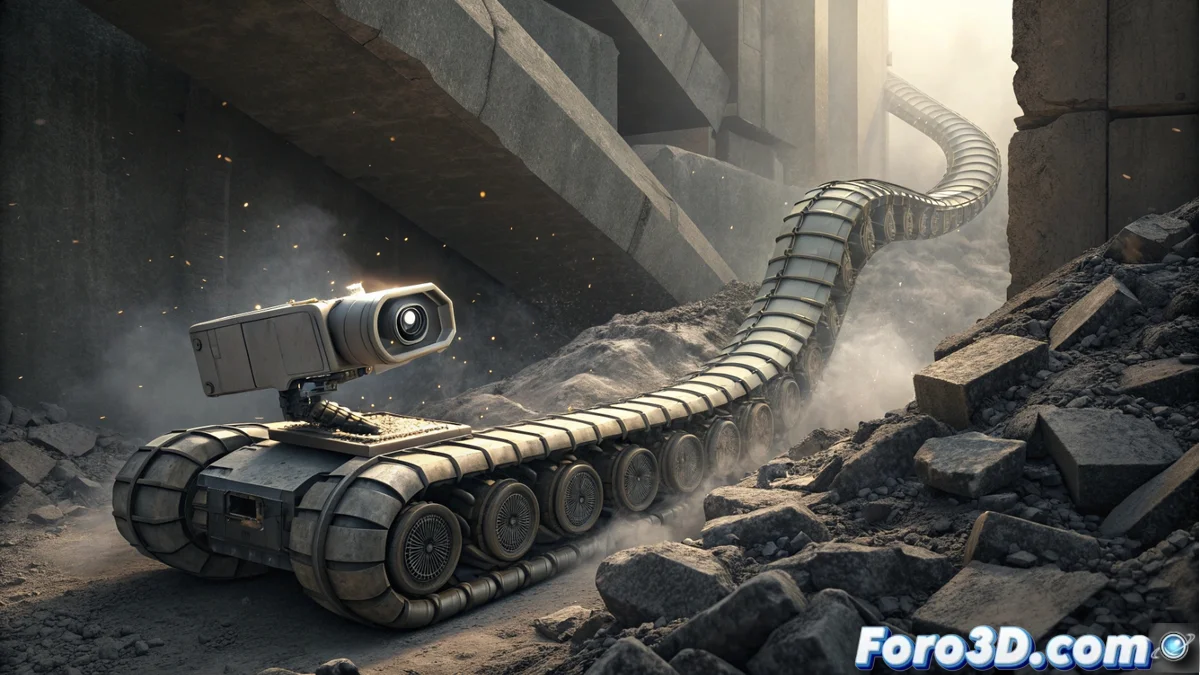
CMU's Snake Robot Searches for Survivors in Rubble
In the CMU Biorobotics Lab, they create modular robots that imitate the shape of a snake. Their main mission is to penetrate disaster zones where traditional rescue teams cannot enter. These devices, called Snakebots, represent a vital tool for locating trapped people. 🐍
Modular Design for Impossible Terrains
The robot's body is built with multiple identical segments joined by motorized joints. Each module carries its own battery, data processing unit, and sensors. This distributed architecture allows the robot to move in a coordinated and adaptable manner, imitating the locomotion patterns of real snakes, such as lateral or concertina movement. Biomimicry is essential for maintaining stability and overcoming obstacles in a chaotic rubble environment.
Key Capabilities of the Snakebot:- Access to confined spaces: Its elongated and flexible shape allows it to crawl through extremely narrow cracks and pipes.
- Versatile movement: It can climb irregular surfaces and navigate complex terrains where wheels or legs would fail.
- Modular autonomy: Each segment operates semi-independently, providing robustness to the entire system.
The goal is to provide crucial information to emergency teams from within the rubble, accelerating rescue operations.
Sensors that Assess the Environment
The robot's head integrates a set of sensors and a camera. The camera transmits live video, giving rescuers "eyes" inside the collapsed area. Other sensors are programmed to measure air temperature, detect the presence of toxic gases, and capture faint sounds, helping to locate signs of life and assess structural risks. This terrain recognition capability is fundamental for planning how to safely extract survivors.
Detection System Functions:- Real-time vision: The camera allows seeing the path and possible victims.
- Environmental analysis: Gas and temperature sensors alert to invisible dangers.
- Acoustic detection: Sensitive microphones can hear knocks or voices.
Current Challenges and Future
Despite its advanced design, the technology still faces limits. A significant problem is that the robot cannot reliably distinguish between an electrical cable, a rope, or a root. This limitation can cause the device to get tangled, turning a rescue mission into a problem that engineers must solve remotely. Overcoming this and other perception obstacles is the next step to make these snake robots even more effective and autonomous in real catastrophe scenarios.