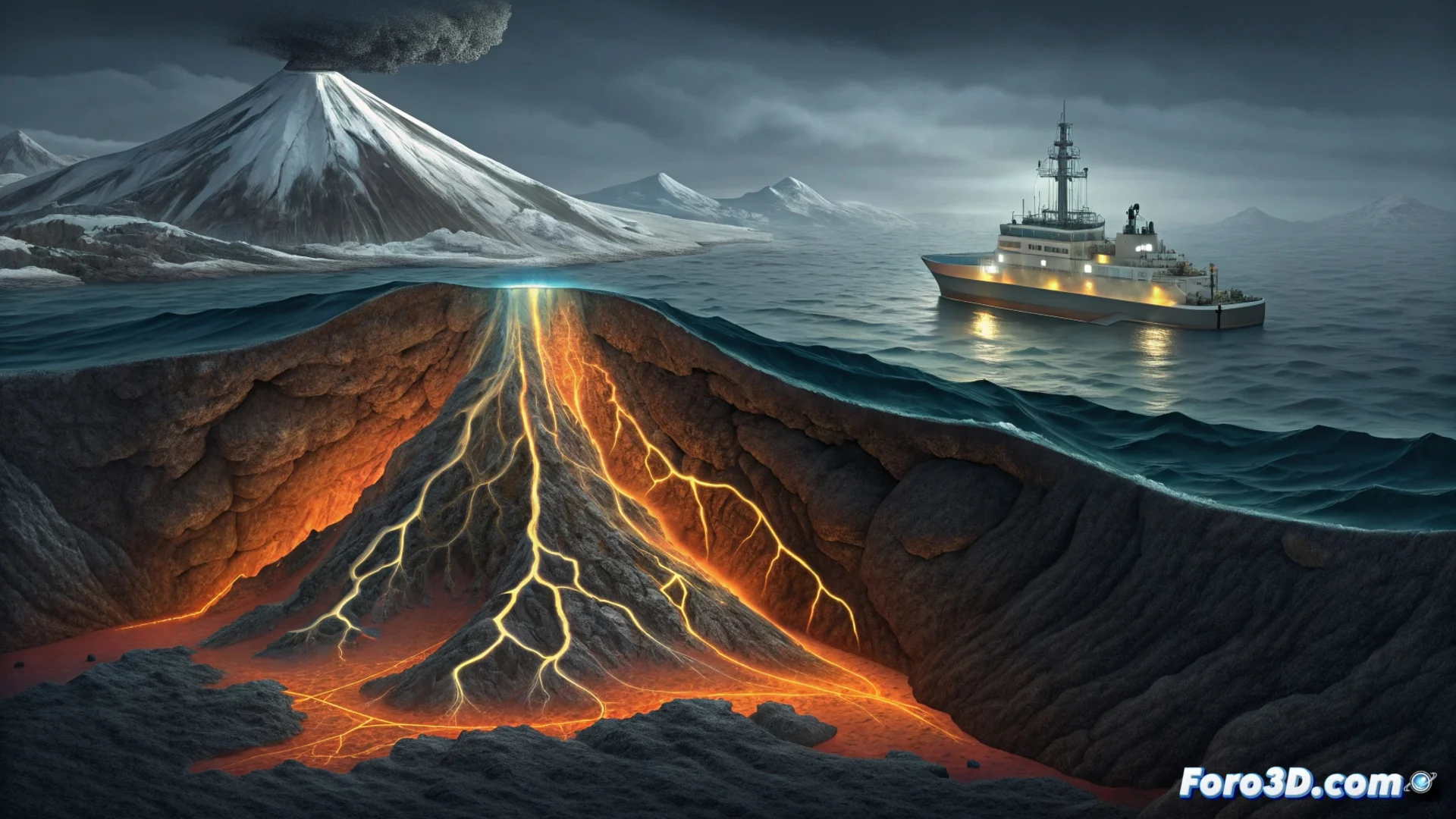
Axial Volcano Data Helps Refine Eruption Prediction Methods
Geophysicists are using data from the underwater Axial volcano, the most monitored on the planet, to refine how they anticipate when it will erupt. Located in the northeast Pacific, this volcano exhibits an activity pattern that scientists can measure with great precision. The key lies in a network of instruments installed on the ocean floor that captures data continuously. 🏔️🔥
A Network That Monitors the Volcano's Every Movement
The project monitoring Axial is called Cabled Array and is part of the Ocean Observatories initiative. It consists of fiber optic and power cables that supply instruments placed directly on the volcanic caldera and its surroundings. These devices record seismicity, water pressure, temperature, and how the seafloor tilts. They transmit the information in real time to onshore laboratories, eliminating the need to collect data intermittently with submarines. Researchers can thus observe how the volcano inflates and deflates with magma movement beneath the crust.
Key Cabled Array Instruments:- Seismic sensors that detect earthquakes and vibrations.
- Pressure gauges to capture seafloor deformations.
- Temperature and chemical probes that analyze changes in the water.
This continuous flow of information is crucial for testing and improving models that anticipate an eruption.
Failed Forecasts Are Part of the Learning Process
The fact that the volcano did not erupt in 2025, as some models predicted, is not considered a mistake, but rather another result of the experiment. The algorithms are based on the idea that Axial accumulates magma at a constant rate and that pressure increases until a breaking point. The fact that it did not occur suggests that other factors, such as the geometry of the magma chambers or the strength of the rocks, are more complex than estimated. Analyzing why the prediction failed allows scientists to adjust the variables and calculations they use.
Factors Complicating the Models:- The geometry and connectivity of internal magma chambers.
- The variable strength of the rocks containing the pressure.
- The actual rate of magma accumulation and movement.
A Constant Cycle of Prediction and Correction
This iterative process of predicting, observing, and correcting defines the scientific method applied to volcanology. The latest prediction, pointing to 2025, provided a valuable opportunity to review the calculations. Now, the next forecast points to 2026. Sometimes, nature prefers not to follow the script written by researchers, reminding them that, no matter how much data they have, the planet still holds its own secrets. The ultimate goal is to use what is learned from Axial to apply these improved models to other volcanoes around the world. 🌍📈