Automate Curtains with Arduino and 3D Printing to Control Light
This project combines digital fabrication and basic electronics to create a system that opens and closes blinds autonomously. The base is a stepper motor managed by an Arduino board, which moves the slats along a guide rail. The entire structure and slats are produced with a 3D printer, providing total freedom to adapt the design to any window size 🛠️.
Customize Slats to Create Lighting Effects
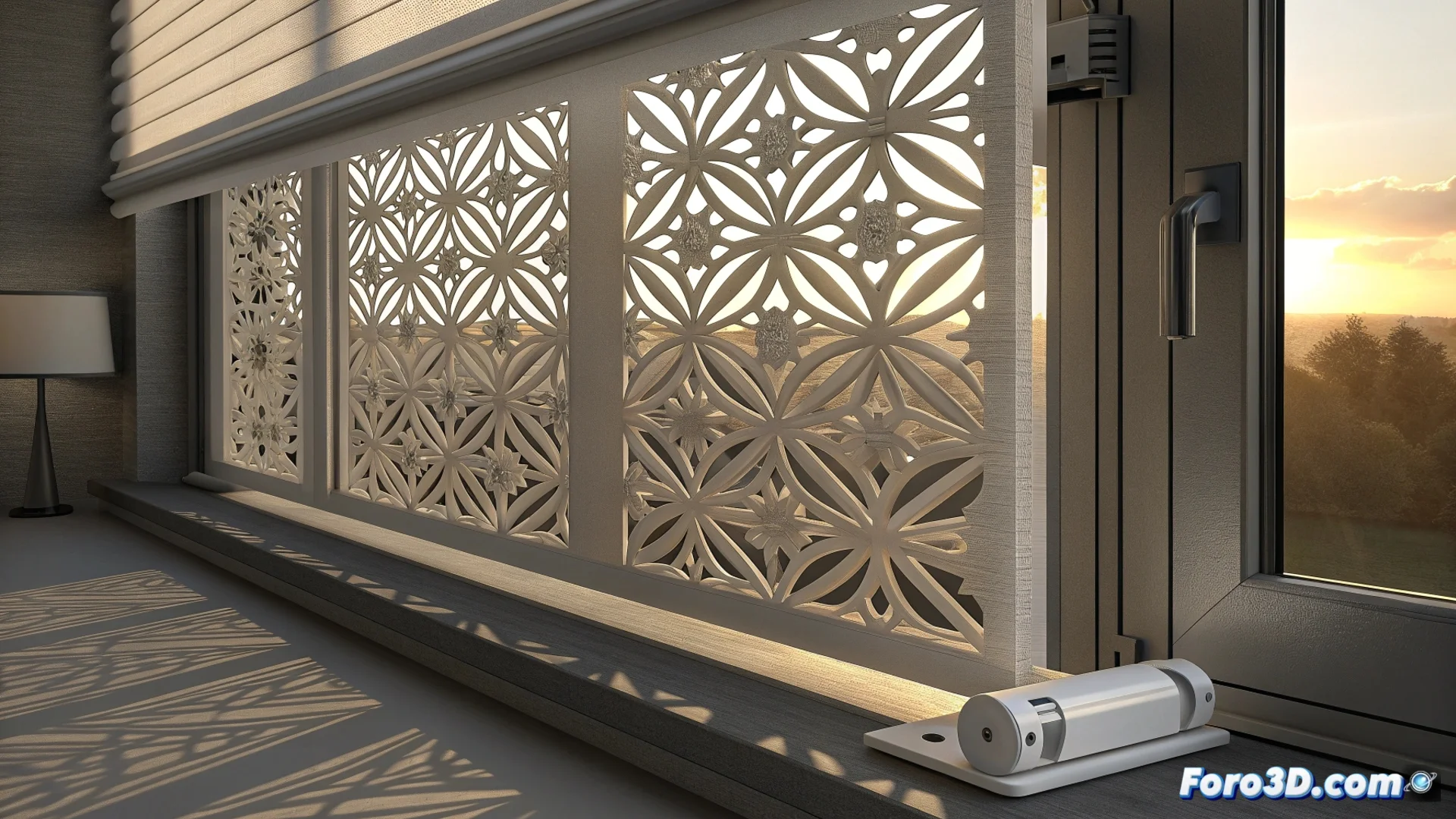
3D printing the slats is key to customizing their shape. You can design them with perforations, textures, or specific reliefs. When sunlight passes through them, decorative and dynamic patterns are projected on the walls and floor. This turns a common blind into an active element that modifies the atmosphere of a room.
Advantages of 3D printing slats:- Adapt the design to the exact geometry of your window.
- Create unique light effects with custom perforations.
- Replace or modify parts quickly and economically.
3D printing transforms the basic function of a blind into a dynamic and customizable lighting element.
Assemble the Circuit and Program the Control
For the electronic assembly, you must connect the stepper motor to the Arduino board. This is done using a driver like the ULN2003 or A4988, which handles the necessary current. The code you upload to the Arduino will program the movement to open or close the curtains. You can configure this movement to be triggered by an ambient light sensor, a programmed timer, or a remote command via Bluetooth.
Key components of the system:- Arduino board (Uno or Nano).
- Stepper motor and corresponding driver.
- 3D printed structure and guide rail.
- Appropriate power supply.
Integrate Mechanics and Electronics
The 3D printed structure must fulfill two main functions: securely house the motor and provide a guide rail that allows the slats to slide with minimal friction. A precise mechanical design is essential for the system to operate quietly and efficiently, without overloading the motor. Thus, the tedious task of manually handling curtains is replaced by the precision and convenience of automation 🤖.