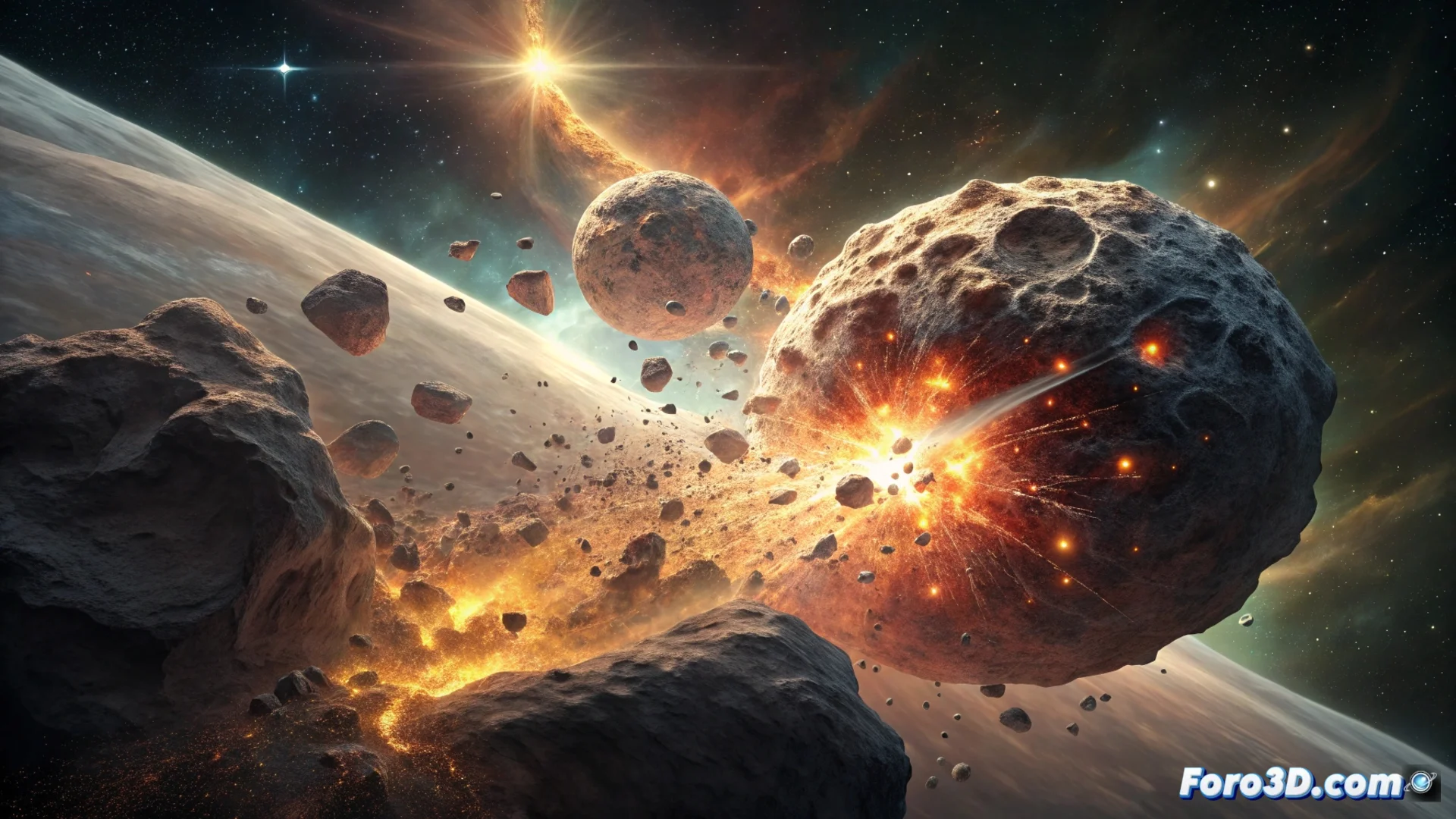
Astronomers Solve a Cosmic Mystery by Observing the Collision of Two Asteroids Near Beta Pictoris
A violent astronomical event just 63 light-years from Earth has allowed scientists to explain a drastic change observed two decades ago. The James Webb Space Telescope has captured the aftermath of a catastrophic collision between two rocky bodies in the Beta Pictoris star system, unveiling the origin of a mysterious disappearance of cosmic dust. 🪐
The James Webb Analyzes the Collision Debris
The MIRI instrument on the Webb Telescope has been able to analyze the composition of the dense cloud resulting from the impact. The data reveal the presence of fine crystalline silicates and massive amounts of carbon monoxide, a chemical signature that confirms the violent and high-energy nature of the event. The collision was so powerful that it vaporized material from both asteroids, creating a curtain of debris that now partially obscures the star's light.
Key Findings from the Spectral Analysis:- Detection of crystalline silicates, indicative of an extreme heating process.
- Large volumes of gaseous carbon monoxide, released after the impact.
- Confirmation that the colliding bodies were considerable-sized asteroids, not mere dust particles.
Observing these events helps us understand how planetesimals, the building blocks of planets, form and are destroyed.
Beta Pictoris, a Laboratory to Understand Our Solar System
This collision demonstrates that young planetary systems are dynamic and chaotic environments where collisions between rocky bodies are frequent. Beta Pictoris, with its known planets and extensive debris disk, serves as a nearby analog to study the processes that shaped our own solar system in its early stages.
Implications of the Discovery:- Explains why the cosmic dust around Beta Pictoris decreased abruptly about twenty years ago.
- Provides direct evidence of the inherent violence in the planetary formation phase.
- Allows astronomers to calibrate models on how giant impacts shape stellar systems.
A Cosmic Accident that Illuminates the Past
Solving this mystery not only satisfies a long-standing scientific curiosity but also strengthens our understanding of planetary evolution. The event captured by the James Webb illustrates spectacularly how major impacts are fundamental mechanisms for building and destroying worlds, a reminder that traffic in deep space can be as dangerous as it is revealing. ✨