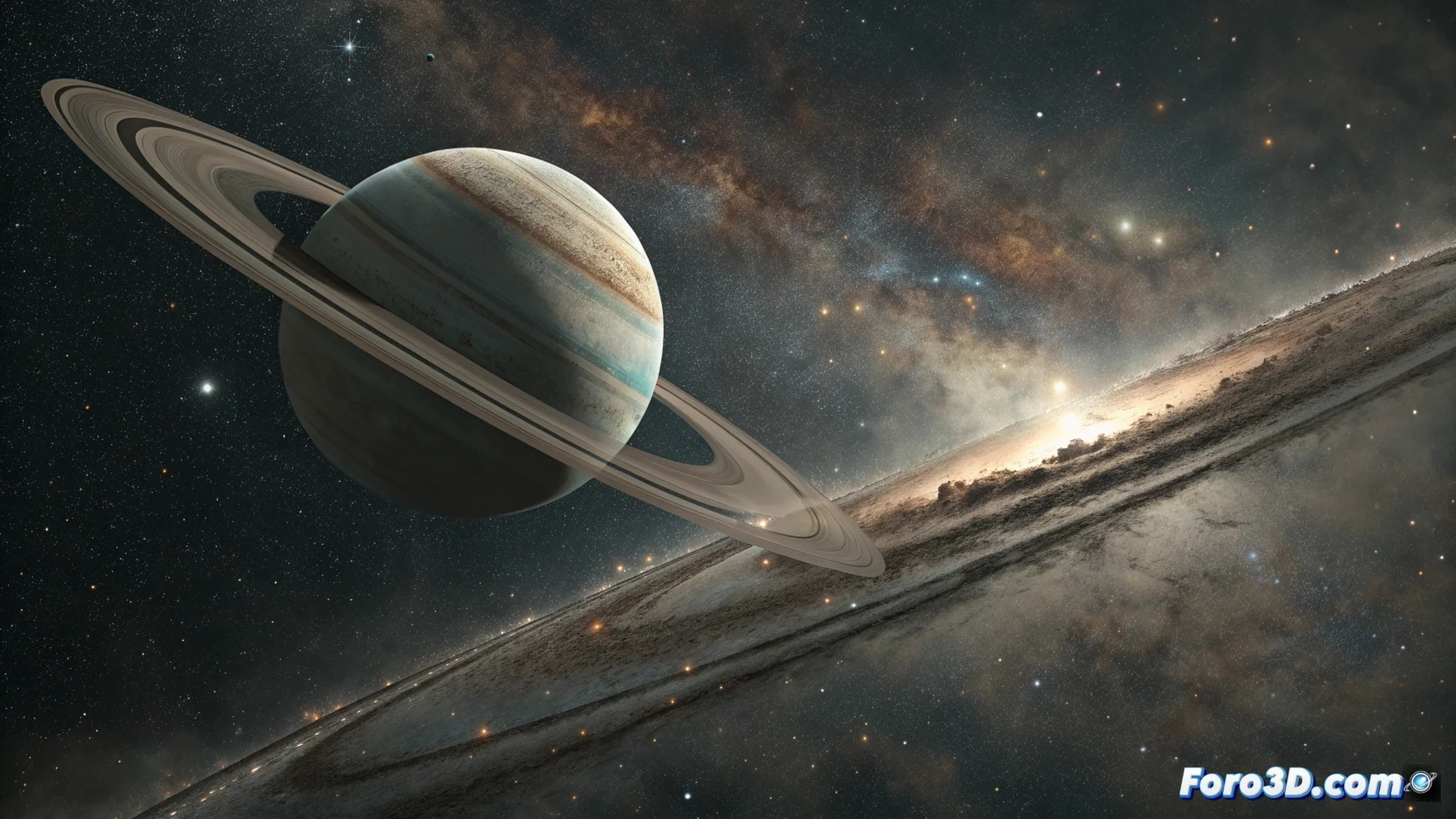
Astronomers Measure the Mass of a Saturn-Sized Rogue Planet for the First Time
Astronomy has reached a milestone by directly measuring the mass of a rogue planet, a world wandering through space unbound by the gravity of a star. This object, named OGLE-2016-BLG-1928, has dimensions comparable to Saturn, and its study, made public in 2026, opens a new window to understand the nature of these solitary celestial bodies. 🪐
The Technique That Reveals the Invisible
To achieve this measurement, scientists used the gravitational microlensing method. This technique leverages how the gravity of a massive object, like this planet, curves spacetime and acts as a magnifying glass, temporarily amplifying the light of a star much farther away in the background. Precisely analyzing the duration and shape of this brightness increase was key.
Key Factors for the Calculation:- The light curvature and the observed brightness pattern during the microlensing event.
- Complementary astrometric data provided by missions like the European Space Agency's Gaia.
- The combination of these data allowed deducing both the planet's mass and its approximate distance.
This method is one of the few capable of detecting planetary-mass objects that do not orbit a star.
A Hidden Population in the Galaxy
This discovery reinforces the idea that the Milky Way may contain an abundant population of rogue planets. Some of these worlds may have originated similarly to stars, from the direct collapse of small clouds of gas and dust, and not necessarily been ejected from a planetary system.
Implications of the Finding:- Helps test theories about different planetary formation mechanisms.
- Allows exploring the blurry boundaries that separate giant gas planets from brown dwarfs.
- Future telescopes, like NASA's Nancy Grace Roman, will actively search for more of these elusive objects.
Independent Worlds and Future Explorations
Studying rogue planets is like observing self-functioning projects, without depending on a central star. This achievement not only confirms the existence of these solitary worlds but also establishes a solid method to characterize them. The ability to measure their mass is a fundamental step to unveiling their origin, composition, and how common they really are in the cosmos. 🔭