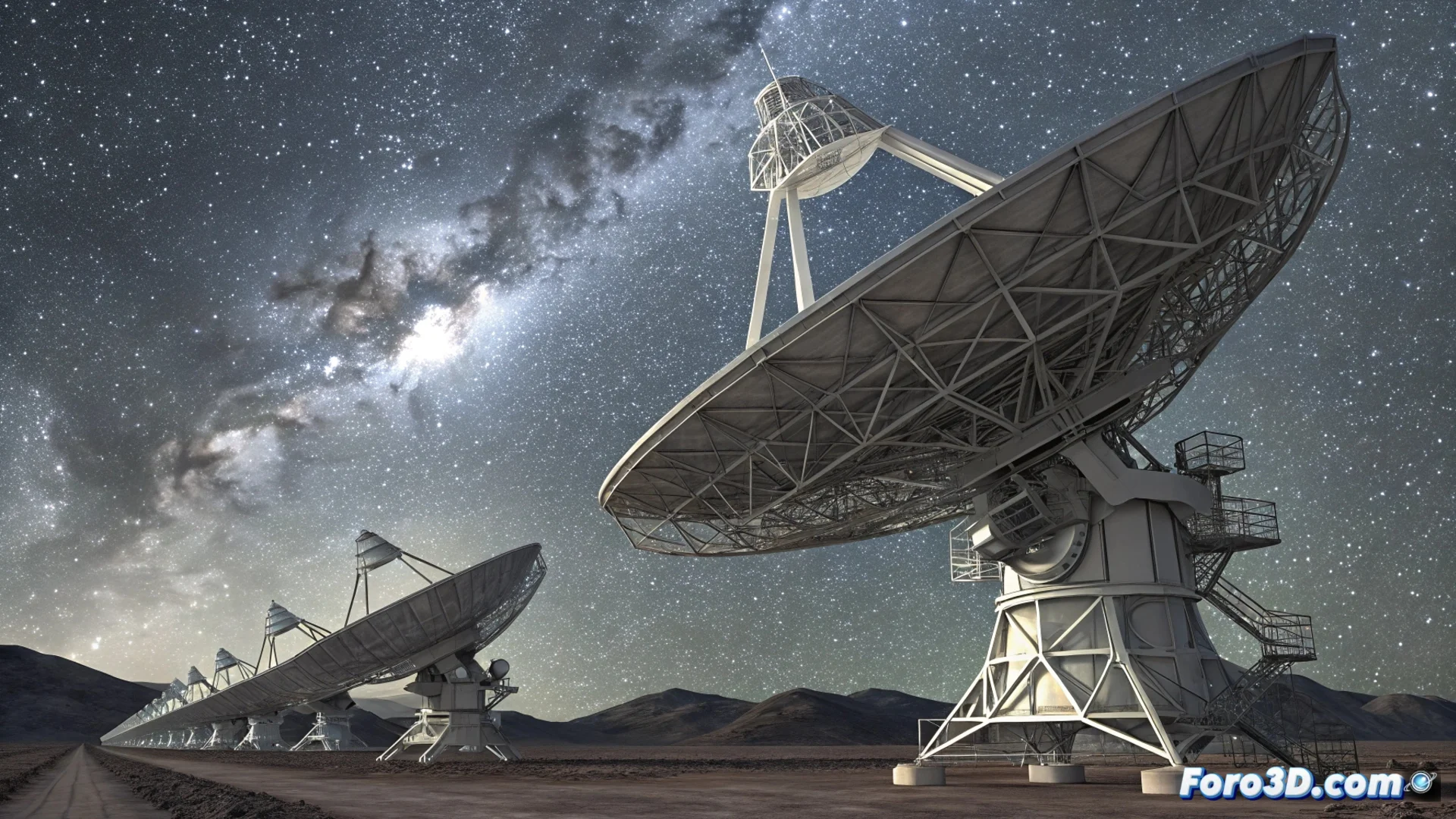
A team investigates gravitational waves using data from a pulsar
A group of scientists publishes the findings of a research focused on detecting gravitational waves from individual sources. To achieve this, they used high-cadence observations of the pulsar J1909-3744, which are part of the second data release from the International Pulsar Timing Array (IPTA) collaboration. 🔭
The observation campaign and data processing
The intensive observation period ran from July 2010 to November 2012. The data were collected using three different radio telescopes: Nançay, Parkes, and Green Bank. Observing at multiple radio frequencies was key to correcting with high precision the effects of dispersion measure and its variations. After applying these corrections, the timing residuals showed an unmodeled periodic noise component with an amplitude of 340 nanoseconds.
Key details of the methodology:- Time campaign: Intensive observations between July 2010 and November 2012.
- Infrastructure: Combined use of the Nançay, Parkes, and Green Bank radio telescopes.
- Technique: Multi-frequency observations to correct ionospheric dispersion effects.
The presence of unmodeled periodic noise underscores the complexity of extracting extremely subtle signals from the background in ultra-high precision experiments.
Upper limits for space-time deformation
The analysis produced upper limits for the deformation that gravitational waves from single sources would cause. For average sky positions, the deformation must be less than 1.9 × 10⁻¹⁴ at 71 nanoherz and 2.3 × 10⁻¹³ at 1 microherz. If the source is located in an optimal position, these limits improve significantly, reducing to 6.2 × 10⁻¹⁵ and 8.9 × 10⁻¹⁴ at the same frequencies, respectively. These new limits are approximately 1.52 times stricter than those previously published by the Perera et al. team using data from the European Pulsar Timing Array (EPTA) collaboration. 📉
Quantitative results of the deformation:- Average position: Limit < 1.9 × 10⁻¹⁴ (71 nHz) and < 2.3 × 10⁻¹³ (1 µHz).
- Optimal position: Improved limit to 6.2 × 10⁻¹⁵ (71 nHz) and 8.9 × 10⁻¹⁴ (1 µHz).
- Progress: Limits 1.52 times stricter than the previous Perera et al. study.
Significance of the detected periodic noise
Finding an unmodeled periodic noise in the residuals, after correcting all known effects, constitutes a relevant finding. Its amplitude of 340 nanoseconds is a crucial datum