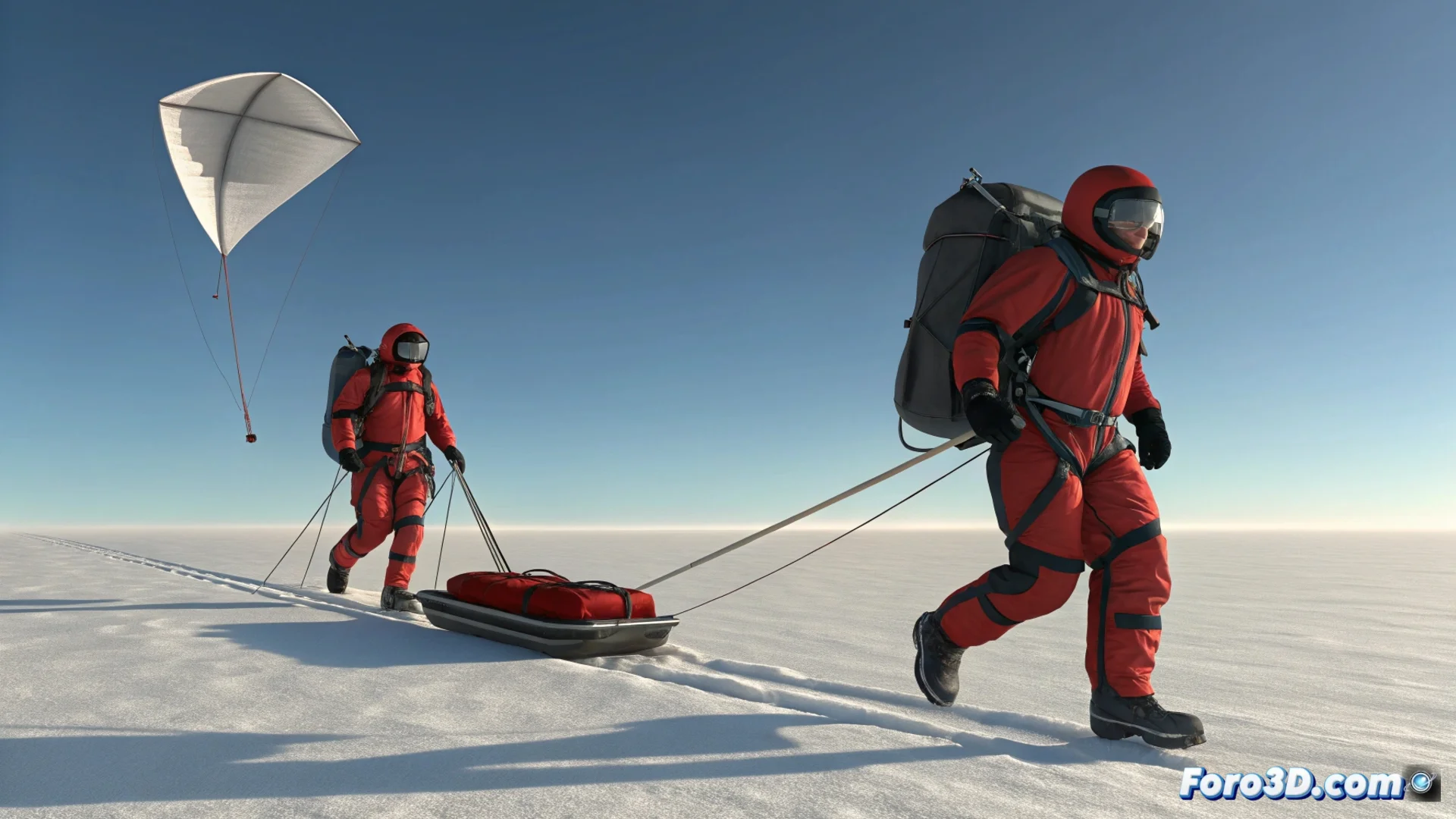
A Scientific Expedition Crosses Antarctica with Kite Power
The polar explorer Manuela Castro and the glaciologist Erik Jansen venture into the heart of the white continent. Their journey, which began in November 2025, plans to cover a 4,000-kilometer route from the Weddell Sea to the Pole of Inaccessibility. To move all their equipment, they rely on the pure power of the wind, using large traction kites that propel them on their skis. 🪁
A Radar Scans the Depths of Millennial Ice
The sled they pull not only carries provisions, but a key scientific instrument: a ground-penetrating radar. This device emits radiofrequency pulses into the ice sheet. By analyzing the returning echoes, the system can measure the total thickness and map hidden structures. The data reveal layers of ancient ice and possible water conduits beneath the surface, offering a window into Antarctica's climatic past.
Key objectives of the radar measurement:- Reconstruct how the ice sheet has grown and shrunk over millennia.
- Detect and map subglacial water channels that influence ice stability.
- Provide ground validation records for satellite measurements.
Understanding the history of the ice is the essential first step to accurately projecting its future.
From Snow to Supercomputers: Feeding Climate Models
The information they collect doesn't stay on the ice. It is transmitted via satellite to research institutes worldwide. Glaciologists use these direct observations to calibrate and validate their complex computer simulations. These climate models aim to predict how Antarctica will respond to global warming. Data from remote areas, where there are almost no stations, is especially valuable for reducing uncertainty in projections.
Logistics and challenges of the crossing:- Manage extreme cold and repair equipment with limited tools in the field.
- Accurately calculate wind strength and direction to control the kites and avoid accidents.
- Optimize every gram of weight on the sled, as the distance is enormous and there is no resupply.
The Journey Continues Toward a Crucial Conclusion
The expedition, which must conclude in January 2026, demonstrates that it is possible to conduct cutting-edge science with sustainable, emission-free transportation methods. Every kilometer traveled and every radar data point brings the scientific community closer to better understanding Antarctica's role in the global climate system. The accelerated melting in this region has the potential to alter sea levels worldwide, making these measurements a task of global importance. 🌍