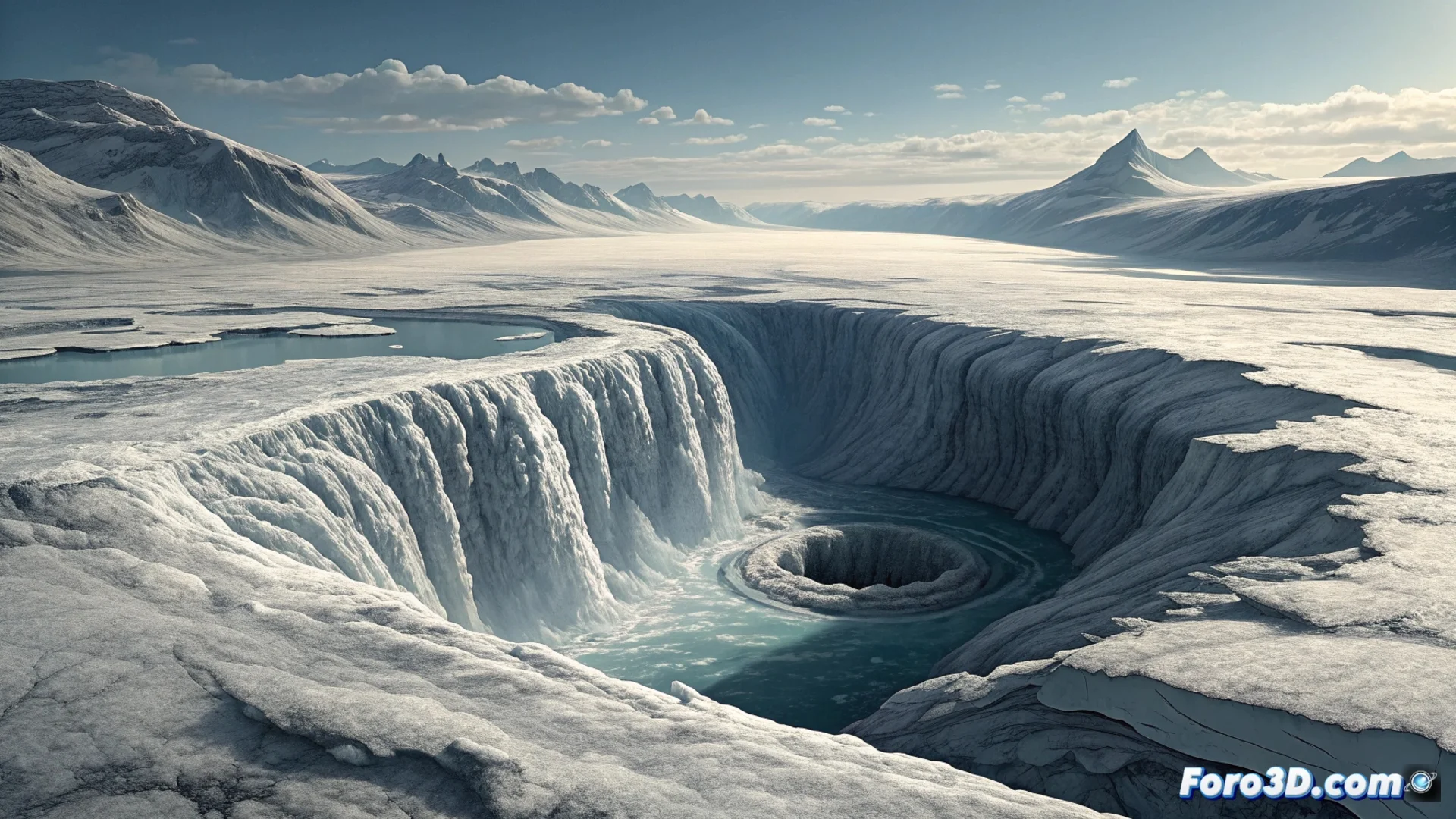
A Glacial Lake Drains and Fractures a Key Glacier in Greenland
On Greenland's Store glacier, a supraglacial lake drains abruptly in just a few hours. This event releases extreme hydraulic pressure that fractures the ice from its base and accelerates its journey toward the ocean. Observed by satellites, this process is a fundamental mechanism that causes global sea levels to rise. 🌊
The Water That Weakens the Ice from Within
As it drains, the lake water descends through glacial mills, which are vertical conduits. Upon reaching the bedrock, the liquid acts as a lubricant, reducing friction and allowing the glacier to slide more easily. The sudden release of pressure can even lift the ice and create large-scale internal fractures that permanently weaken its structure.
Consequences of Rapid Drainage:- Generates extreme pressure at the glacier's base, forcing the opening of cracks.
- The water lubricates the rocky bed, reducing friction and accelerating ice flow.
- Creates internal fractures that can measure hundreds of meters, compromising the glacier's integrity.
The Earth has its own rapid drainages, but instead of solving a problem, they create one on a continental scale: accelerated ice loss.
Satellites Capture the Impact in Detail
Scientists use data from missions like Sentinel-1 and ICESat-2 to track these events. The images reveal the surface subsidence where the lake was and the appearance of new cracks. Comparing ice speed before and after confirms a significant acceleration in its movement.
What the Observations Measure:- The surface collapse in the area of the drained lake.
- The formation and propagation of radial cracks around the drainage area.
- The measurable increase in the glacier's flow speed after the event.
A Natural Process with Global Effects
This constant monitoring is vital for predicting how much ice Greenland will lose. The rapid drainage of supraglacial lakes is not just a phenom