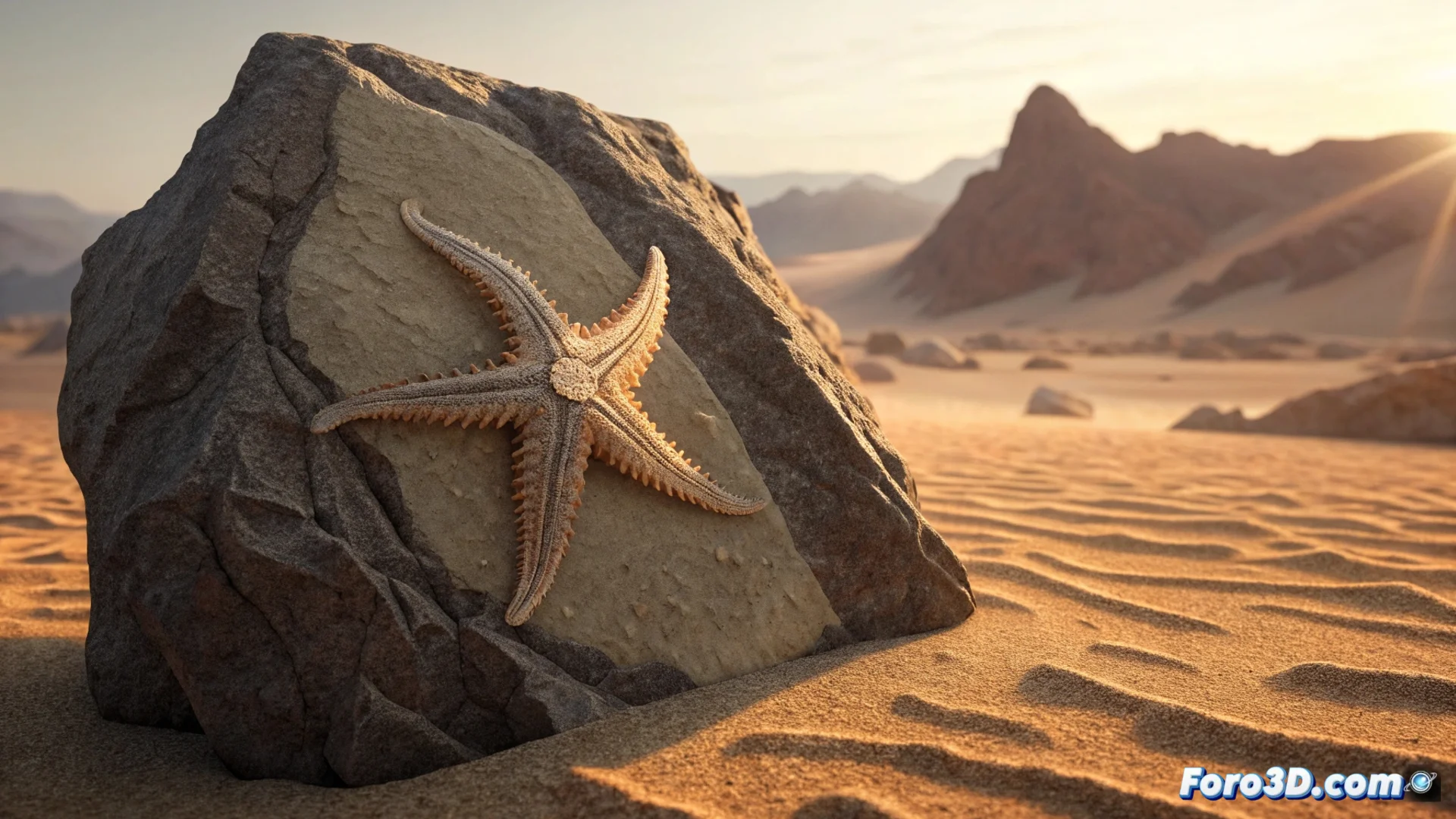
The Marine Ancestor That Reveals the Origin of Starfish
It does not come from space, but from the depths of geological time. A paleontological find in Morocco, which initially seemed like a strange-shaped starfish, has been recognized as the most distant ancestor of the starfish and brittle stars we know today. This tiny fossil, nearly 500 million years old, represents the missing link that researchers have long yearned to find. 🌊
A Half-Billion-Year Evolutionary Puzzle
The specimen, named Cantabrigiaster fezouataensis, has a much more basic anatomy than that of its modern descendants. If we compare a current starfish to a luxury vehicle full of features, this ancestor would be the basic model, lacking the complex systems. This simplicity is key to deciphering how the body plan of these beings developed over the eras.
Key Features of the Ancestral Fossil:- It shows a simpler radial structure, without some of the specialized parts of its successors.
- Its design helps trace the point in the evolutionary tree where the paths of starfish and brittle stars began to diverge.
- It provides direct physical evidence of a transitional morphology prior to the great diversification of echinoderms.
This fossil is like the original instruction manual; it allows us to see the base design before all the evolutionary improvements were added.
The Divergence Between Close Relatives
Although starfish and brittle stars may seem similar at first glance, a detail in their mode of locomotion distinguishes them crucially. Starfish use numerous ambulacral feet located on their ventral surface to walk. Brittle stars, in contrast, propel themselves mainly by flexing and moving their agile arms, in a manner similar to rowing. The study of this ancestral fossil allows for a better understanding of when and how this fundamental difference arose.
Differences in Locomotion:- Starfish: Locomotion via a hydraulic system of tubular feet.
- Brittle Stars or Serpent Stars: Primary locomotion through waving and dragging their arms.
- Common Ancestor: Likely had an intermediate or less specialized form of movement.
A Window into the Remote Past
It is astonishing to think that such an ancient organism holds the keys to interpreting creatures that still inhabit our oceans. The next time you observe a starfish, remember that its efficient design has been refining since a time much earlier than the dinosaurs. Its lineage has a longer history than that of most human settlements. This discovery not only fills a scientific gap but also connects us directly to a lost world under the sea. 🐚