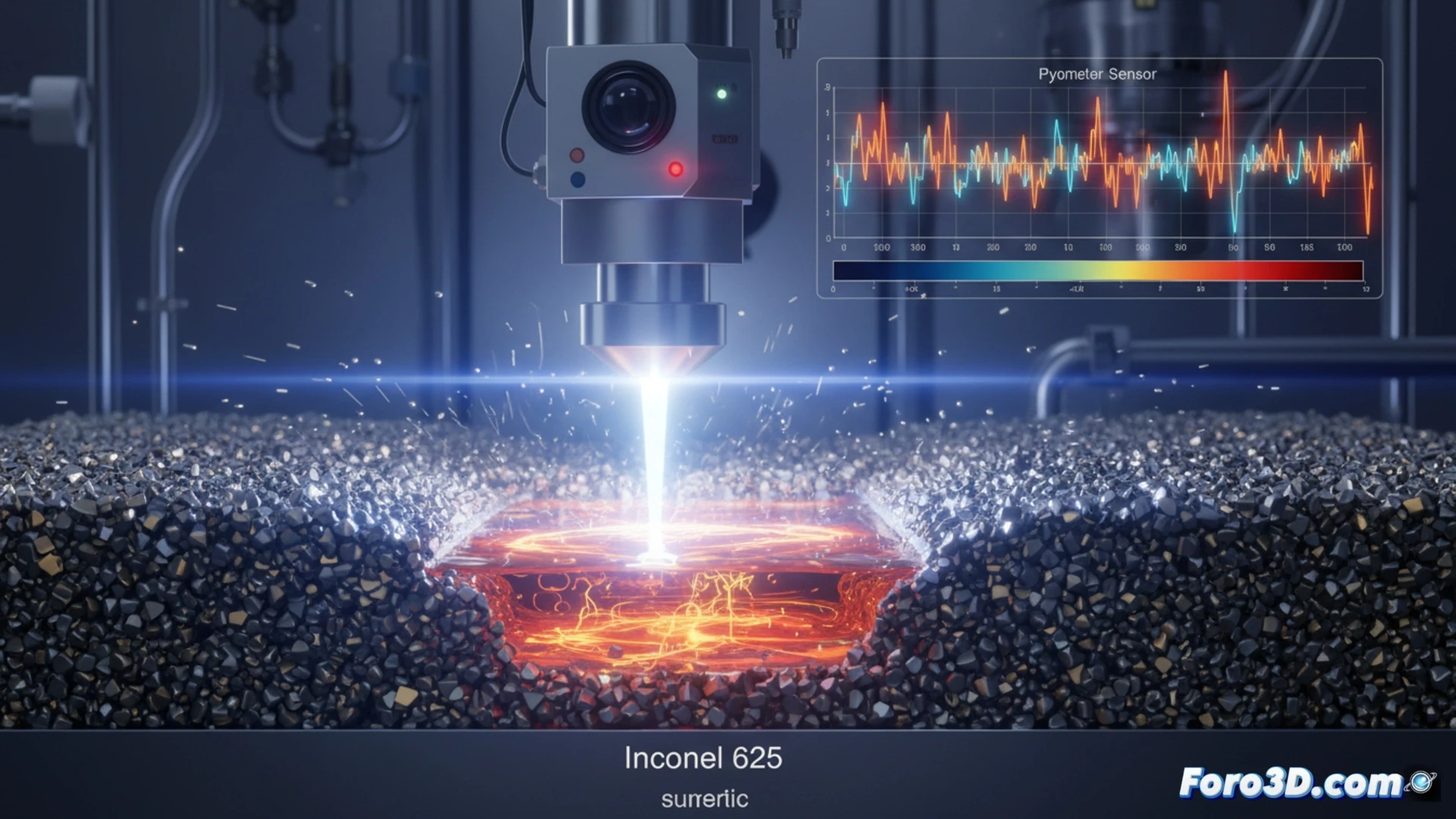
A recent study has employed in situ pyrometry to monitor an additive manufacturing process with metal powder. The objective was to analyze how the ability of the Inconel 625 powder bed to absorb laser energy varies as it is printed. The results show that this optical property changes significantly, a fact that until now has not been considered in many simulation models.
Real-Time Measurement Reveals Sharp Drop in Absorbance 📉
The researchers observed that, at the beginning, the loose powder has a relatively high thermal absorbance. However, at the moment the material melts and begins to densify to form the solid, that ability to absorb laser energy decreases sharply. This implies that the laser-material coupling efficiency is not uniform throughout the process, which directly affects thermal stability and the final quality of the manufactured part.
The Powder Gets Lazy When It Gets Too Hot 😤
It seems that Inconel powder has its own rules. First, it is cooperative, enthusiastically absorbing the laser energy. But as soon as things get really hot and it melts, it decides it has worked enough and reduces its absorbance. It's as if the material, once it reaches the liquid state, thinks: that's it for my turn, now it's time to reflect a bit. A behavior that complicates life for predictive models, which expected a constancy that does not exist.