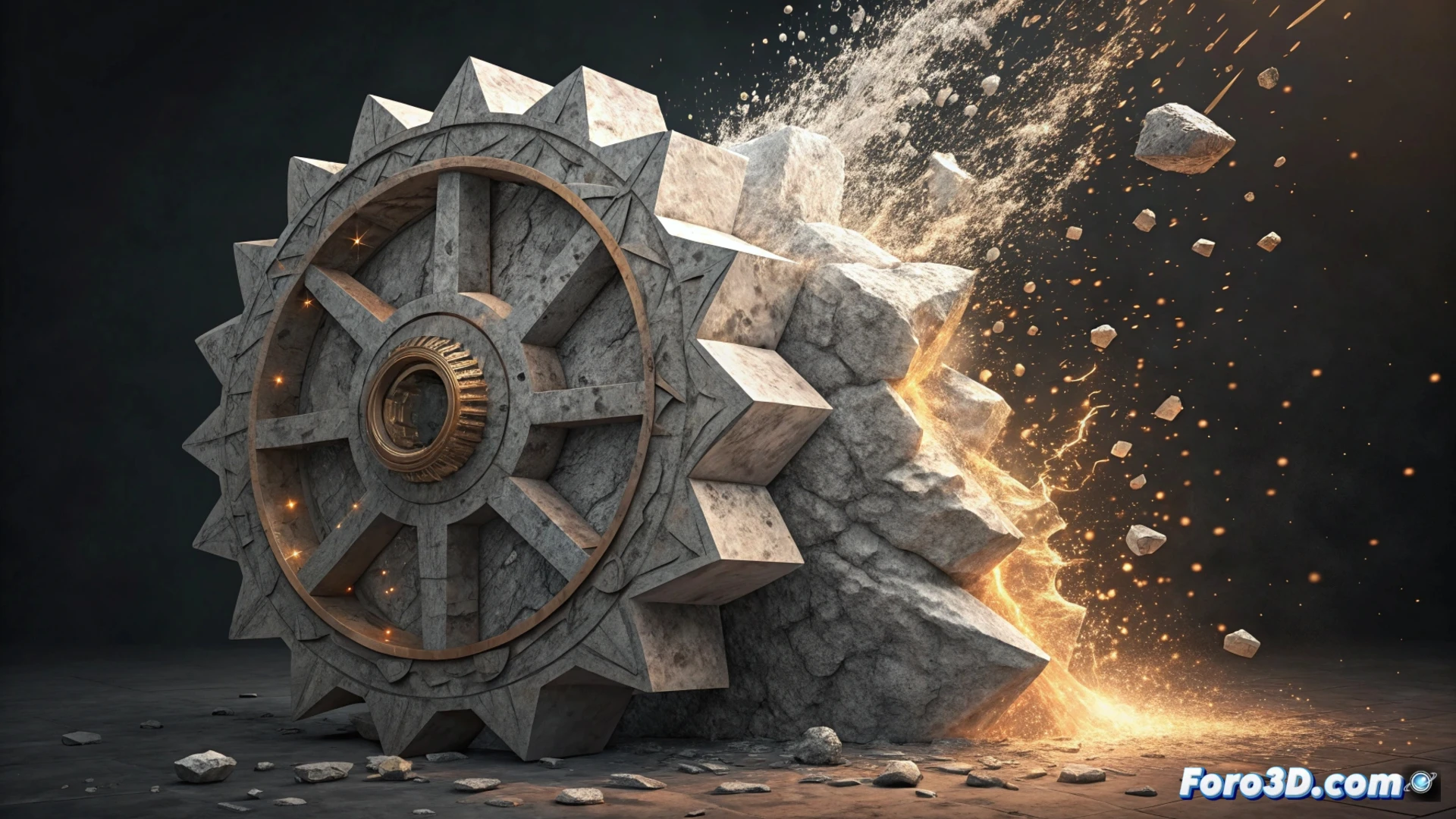
Simulate an Object Disintegrating and Reassembling in Houdini
Creating the illusion of a piece fragmenting into pieces and then reassembling requires a specific technique in Houdini. This workflow combines the power of particle systems with the flexibility of volumes to handle the transition in a controlled and visually appealing way. 🌀
The Core of the Effect: From Mesh to Particles
The starting point is a source object. Points are extracted from its geometry and transformed into the origin of a particle system. To simulate the object disintegrating, the emission of these particles is animated, and forces and noise are applied to generate chaotic and dispersed movement.
Key Components of the Process:- Extract points from the original geometry to use them as particle seeds.
- Apply forces and noise to direct the dispersion and create the visual chaos of disintegration.
- Control emission time to animate when the fragmentation effect starts and ends.
The real challenge is not making it disintegrate, but achieving a convincing and natural reassembly.
Handling the Cycle with Attributes and VEX
To orchestrate the complete cycle of disintegrating and reassembling, it is vital to use custom attributes. Attributes like pinto or age allow controlling the behavior of each particle over time. A solver or a for loop handles processing the simulation frame by frame. Within this loop, a pop wrangle node allows writing VEX code. This code directly manipulates the velocity and position of each particle, first to disperse them and then to attract them back to their original location.
Steps to Control Behavior:- Use a solver to maintain the simulation over time and update states.
- Write VEX code in a pop wrangle to dynamically modify velocity (direct dispersion and attraction).
- Use the age attribute to activate or deactivate effect phases at precise moments.
Putting It All Back Together: From Particles to Mesh
The reintegration phase reverses the process. The particles must return to their origin position. An effective method is to convert them into a volume using a node like vdb from particles or particle fluid surface. This volume acts as a dense field representing the original object's shape. Finally, that volume is converted into a solid polygonal mesh with a convert vdb node. Smoothly animating the transition between the dispersed particles state and the unified volume generates the perfect illusion that the object is reconstructing itself. The precision of this method can make the final result seem magical. ✨