Resident Evil Requiem closes a narrative arc that begins with Oswald Spencer's experiments. His quest to redefine humanity with the Progenitor virus founded Umbrella and the foundations of the saga. For 3D artists, this timeline is key to understanding visual evolution: from the 70s laboratories to dystopian megacities. It is an example of consistent worldbuilding, where the narrative supports the design of environments and creatures, a principle applicable to our projects.
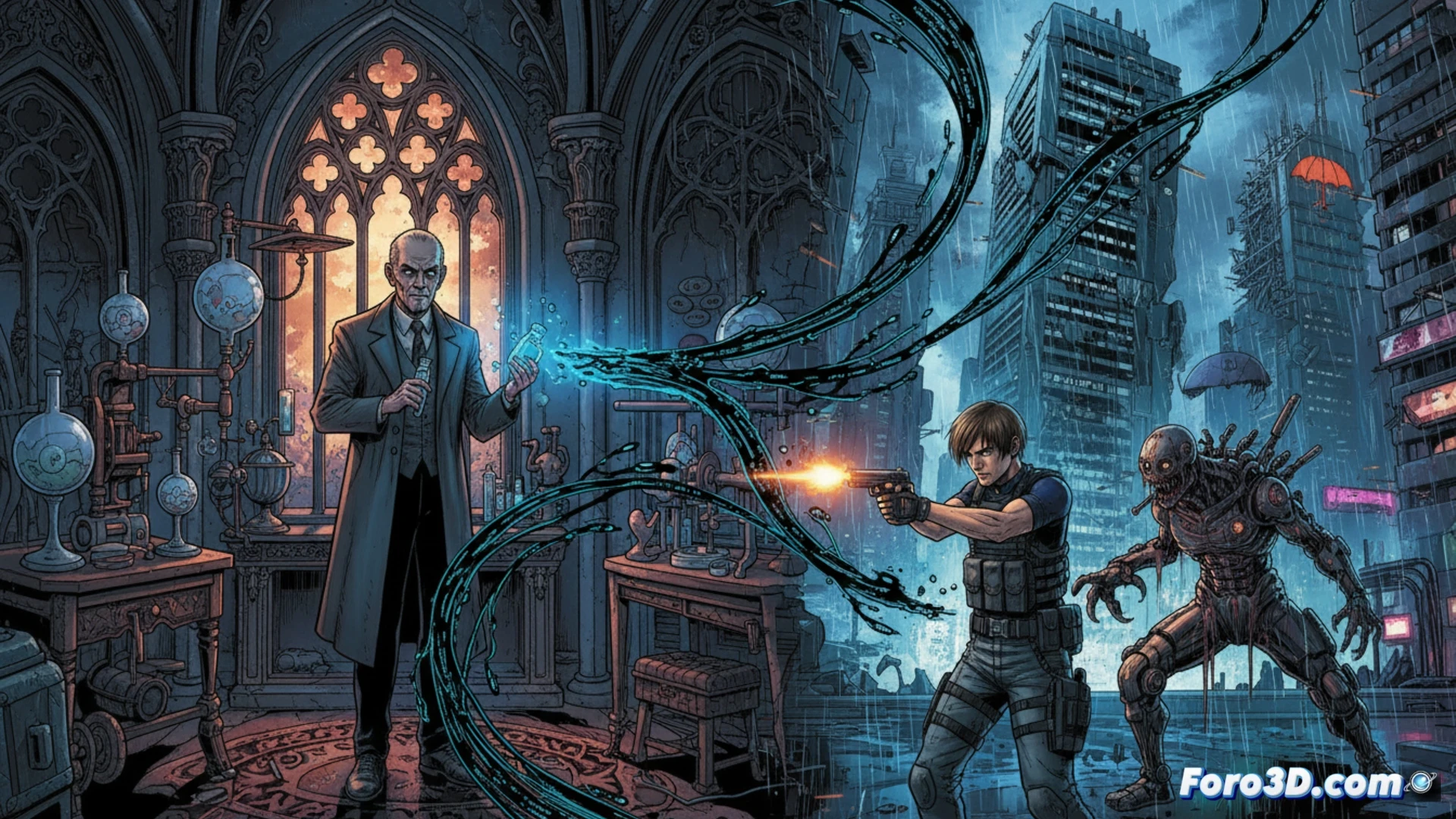
From Sketch to Infection: Technical Evolution of Design in RE 🖥️
The chronology of Requiem shows a technical evolution parallel to the narrative. The design of Umbrella's first laboratories, with their industrial and organic aesthetic, gives way to futuristic complexes and collapsed cities. Studying this transition is useful for understanding how modeling and texturing must reflect an era and a state of deterioration. Corporate architecture, research equipment, and virus mutations present a catalog of references for creating visual coherence in complex 3D environments.
Spencer, the First "Level Designer" of Raccoon City 🗺️
We can say that Oswald Spencer was a very particular level designer. Without using a single 3D modeling tool, his obsession with creating a new humanity ended up designing the most infested and famous city in gaming. We rack our brains with lighting and gameplay flow, and he only needed a poorly stored virus. His legacy reminds us that, sometimes, the most influential concept art can be a jar with a biological hazard label.