Before 3D scanners and printers, the 19th century developed a technique to create volumetric portraits: photo-sculpture. This process, documented in a note from Turismo Madrid, fused photography and sculpture to produce three-dimensional busts. It is presented as a clear precursor to current 3D capture and printing technologies, marking a step in the democratization of volumetric portraiture.
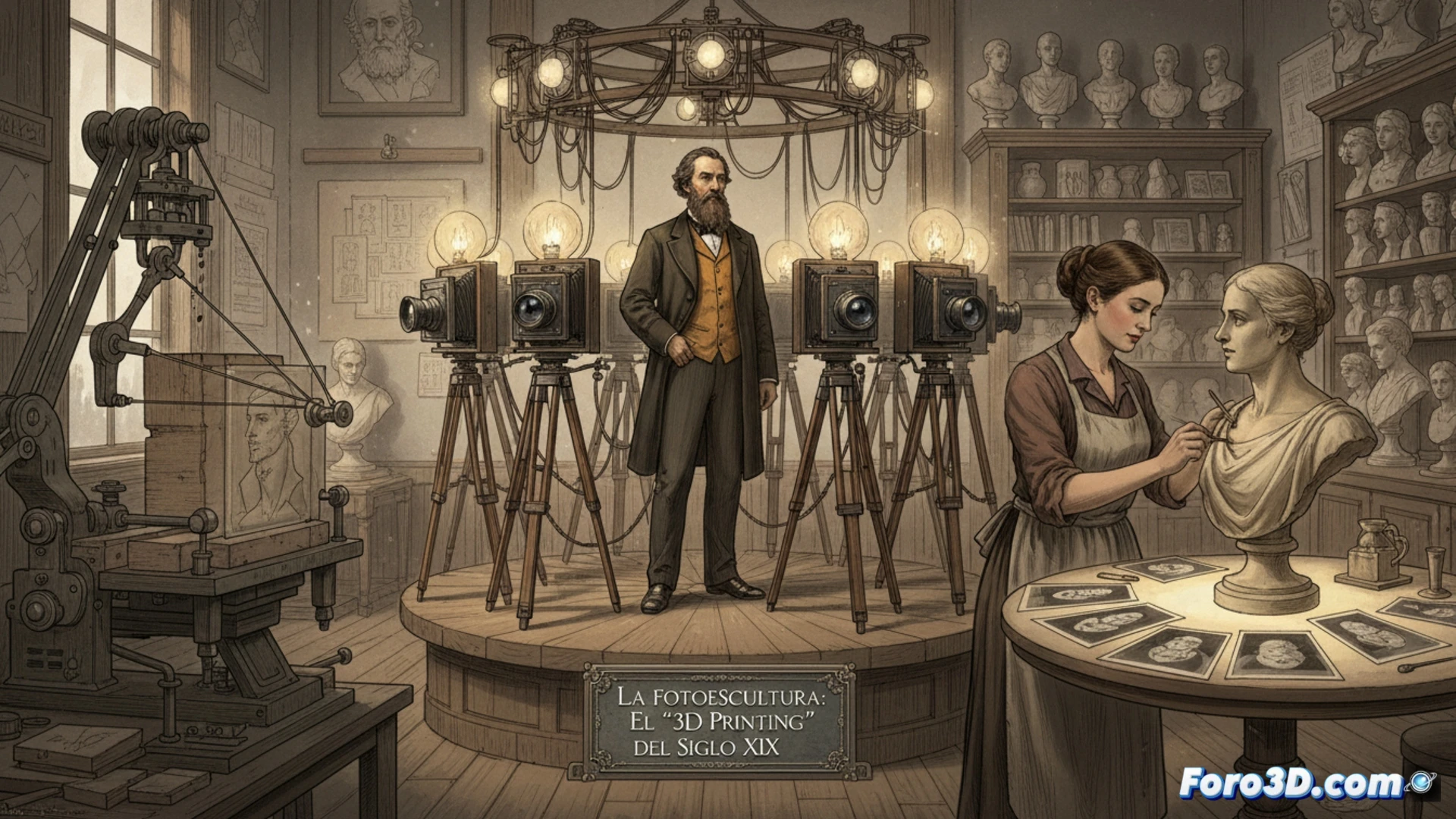
The technical process: from the multiple camera to mechanical carving ⚙️
The system, patented by François Willème in 1860, used a circular room with 24 synchronized cameras. These simultaneously captured the model's profile from all angles. The projected silhouettes served as a guide for a pantograph machine, which carved the figure in a block of clay or plaster. Thus, two-dimensional visual data was transformed into a physical three-dimensional object in a semi-mechanized way.
The first render took weeks and couldn't be canceled 😵
Imagine the session: 24 magnesium powder flashes exploding at once, leaving the subject blinded and coughing. Then, waiting weeks for your plaster effigy to emerge, with no option for Ctrl+Z if the result wasn't flattering. It was the commitment of the pre-digital era: a slow, invasive process without Instagram filters to soften features. Patience, without a doubt, was a sculptural attribute.