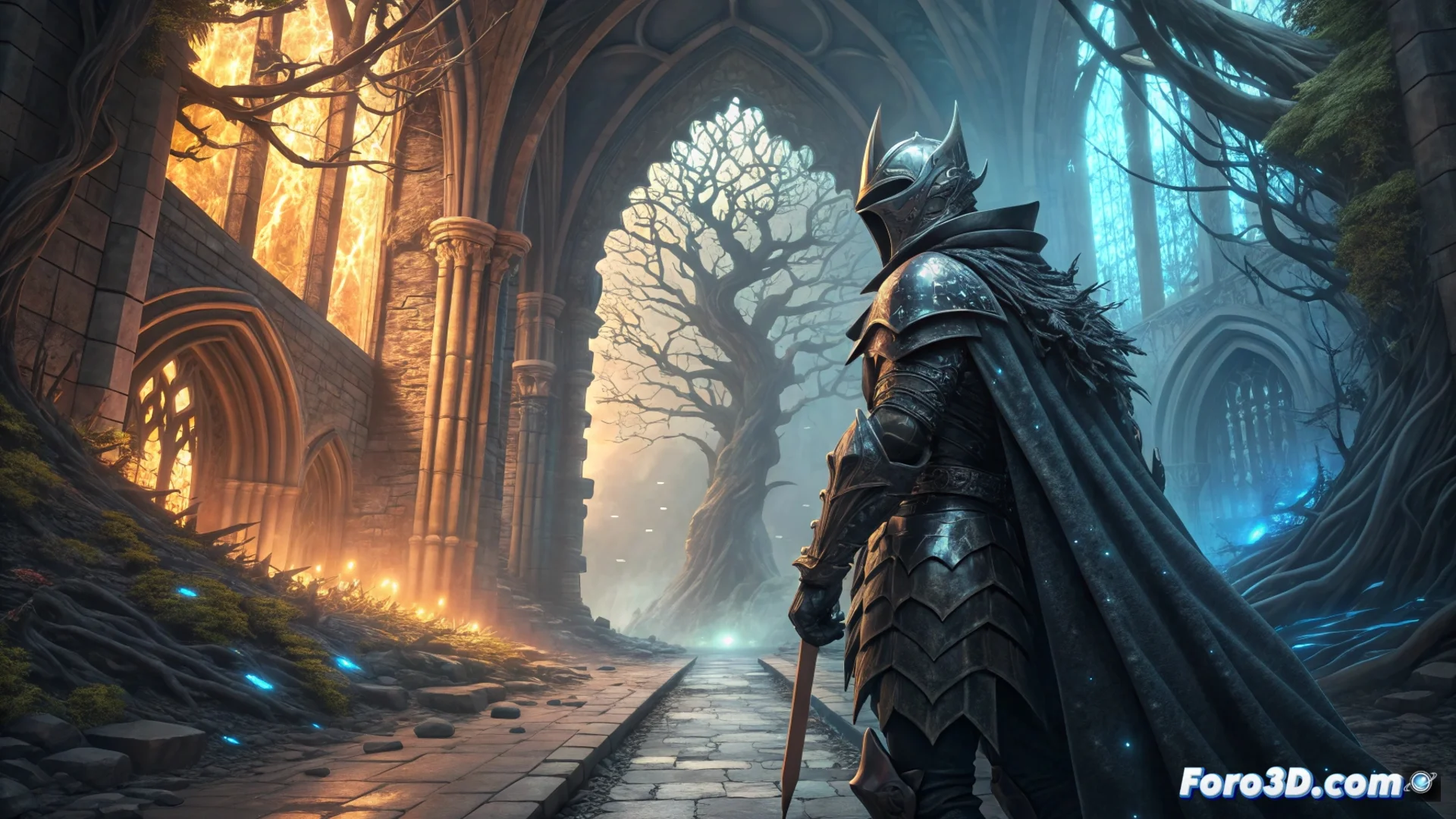
Lords of the Fallen was built from scratch with Unreal Engine 5
The development of the title Lords of the Fallen (2023) made a fundamental technical decision from the beginning: adopt Unreal Engine 5 as the base. This latest-generation graphics engine provided the necessary tools to materialize its most ambitious concept: a universe composed of two coexisting planes of reality. 🎮
The duality of worlds as the central pillar
The game's main mechanic revolves around the realms of Axiom (the world of the living) and Umbral (the spectral realm). They are not separate levels, but parallel dimensions that the player can perceive and traverse in real time. This premise not only defines the gameplay and story, but also establishes a monumental technical challenge for the graphics engine.
Key features of the dual world:- Simultaneous visualization of both planes of reality.
- Instant and fluid transitions between Axiom and Umbral.
- A narrative and exploration that depend entirely on this interaction.
Umbral is not just a color filter; it is a complete world that your hardware must render twice.
Lumen: illuminating two realities at once
To handle the lighting of this complex scenario, the developers relied on Lumen, UE5's fully dynamic global illumination system. This technology processes how light interacts with both worlds completely dynamically. When the player moves between dimensions, the lighting adapts instantly, creating coherent atmospheres and impactful visual transitions. The gothic-inspired architecture benefits enormously from this luminous realism. 💡
Nanite: geometric detail without compromises
The intricate geometry of environments and characters was managed with Nanite. This micropolygon technology allows using assets with extremely high polygon density without penalizing performance. Artists were able to create gothic structures, sculptures, and landscapes with microscopic detail levels, without the need to generate manual simplified versions (LODs) for distant views. 🏰
Advantages of using Nanite in the project:- Efficient handling of millions of polygons on screen.
- Artistic freedom to design hyper-detailed assets.
- Elimination of the work to create and manage manual levels of detail.
The real cost of graphical power
Rendering two complete worlds simultaneously has a direct impact on performance. Every time the player crosses into Umbral, the hardware must calculate and draw the geometry and lighting of both realms. This translates into significant resource demands, where the frames per second rate can be affected, underscoring the importance of optimizing the engine for a fluid experience. ⚙️