A University of Nottingham research addresses a challenge in multi-material additive manufacturing: the joining of alloys. The work focuses on IN718 and GRCop-42 parts, used in combustion chambers, manufactured by powder bed fusion. The study analyzes how the interface orientation (horizontal, vertical, or angular) and the deposition order affect the final quality, a decisive factor for high-performance aerospace applications.
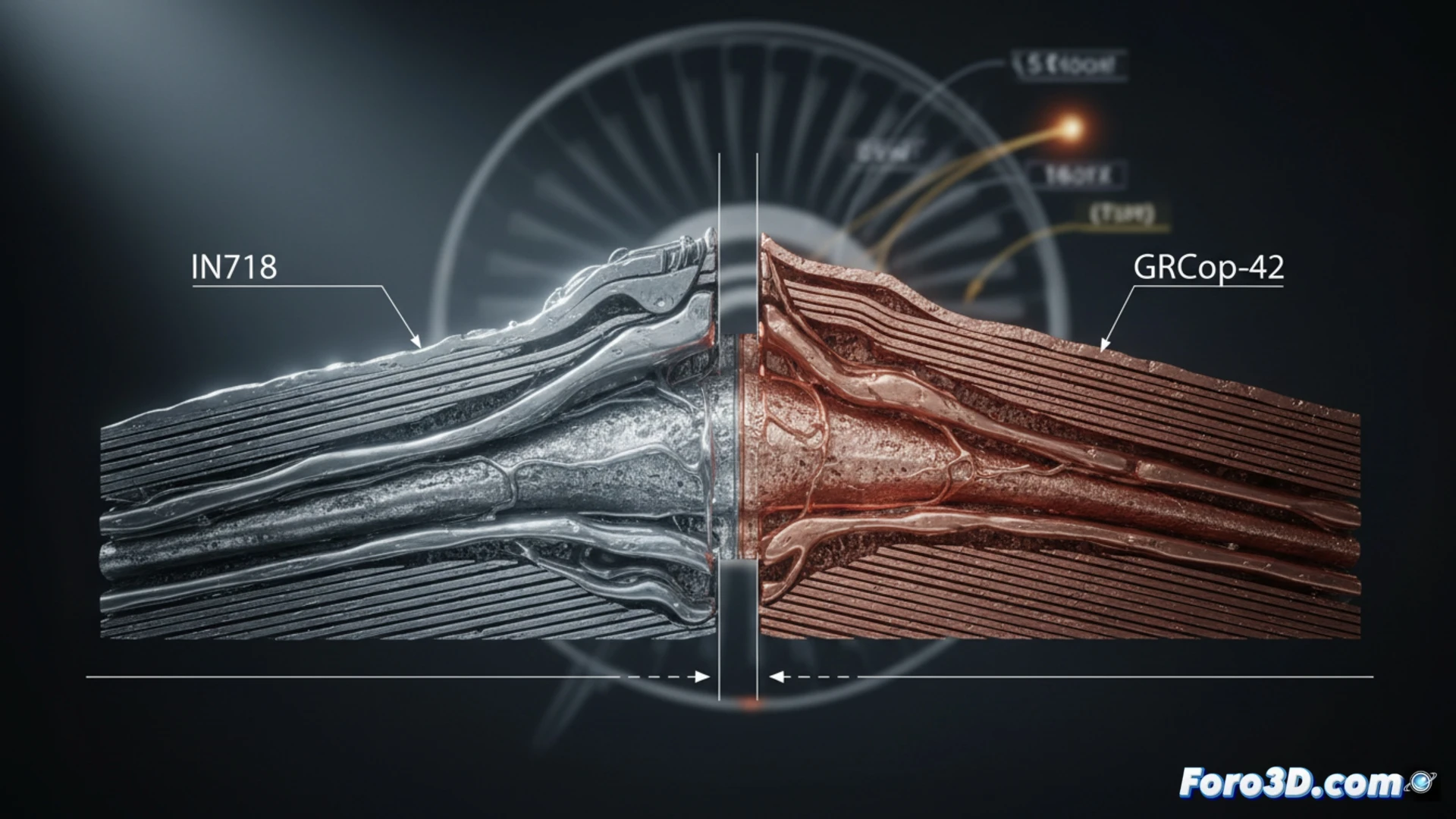
Deposition order and direction define the microstructure ⚙️
The results show that in horizontal interfaces, the sequence is critical. Depositing the superalloy IN718 over the copper GRCop-42 generated lack-of-fusion defects. The reverse order, GRCop-42 first, produced an alloy mixing zone and grain refinement in the subsequently deposited IN718. Additionally, the laser scan direction influenced the geometry of the molten zone and grain growth, affecting the mechanical properties of the joint.
The bimetallic sandwich dilemma: what goes first? 🥪
It seems that even for rocket alloys, there's the problem of layer order, like in a sandwich. If you put the IN718 ham on the copper cheese, it stays raw and with holes. But if you start with the cheese, everything mixes more civilly. One would think that with high-power lasers these things would be solved, but in the end, it all comes down to not messing up the powder stacking, like in a high-tech kitchen recipe.