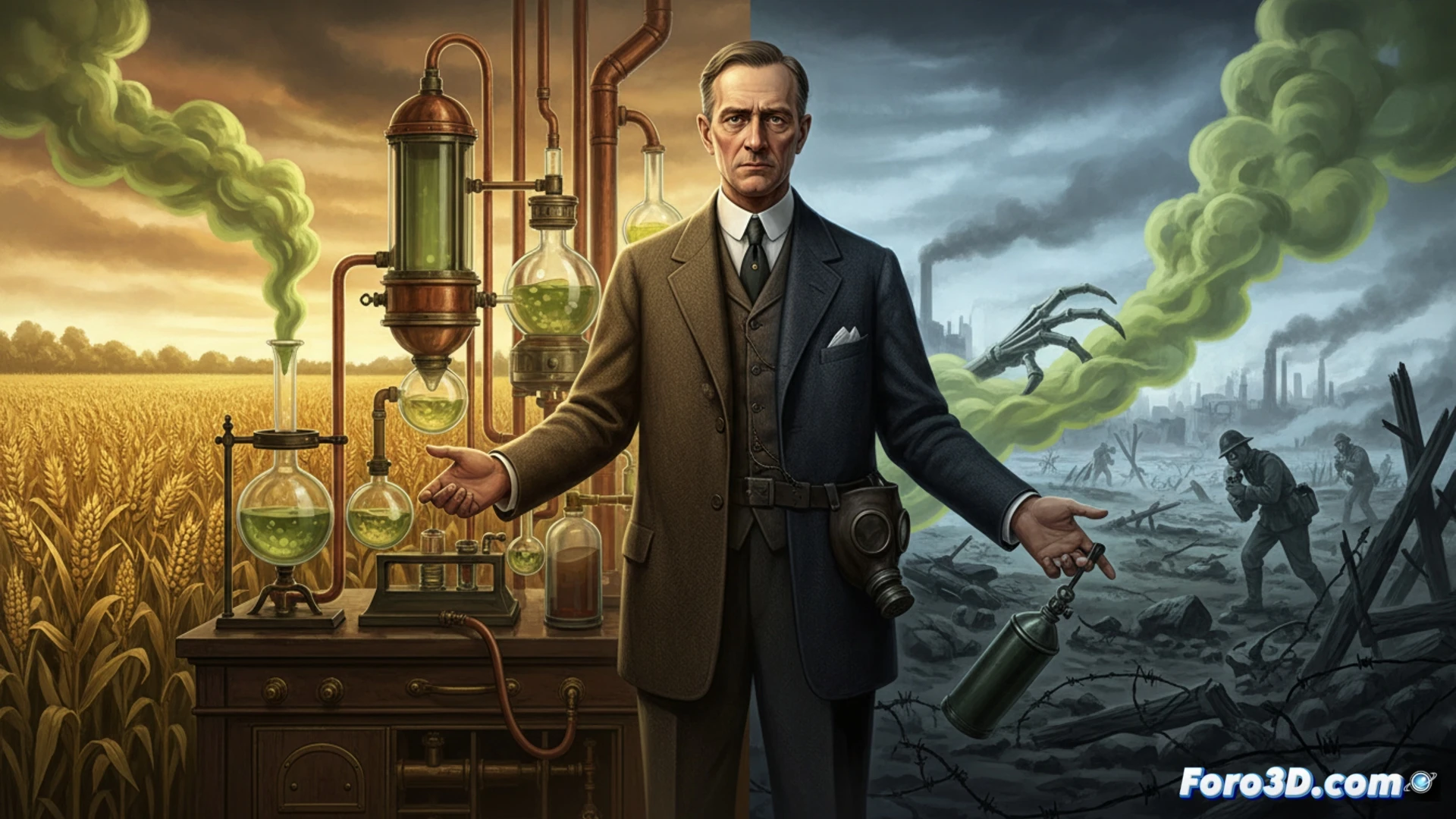
The figure of Fritz Haber is a knot of contradictions. This German chemist, with his process to synthesize ammonia from the air, laid the foundations for artificial fertilizers. His work sustains the feeding of a large part of the current population. However, the same mind that sought to fertilize the earth applied his science to the development of chemical weapons during the Great War, leaving a morally ambiguous legacy.
The Haber-Bosch Process: Fixing Nitrogen from the Air 🌱
The challenge was to access atmospheric nitrogen, an inert gas. Haber and then Bosch devised an industrial method that combines nitrogen and hydrogen at high pressure (about 200 atm) and temperature (about 500°C), using an iron catalyst. This forced reaction produces ammonia, the raw material for nitrogen fertilizers. The technology transformed agriculture, allowing intensive crops without depending on limited natural sources like guano.
From the Farm to the Trenches: A Survival and Destruction Kit ⚔️
Haber demonstrated that with a single discovery one can be the hero of two opposing stories. On one hand, the farmer who saves his harvest with fertilizer. On the other, the soldier who receives a cloud of chlorine in the trenches. It is the case of the genius who, after watering the world's garden, decides to test his hose with mustard gas. A legacy that makes us wonder if science advances in a straight line or in a strange loop.