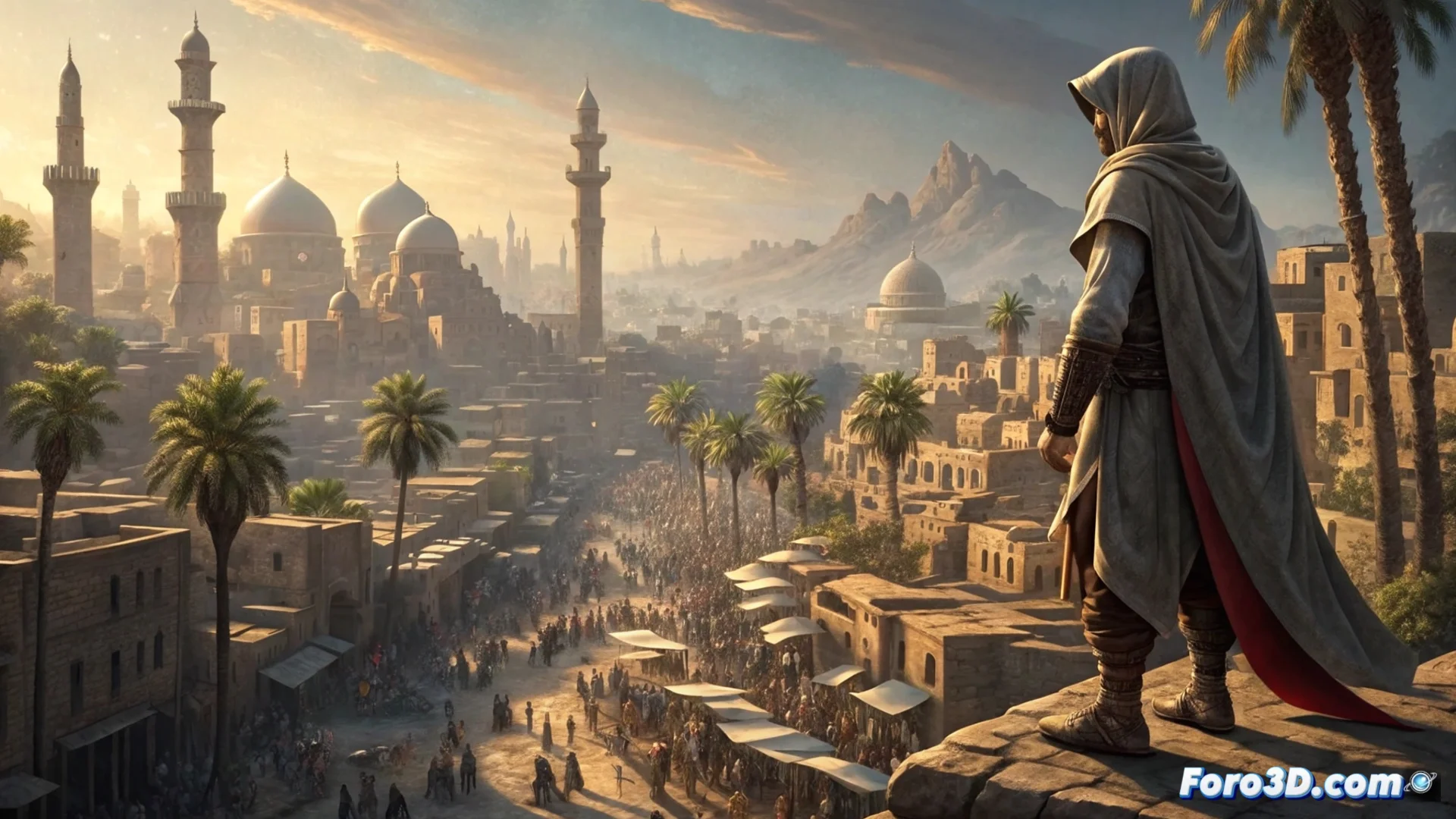
Assassin's Creed Mirage Relies on the Renewed Anvil Engine
To create Assassin's Creed Mirage, Ubisoft has decided to use an improved iteration of its well-known graphics engine, Anvil. This technology, which has been the foundation of the franchise for a long time, has been specifically adapted for this project to offer a more focused gameplay experience with greater emphasis on vertical exploration within Baghdad, marking a return to the design principles of the early titles in the series. 🎮
The Anvil Engine Powers a More Vibrant and Vertical Baghdad
The engine's renewal was oriented toward two fundamental pillars for Mirage. First, it enabled a significant increase in the number of non-playable characters populating the streets, thus generating a sense of a bustling and organic city. Second, the fluidity of the parkour system and the precision of the architecture were refined, allowing the character to move agilely across facades, rooftops, and narrow alleys.
Main improvements implemented:- NPC Density: The engine can now process such large crowds that, at times, it feels like the entire city is on the streets simultaneously, a useful resource for both camouflage and generating chaos.
- Agile Parkour: The code was optimized so that climbing and jumping movements are faster and respond better to player control.
- Environmental Fidelity: The representation of buildings and the urban environment is more detailed, facilitating the planning of vertical routes.
The engine now processes so many NPCs that sometimes it seems like all of Baghdad goes shopping at the same time.
Graphical Advances and Technical Workflow
Although Mirage is a title that spans console generations, it incorporates an advanced volumetric lighting system and very detailed rendering for textures like fabrics, woods, and stones. To achieve this level of quality, the development team used a set of professional tools.
Key software in production:- 3D Modeling: Applications like 3ds Max, Maya, and ZBrush were used to sculpt and create character and environment models.
- Texturing: The painting and materials process was carried out with Substance 3D Suite and enriched with assets from Quixel Megascans.
- Integrated Audio: The Wwise tool was fundamental for implementing and managing all sound elements directly within the Anvil engine.
A Return to Origins with Modern Technology
In conclusion, Assassin's Creed Mirage represents a fusion between the classic essence of the series and the capabilities of an updated Anvil engine. The technical optimization has not only served to recreate a dense and vertical Baghdad but has also allowed for the integration of an efficient workflow with the best tools in the industry to achieve a solid visual section. The result is a world that invites you to get lost in its crowds and to climb its heights with renewed fluidity. ⚔️