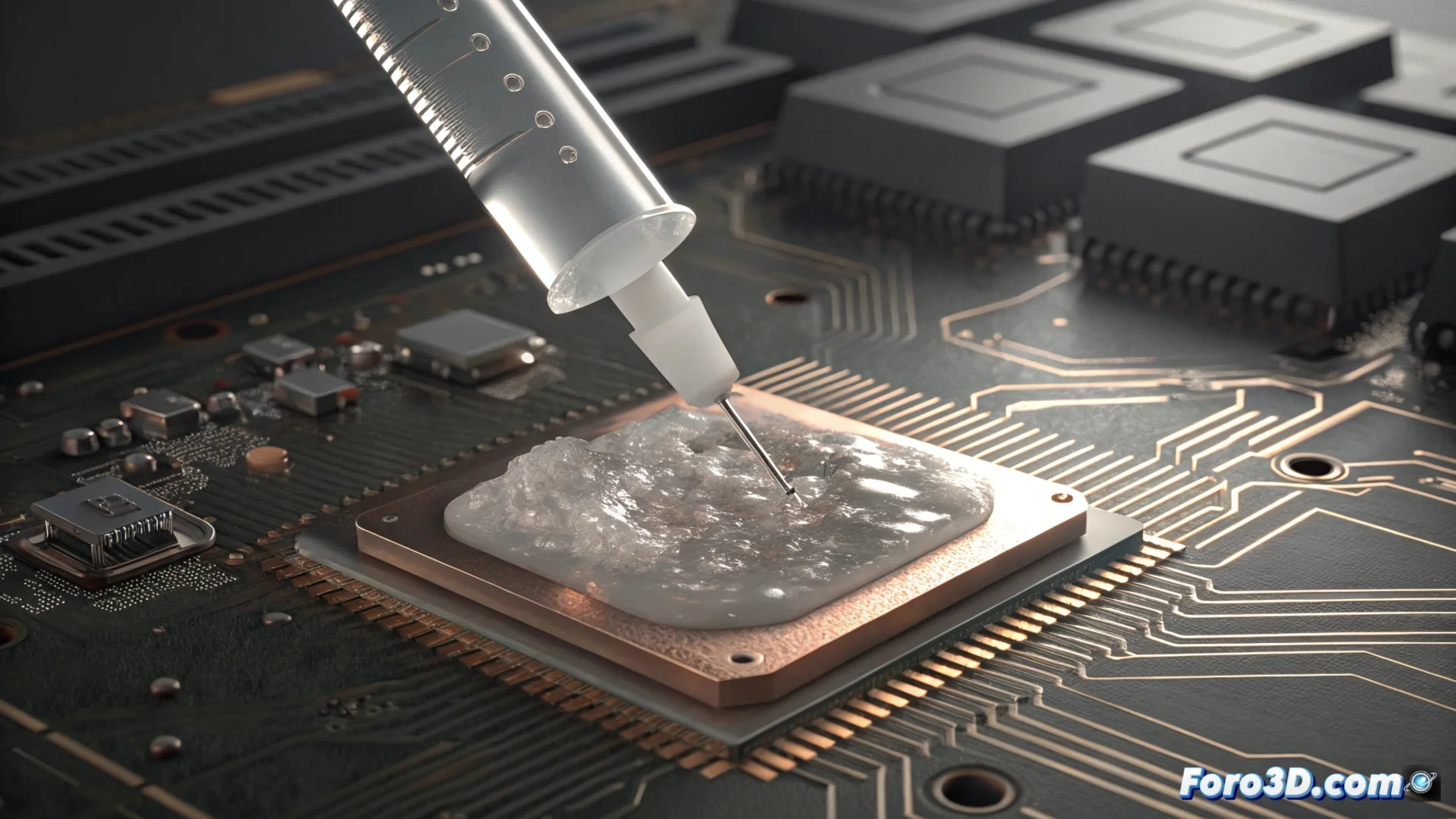
Alphacool presents a liquid thermal putty as an alternative to pads
The company Alphacool, recognized in the field of liquid cooling, has unveiled its innovation: the Apex Thermal Putty X1 Liquid Thermal Pad. This product constitutes a high-performance thermal interface designed to replace classic solid sheets, aiming to optimize heat dissipation between chips and their heatsinks. 🔥
What defines this new material?
Its main characteristic is a pasty and malleable consistency. This property allows it to cover imperfections and adapt to surfaces more efficiently than a rigid solution. It is formulated with a silicone base enriched with microparticles that conduct heat. The user can distribute it over elements like VRAM or voltage regulators, and it maintains its flexibility without hardening over time.
Key properties of the putty:- Superior adaptability: Fills microscopic gaps on surfaces that are not perfectly flat.
- Stable composition: Based on silicone and conductive fillers, it does not cure or solidify.
- Direct application: Used on multiple points of a circuit, such as memory chips and power supplies.
A thermal interface that flows to fill every space, eliminating poor contact points.
Benefits over preformed pads
Without a fixed thickness, it solves the issues of uneven pressure and fit that traditional pads often present. This translates into a more uniform thermal contact, especially useful when components on a board have different heights. Additionally, a single package serves for many applications, offering greater versatility than a set of pads with specific sizes.
Practical advantages of its use:- Eliminates thickness problems: Adapts automatically, without trapping air.
- Uniformizes pressure: Improves contact in assemblies with components of different heights.
- Higher performance per cost: One tube can replace a full package of pads of various sizes.
The final choice is in your hands
The decision comes down to preferring to apply precisely a controlled amount of this viscous compound or continue placing a solid sheet that may not settle optimally on its own. This Alphacool novelty poses an interesting change in how we approach heat transfer in complex electronic assemblies. 🛠️