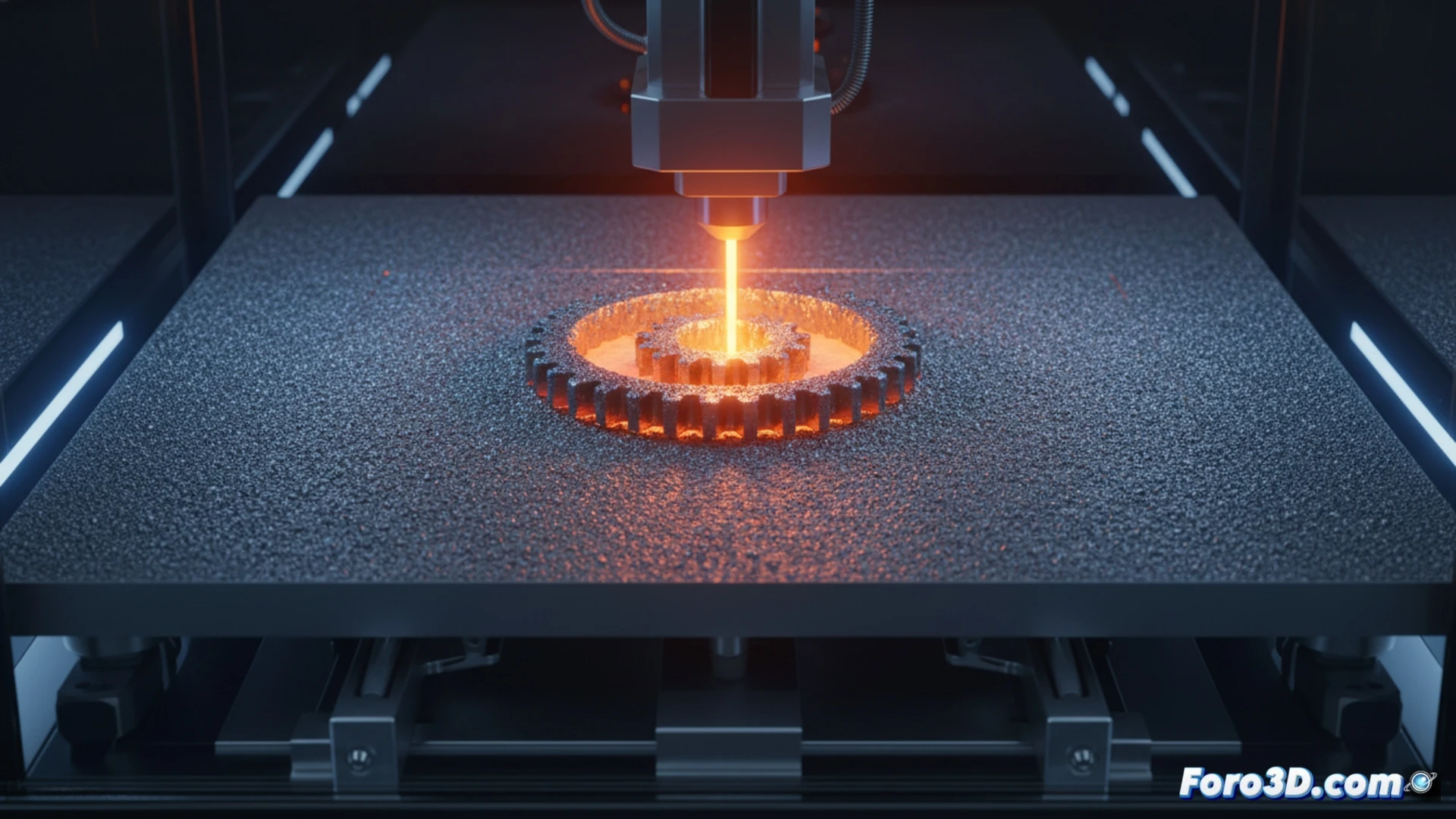
3D Printing of Ultra-Resistant Tools Without Wasting Material
How are the hardest industrial components manufactured? 🛠️ The conventional process usually generates a significant amount of waste. A team of scientists in Japan has devised an innovative method: three-dimensional printing with a tungsten and cobalt (WC-Co) alloy, known for its extreme hardness. The key lies in not fully melting the powder, but using laser energy to join it selectively, superimposing layers with millimeter precision.
The "Precise Softening" Technique
The process is akin to heating a metal just below its full melting point. The high-power laser applies heat in a controlled manner, allowing the particles to adhere to the lower layer without liquefying. This approach avoids common problems such as the formation of pores or internal cracks, which compromise the integrity of the piece. The final result achieves mechanical strength equivalent to that of classical production methods, but with a decisive advantage: almost all of the raw material is utilized.
Key advantages of this method:- Minimizes waste: Being an additive process, only the material strictly necessary to build the piece is used.
- Avoids defects: By not fully melting, internal stresses and gas bubble formation are reduced.
- Allows complex geometries: Facilitates designing tools with internal or external shapes that would be unfeasible with subtractive techniques.
To build something stronger, sometimes more force is not needed, but more intelligence and precision in the process.
The Strategic Value of Tungsten
Tungsten is a scarce mineral resource of great strategic importance, used in a wide range of products, from industrial milling cutters to electronic components. This new 3D printing technique presents itself as a promising solution for conserving this valuable material, allowing the manufacture of high-performance parts with efficient consumption. Although the process is still in the development phase and not ready to scale to mass production, it lays the foundation for creating hybrid structures and custom components with superior performance.
Potential applications:- Cutting and machining tools with optimized internal cooling channels.
- Components for the aerospace and defense industries that require maximum hardness and lightweight geometries.
- Manufacturing of long-lasting molds for injection processes under extreme conditions.
A More Efficient Future for Manufacturing
This research demonstrates that the future of manufacturing is not at odds with resource efficiency. 🚀 Combining the precision of additive manufacturing with extreme-performance materials like WC-Co opens a path toward a more sustainable industry capable of producing what was previously impossible. Innovation does not always mean applying more energy, but directing it more intelligently to achieve superior results.