The Colón Towers in Madrid represent an exceptional technical challenge: a building constructed from the top down. Designed by Antonio Lamela, their suspended construction method emerged to overcome a site of only 1,710 square meters and municipal parking requirements. This case is a perfect laboratory for applying BIM modeling, allowing visualization of how the central core and suspension platform were erected before hanging the floors, solving physical and regulatory limitations with precise digital planning.
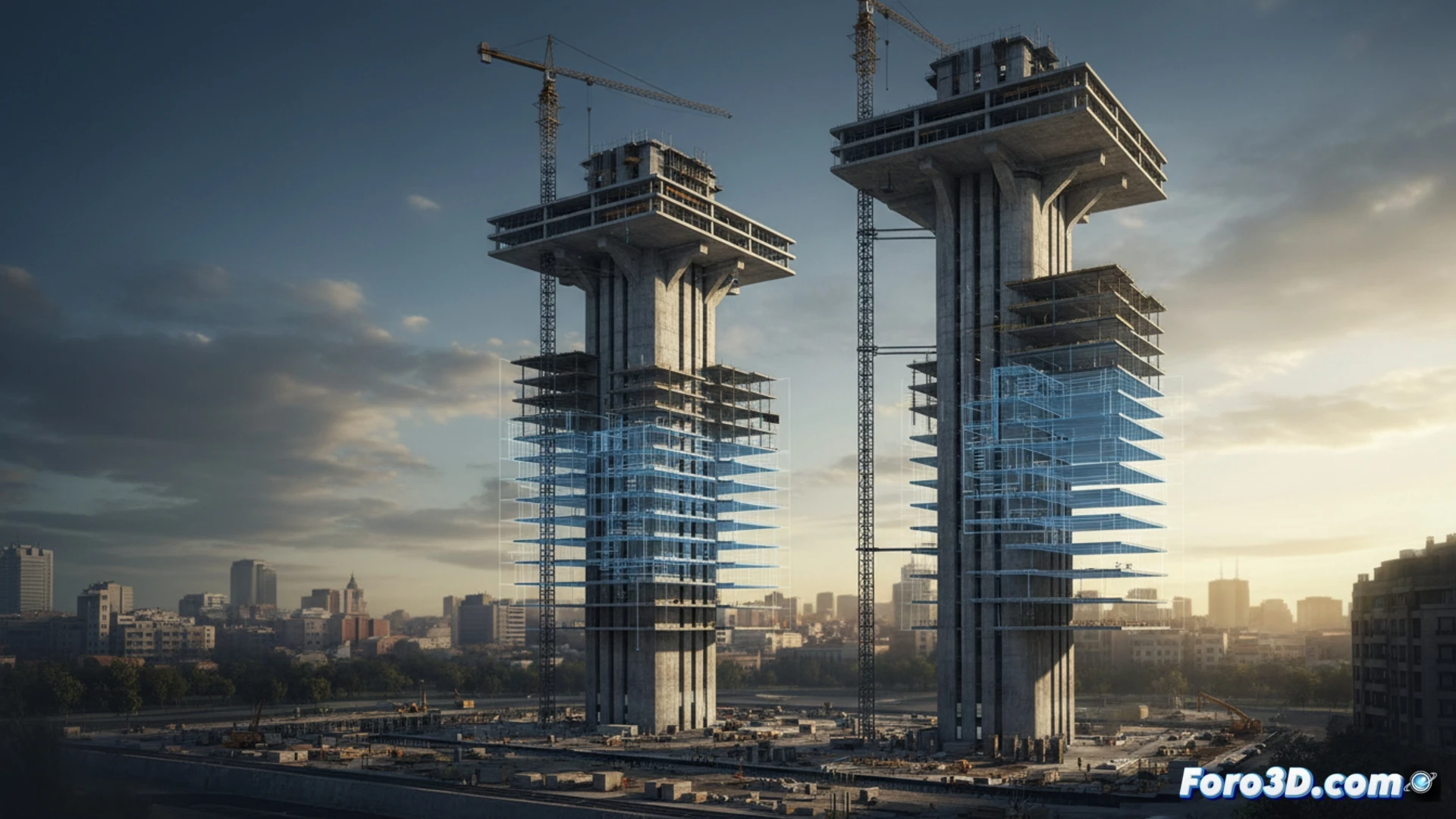
BIM planning of the reverse construction process 🏗️
In a BIM model, the first step is to simulate the reinforced concrete central core, which acts as the structural backbone. On top of this, the large suspension platform is modeled, an upper slab that supports the entire weight of the building. The key of BIM here is the phase simulation: first, this platform is assembled, and then the hanging floors are added one by one, without the upper floors transferring weight to the lower ones. The software allows verifying loads at each level and the behavior of the tie rods, ensuring the whole behaves as three almost independent parts: the two towers and the base. This digital methodology avoids collisions and optimizes the use of the small site, something that the traditional method would not have allowed.
Lamela's lessons for architectural visualization 🎨
Lamela's decision to split the municipal proposal into two towers to avoid a disproportionate urban impact is an example of how design must engage with its surroundings. With BIM, this dialogue is enriched: realistic views of the building in its urban setting can be generated, simulating how light falls between the towers and how the suspended structure frees up ground floor space. This case demonstrates that 3D visualization is not only useful for showing the final result, but also for validating construction solutions impossible on paper, starting the house from the roof with technical rigor.
How was the inverted construction sequence of the Colón Towers modeled in BIM to guarantee structural stability during the temporary suspension process?
(PS: BIM is like having a building in Excel, but with nice windows.)