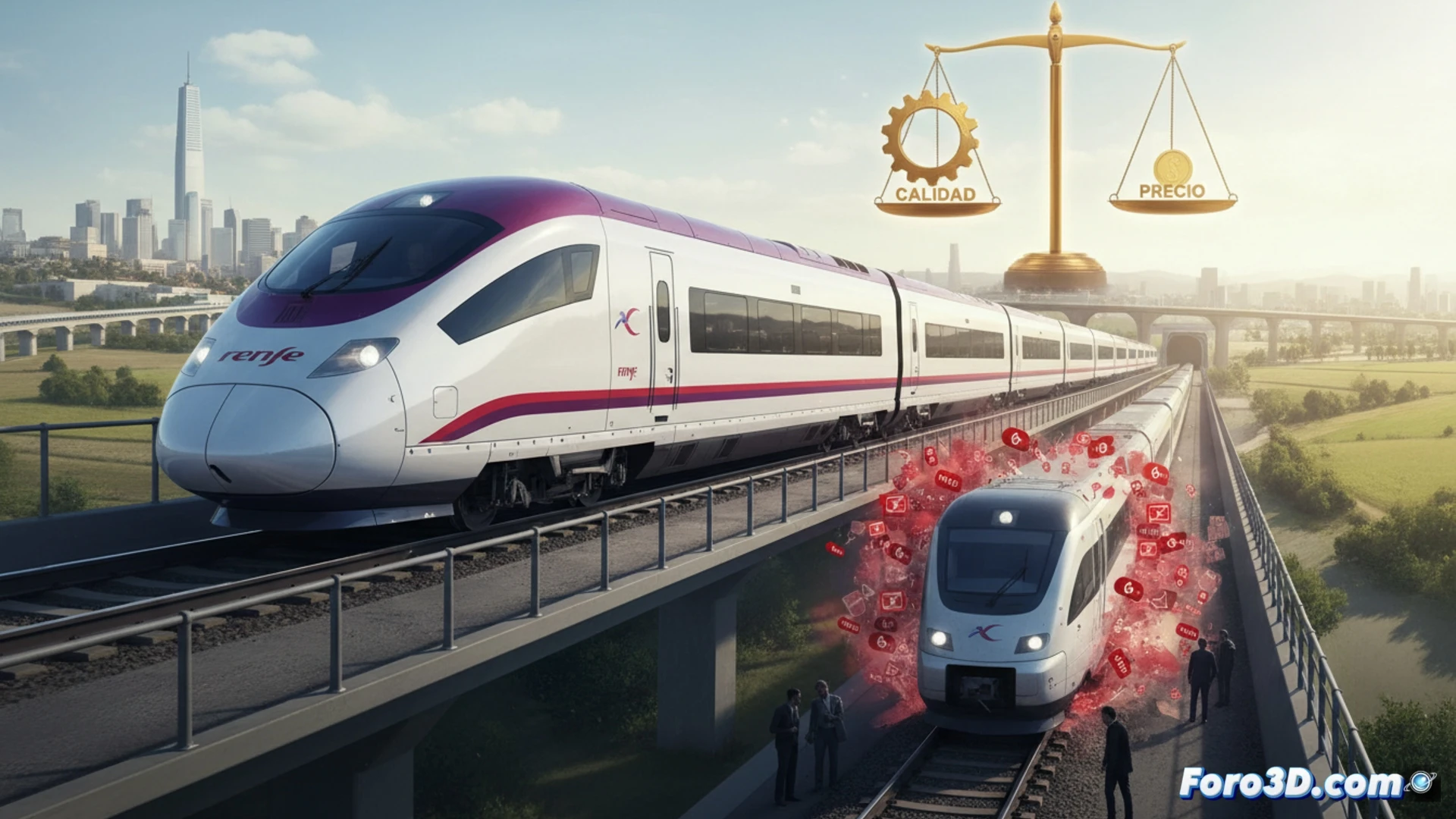
Renfe has launched a tender to acquire between 30 and 40 new high-speed trains. The goal is to renew a fleet that has caused more headaches than joys. The operator wants to avoid repeating the disaster of the Talgo Avril, whose arrival accumulated more than two years of delay and generated numerous technical incidents. Therefore, in this tender, reliability will be valued more than cost.
Railway technology: reliability as a key criterion 🚄
The new trains must meet technical specifications that guarantee a continuous and predictable service. Renfe has established an evaluation system where quality weighs more than price, an unusual decision in a sector where low cost usually prevails. Redundant traction systems, state-of-the-art regenerative brakes, and sensor-based predictive maintenance will be required. All so that the next time an AVE breaks down, it is not due to a basic design flaw.
The lesson of the Avril: better late than never, but not that late ⏳
The Talgo Avril arrived with a two-year delay, and when they finally ran, they did so with more breakdowns than a second-hand car. Renfe has learned its lesson: it now asks for trains that are not only beautiful but also work. Of course, passengers who lost their connections due to the Avril can take comfort in thinking that, at least, their delays served to make Renfe a little more demanding. Good thing the AVE is not like the Phoenix, because this one took a while to rise again.