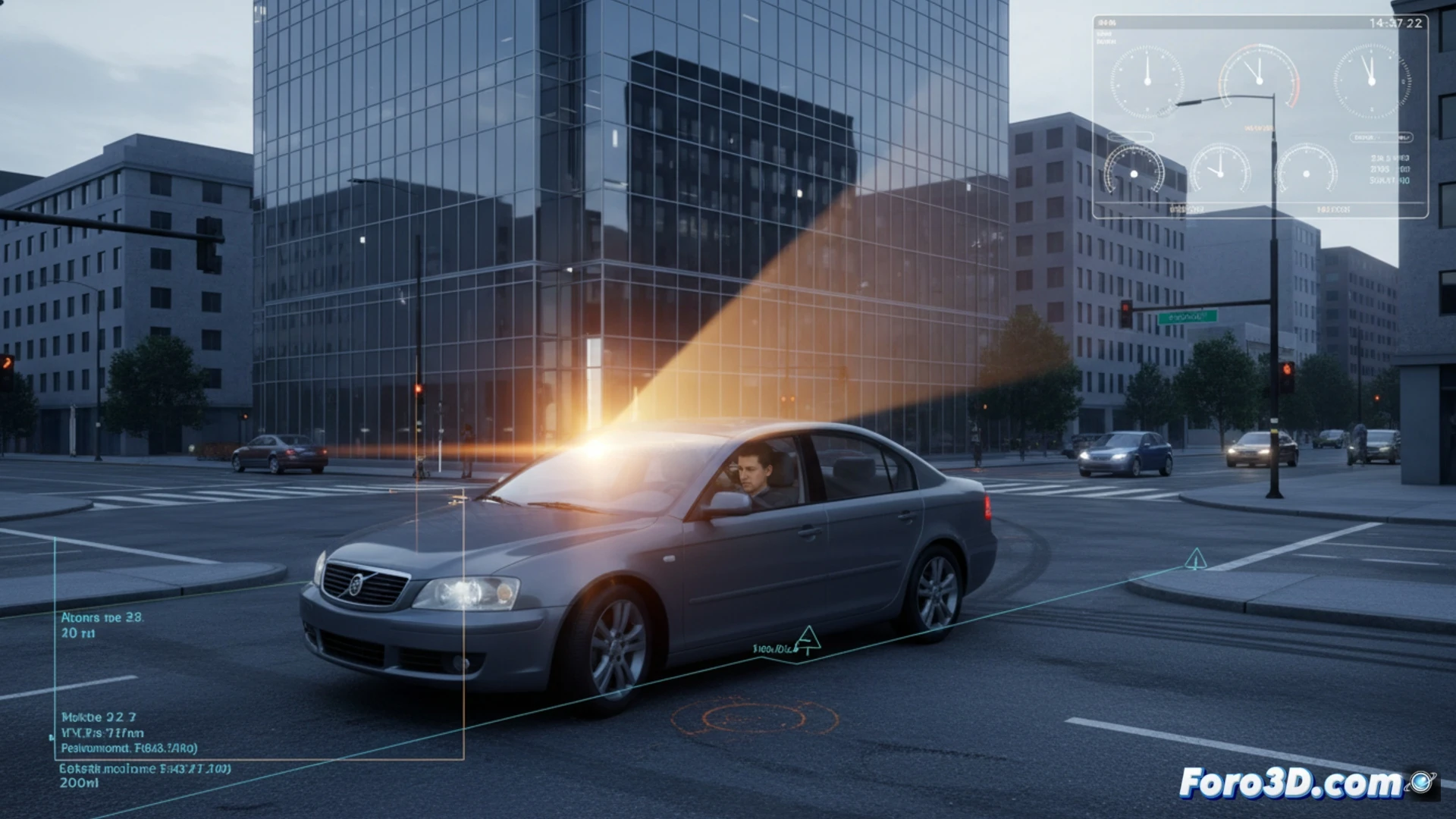
A driver crossing an urban intersection lost control and struck a pedestrian, claiming to have been blinded by a solar reflection from a glass facade. To verify this hypothesis, the forensic team developed a digital recreation of the accident. The objective was to determine whether the sun's position and the building's geometry could generate a direct glare on the vehicle's windshield at the exact moment of impact, thus validating the driver's statement.
Workflow: urban modeling and astronomical simulation 🌞
The process began with creating the environment in SketchUp, importing the geometry of the intersection, the office building, and the glass facade from Google Earth Pro data. Reflective surfaces were modeled with realistic specular properties. The key was synchronizing the exact solar position: using astronomical data from the time, date, and GPS coordinates of the incident, a digital sun was configured in V-Ray with precise inclination and azimuth down to the second. The physical lighting simulation demonstrated that at 17:23:45, a concentrated beam of light directly impacted the center of the driver's windshield, generating total glare. This blind spot was then integrated into PC-Crash, where the vehicle's trajectory and the driver's reaction were adjusted to validate that the loss of control was consistent with the simulated reflection.
The precision of time data as expert evidence ⏱️
This case demonstrates that 3D simulation technology serves not only to recreate damage but also to refute or confirm subjective perceptions. Incorporating exact astronomy into the forensic workflow raises the standard of expert evidence. A one-minute error in the solar simulation would have changed the angle of incidence, dismissing the cause. Precision down to the second, combined with V-Ray's physical rendering, allowed for an image of the reflection that the court accepted as irrefutable visual evidence.
How can the angle of incidence of the sun on the windshield at the exact moment of the accident be determined through 3D simulation and precise astronomical data to validate or refute the driver's claim of glare?
(PS: In scene analysis, every scale witness is a small anonymous hero.)