A passenger fell onto the tracks at a curved subway station after becoming trapped in the gap between the train and the platform. The forensic investigation used an integrated workflow of LiDAR scanning, dynamic simulation, and virtual reality to determine the cause. The team used a Leica RTC360 to capture the exact geometry of the station and the train car model, establishing the basis for a rigorous technical analysis.
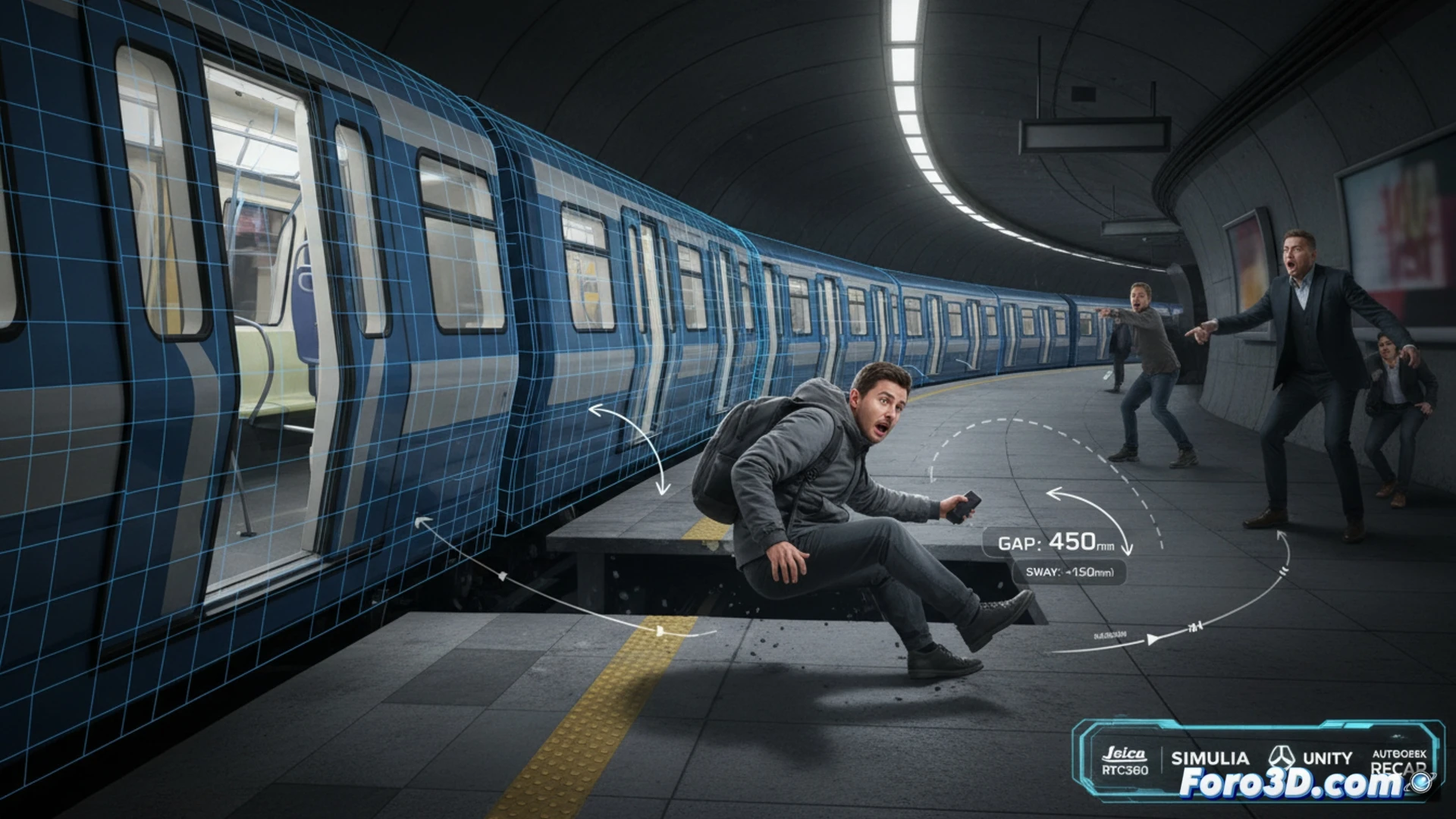
Technical workflow: scanning, simulation, and visibility analysis 🚇
The process began with LiDAR scanning using the Leica RTC360, generating a high-precision point cloud of the station and the specific train car. The data was processed in Autodesk ReCap to align and clean the scene. Subsequently, the geometry was imported into Simulia to perform a dynamic simulation of the train's sway. The model included parameters for load, speed, and track curvature. The results revealed that the momentary oscillation of the train car, due to the curve dynamics, increased the instantaneous gap to a critical value. Finally, the scene was recreated in Unity to analyze the driver's visibility and the actual distances from the passenger's perspective, confirming that the gap exceeded architectural safety limits during that instant.
Technical lessons and the value of dynamic simulation ⚙️
This case demonstrates that static platform gaps are not the only risk factor. The dynamic sway of the train can amplify the dangerous space in fractions of a second. The combination of 3D scanning, simulation in Simulia, and visibility analysis in Unity allows experts not only to document the scene but also to mathematically prove how safety margins were exceeded. This is a replicable methodology for any accident investigation in transportation infrastructure where geometry and movement are critical factors.
Is it possible to accurately model the dynamics of the impact and compression of the human body against the edge of the curved platform during a fall, using finite element simulation techniques integrated into the 3D model of the forensic scene?
(PS: In scene analysis, every scale witness is a small anonymous hero.)