The energy crisis in Cuba has led mechanics like Juan Carlos Pino to develop extreme solutions. His 1980 Fiat Polski, modified to run on charcoal, represents a fascinating case study for reverse engineering. From the perspective of automotive engineering and 3D design, we will analyze the key components of this system: the propane tank repurposed as a combustion chamber, the handmade filter made from a milk can, and the 60-liter rear tank.
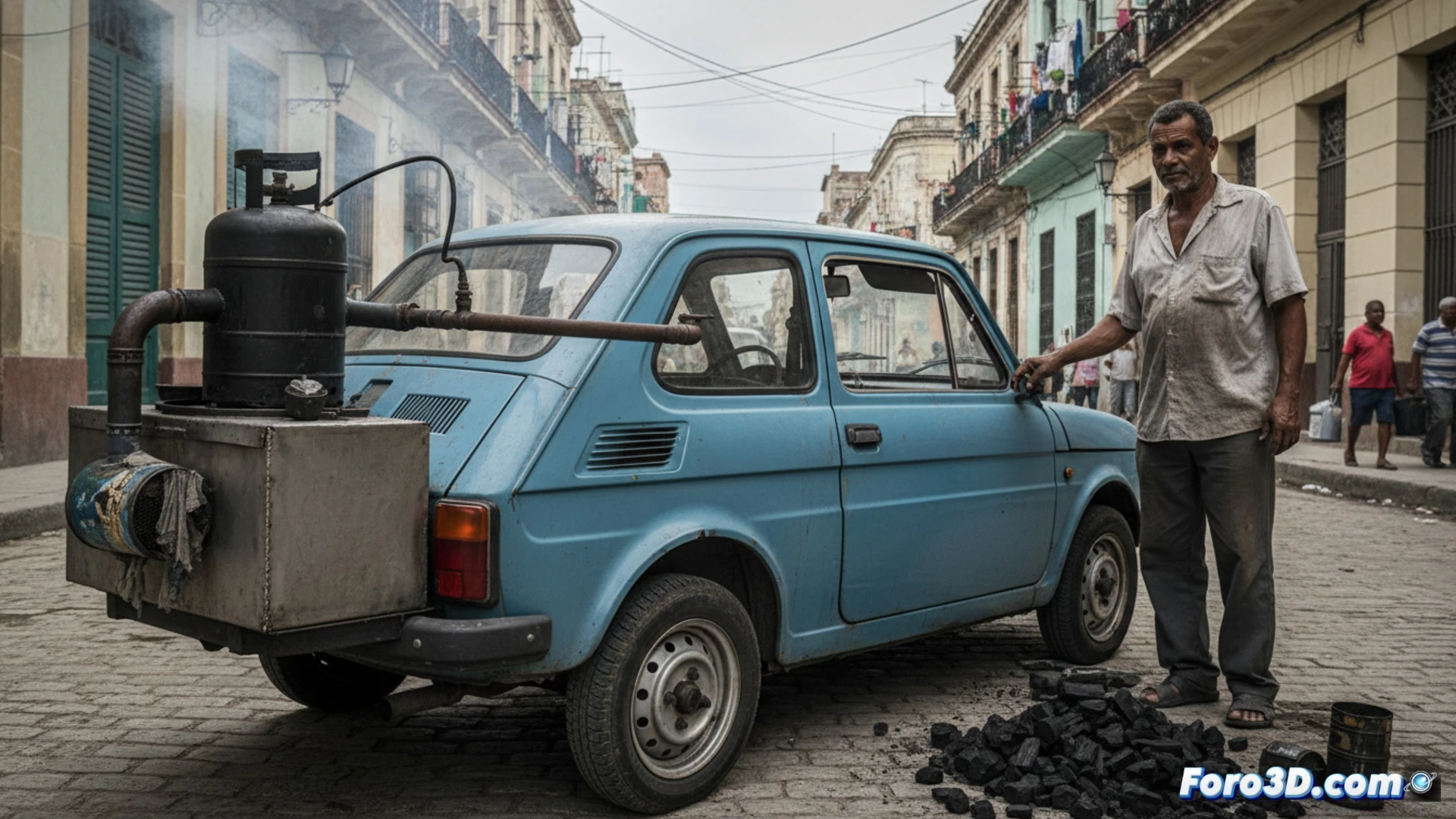
Technical analysis of the gasification system and component modeling 🔧
Pino's system is based on a downdraft gasifier. The propane tank, about 30 cm in diameter, acts as a reactor where charcoal burns at a low temperature, generating carbon monoxide and hydrogen. In our 3D model, we have recreated this flow: air enters through a lower nozzle, the producer gas rises and passes through a rudimentary filter. The filter, a 5-liter milk can filled with rags and activated charcoal, removes particles and tar. The rear tank, welded with steel profiles, stores the dry charcoal. Compared to a gasoline system, volumetric efficiency drops by 40%, and intake pressure is nearly atmospheric, versus the 3-5 bar of a modern injector.
Energy simulation: charcoal vs. gasoline in a blockade context ⚡
We have simulated the combustion process in our fluid dynamics software. Atomized gasoline offers fast and homogeneous combustion, with flame temperatures of 2000 degrees Celsius. Charcoal gas, on the other hand, burns slower and at 1200 degrees, reducing power by 30%. However, in Cuba, where a liter of gasoline costs eight dollars on the black market and blackouts paralyze gas stations, charcoal allows mobility for less than one dollar per trip. This adaptation, though crude, is a testament to human resilience that deserves to be documented in 3D for future generations of engineers.
What techniques would you use to represent the embedded electronics in a vehicle?