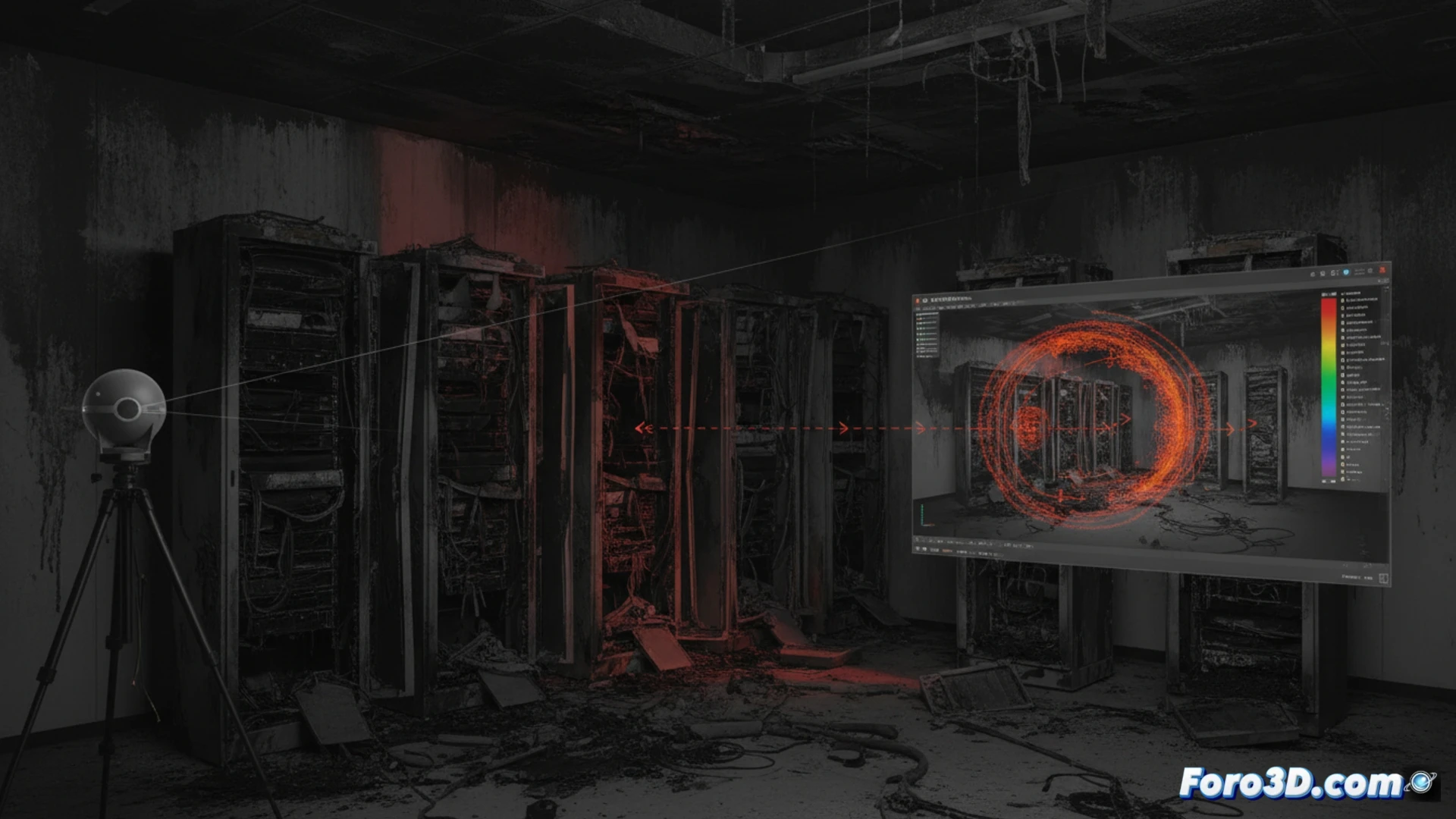
A devastating fire in a server farm has been analyzed using a forensic combination of thermal laser scanning and 3D simulation. The incident, which destroyed entire racks, revealed a critical failure in safety protocols. Thanks to scanning with a Leica RTC360, investigators captured metal deformation and soot patterns. The subsequent simulation with Fire Dynamics Simulator (FDS) and PyroSim demonstrated that the forced air conditioning system (HVAC) acted as an unforeseen conduit, accelerating the spread of flames along a lethal trajectory.
Forensic reconstruction: from thermal scanning to fluid dynamics 🔥
The process began with the Leica RTC360, a high-precision laser scanner that mapped the disaster scene. The point cloud data captured not only the deformed geometry of the racks, but also the residual thermal marks of the soot. This 3D model was imported into PyroSim, the graphical interface for FDS, to recreate the fire. The computational fluid dynamics (CFD) simulation revealed that the HVAC airflow, designed for cooling, channeled heat and oxygen into dead zones. The flashover occurred when the room ceiling reached ignition temperature, a blind spot in the original protocols that assumed the climate control system was inert in case of fire.
Lessons for critical infrastructure: when design fails ⚠️
This case demonstrates that passive safety cannot ignore the interaction between active systems. The HVAC not only propagated the fire, but created a thermal feedback path that no smoke sensor could anticipate. The combination of 3D scanning and FDS simulation not only solves the forensic puzzle, but offers a methodology for auditing data centers. The next step is to integrate these models into design protocols, preventing the cooling system itself from becoming the infrastructure's worst enemy.
As a systems engineer, what immediate lessons should I apply in the design of my own data center to prevent the HVAC system from becoming a fire propagation vector, as occurred in the analyzed flashover case?
(PS: Simulating catastrophes is fun until the computer melts down and you are the catastrophe.)