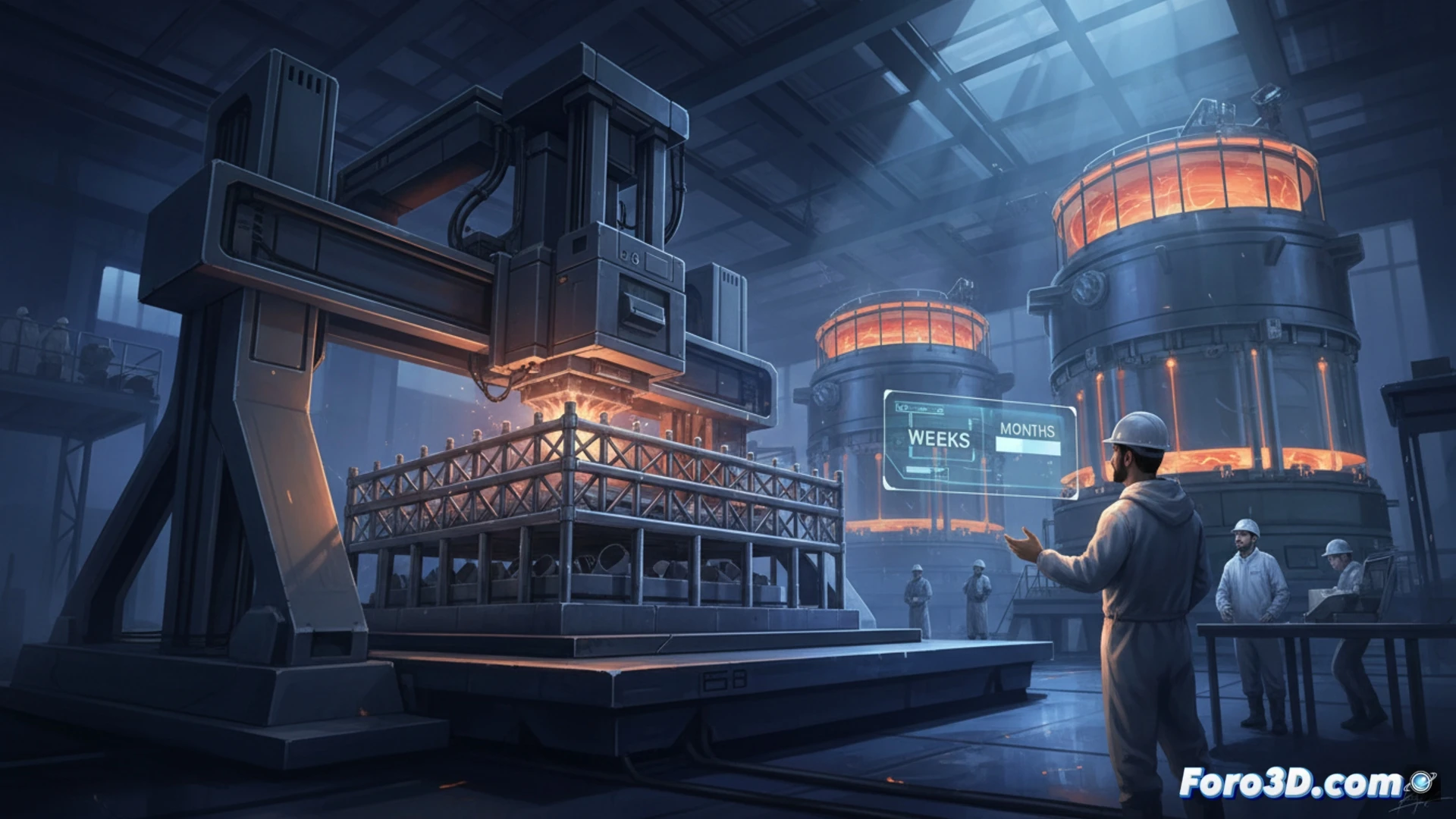
The Oak Ridge National Laboratory (ORNL) applies large-format 3D printing to the construction of nuclear reactors. The project, led by Ahmed Arabi Hassan, aims to reduce the manufacturing time of structural components from months to weeks, leveraging geometries impossible with traditional methods. The initiative is already being deployed in the first molten salt reactor in the US, at the historic K-25 site.
Additive manufacturing for shielding and cooling channels ⚛️
The technique allows for creating parts with complex shapes, such as internal shielding and curved cooling channels, which would be unfeasible with concrete formwork. ORNL uses large-format printers that deposit material layer by layer, using polymers and ceramic composites. This eliminates the need for molds and reduces material waste. Dimensional precision surpasses that of manual processes, accelerating the final assembly of the reactor.
Now the atomic core is printed like an IKEA piece of furniture 🖨️
Engineers have gone from pouring concrete for months to pressing the print button and waiting for the part to come out hot. If everything goes well, the reactor will have perfect cooling channels. If it fails, they will have a 200-kilo radioactive paperweight. At least, when something goes wrong, they no longer blame the formworker, but the STL file. Nuclear energy has never been so close to a software error.