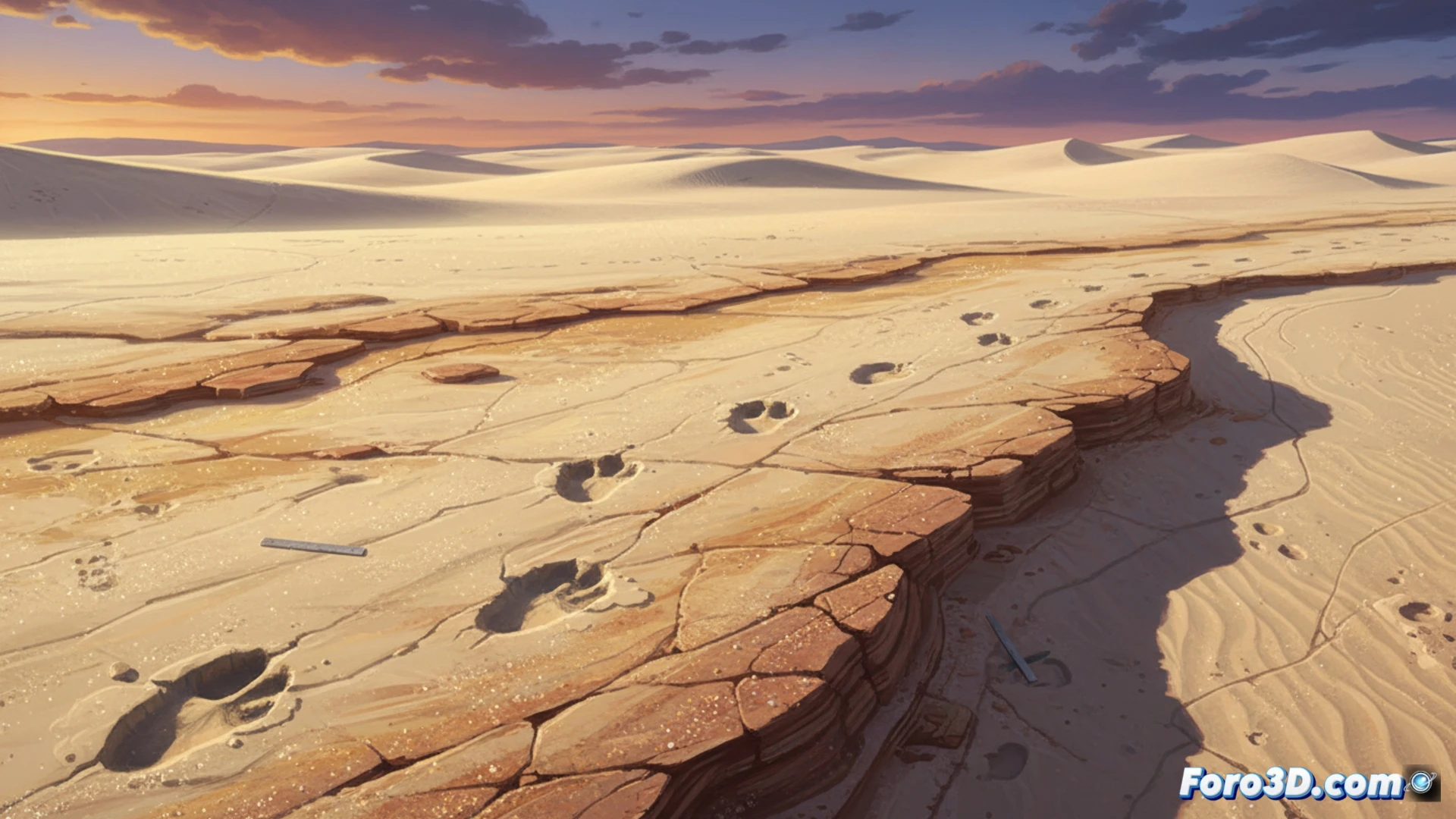
A discovery in White Sands National Park, New Mexico, has altered the accepted timeline for the peopling of the Americas. Fossilized footprints, precisely dated to 23,000 years old, show human presence thousands of years earlier than the ice-free corridor theory held. This discovery places human groups in North America during the Last Glacial Maximum.
Radiocarbon dating of aquatic seeds: the technical key 🔬
The dating was performed on numerous seeds of the aquatic plant Ruppia cirrhosa, found in sediment layers just above and below the footprints. Accelerator mass spectrometry was used for radiocarbon analysis. This method, applied to such a specific organic material and in a sealed stratigraphic context, offers greater reliability than previous attempts with more controversial materials. The technique has allowed the age to be narrowed down within a very defined time window.
Planning the family trip during the peak glaciation 🧊
The image of those pioneers walking through the mud of White Sands invites curious reflections. They surely didn't have a detailed map of the Pleistocene, and their glacial GPS must have had terrible coverage. One can almost imagine the conversation: Are you sure this shortcut between glaciers is a good idea? or The kids are asking if we've arrived in America yet. It shows that the spirit of taking a trip without knowing what's at the end is not a modern invention.