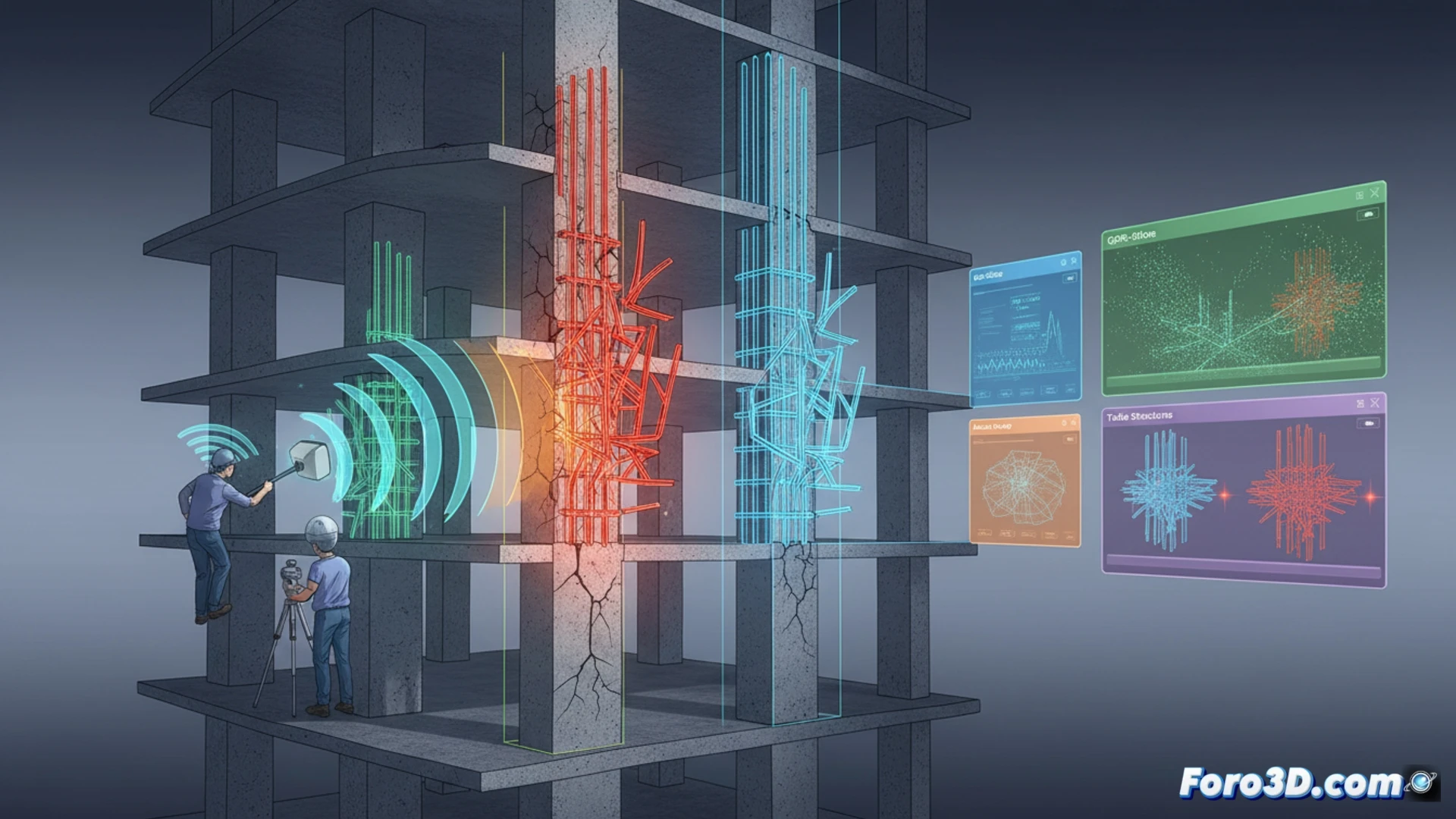
A building under construction began to show concerning diagonal cracks in several ground floor columns. Suspecting an internal failure, engineers turned to a combination of ground-penetrating radar (GPR) and 3D laser scanning to inspect the interior of the concrete without the need for demolition. The results were alarming: the steel bars were not in the position indicated in the design plans, seriously compromising the load-bearing capacity of the structure.
Forensic workflow: from laser scanning to BIM model 🔍
The process began with scanning the columns using a Leica RTC360, capturing high-precision point clouds that documented the actual geometry and surface cracks. Simultaneously, a GPR survey was conducted, and the data was processed in GPR-Slice, generating cross-sections that located each steel bar. These two data sources were merged in Autodesk ReCap to create a realistic 3D model of the column's interior. Finally, the model was imported into Tekla Structures, where it was superimposed onto the theoretical structural model, calculating the millimetric deviations of the steel and their impact on compressive and flexural strength.
Collapse prevention through non-destructive diagnosis 🏗️
This case demonstrates that visual inspection is not enough to guarantee safety on site. The combined technology of GPR and 3D scanning allows for the detection of hidden defects such as displaced reinforcement, gravel nests, or insufficient cover before the structure is loaded. For the forensic sector, this methodology becomes an essential tool: it allows quantifying the real risk of collapse and making decisions about reinforcement or controlled demolition with objective data, avoiding catastrophes and subsequent litigation.
Which methodology of 3D scanning and GPR data processing allows for the most accurate detection of millimetric deviations of reinforcement in reinforced concrete columns before visible diagonal cracks appear?
(PS: Simulating a collapse is easy. The hard part is not crashing the program.)