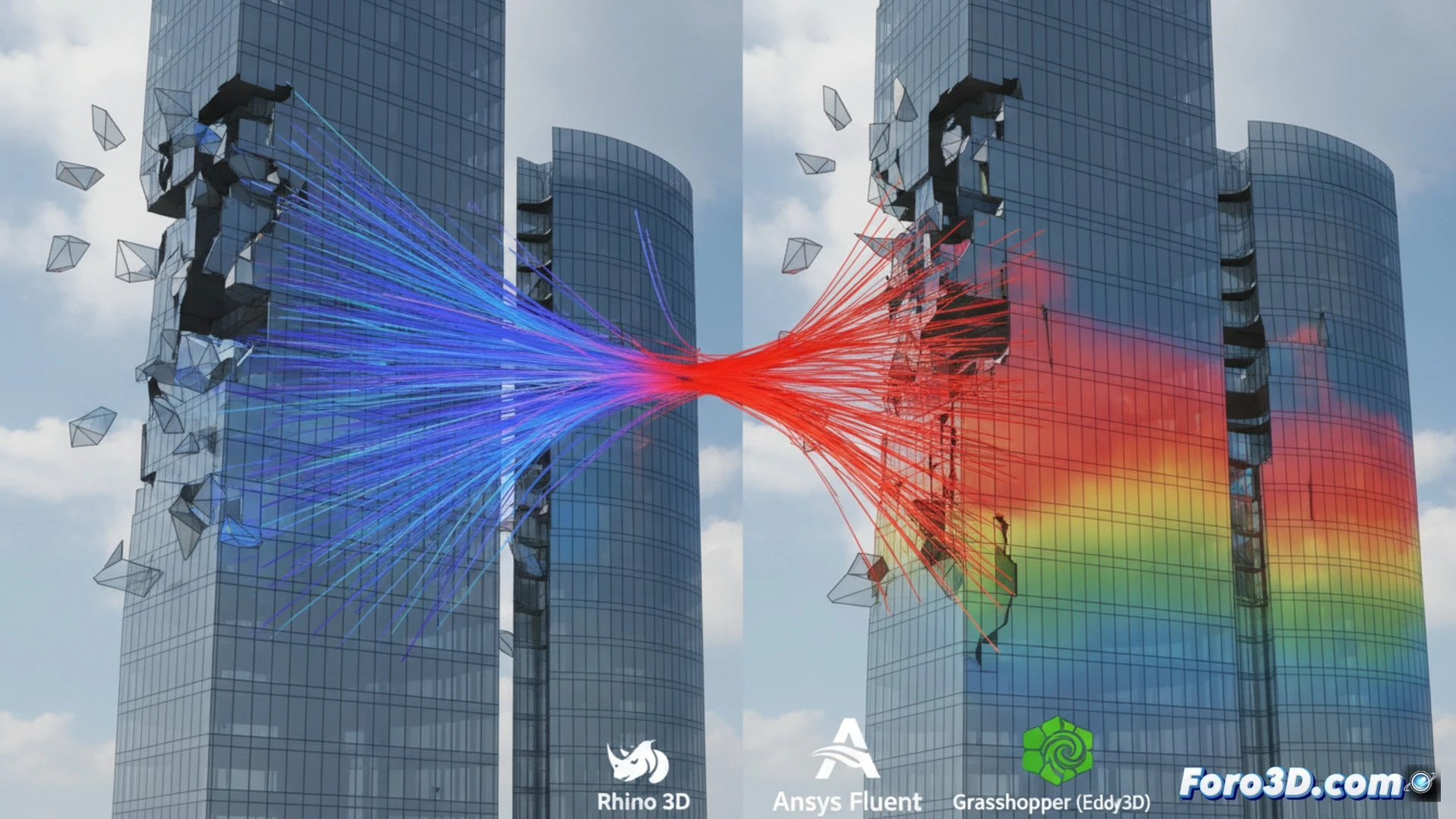
In a recently constructed skyscraper, several glass panels began to detach during days of moderate wind, a phenomenon that puzzled engineers. The solution came not from visual inspections, but from creating a digital twin of the facade. Combining a precise 3D model in Rhino with CFD simulations in Ansys Fluent, the team discovered that an adjacent building generated a Venturi effect, accelerating the wind to critical levels in specific areas. This case demonstrates how predictive simulation can anticipate structural failures before they occur.
Construction of the digital twin and CFD simulation 🏗️
The process began in Rhino 3D, where the entire skyscraper facade was modeled with millimeter precision, including each glass panel, joint, and support. Then, in Grasshopper, the Eddy3D plugin was used to prepare the geometry and define the wind flow boundary conditions. The model was exported to Ansys Fluent, where computational fluid dynamics (CFD) simulations were run using real meteorological data from the days of the incidents. The results showed a narrowing of the airflow between the two buildings, causing a localized increase in wind speed of up to 40% above what was anticipated in the design codes. This finding explained why panels in those specific areas failed under conditions that were theoretically safe.
The predictive value of the digital twin in facade engineering 🔍
This case goes beyond mere damage documentation. The digital twin not only identified the root cause of the problem but also allowed corrective solutions to be simulated without physically intervening in the building. Different configurations of deflectors and modifications to the glass geometry were tested, all within the virtual environment. The lesson is clear: a digital twin is not a luxury, but an indispensable tool for anticipating failures in complex systems. In a world where skyscrapers are becoming more slender and weather conditions more unpredictable, predictive simulation is the only way to ensure safety without relying on destructive testing.
As an engineer, what specific CFD simulation methodology was applied to the digital twin to identify the Venturi effect as the cause of the structural failure, and how was that model validated with real wind data?
(PS: My digital twin is currently in a meeting, while I am here modeling. So technically, I am in two places at once.)