A user suffered a severe cervical injury after an impact in a bumper car ride. The plaintiff's legal defense required an in-depth technical analysis combining laser scanning, biomechanical simulation, and 3D animation. The objective was to demonstrate that the vehicle's shock absorption system was locked, generating a violent deceleration that exceeded tolerable physiological limits.
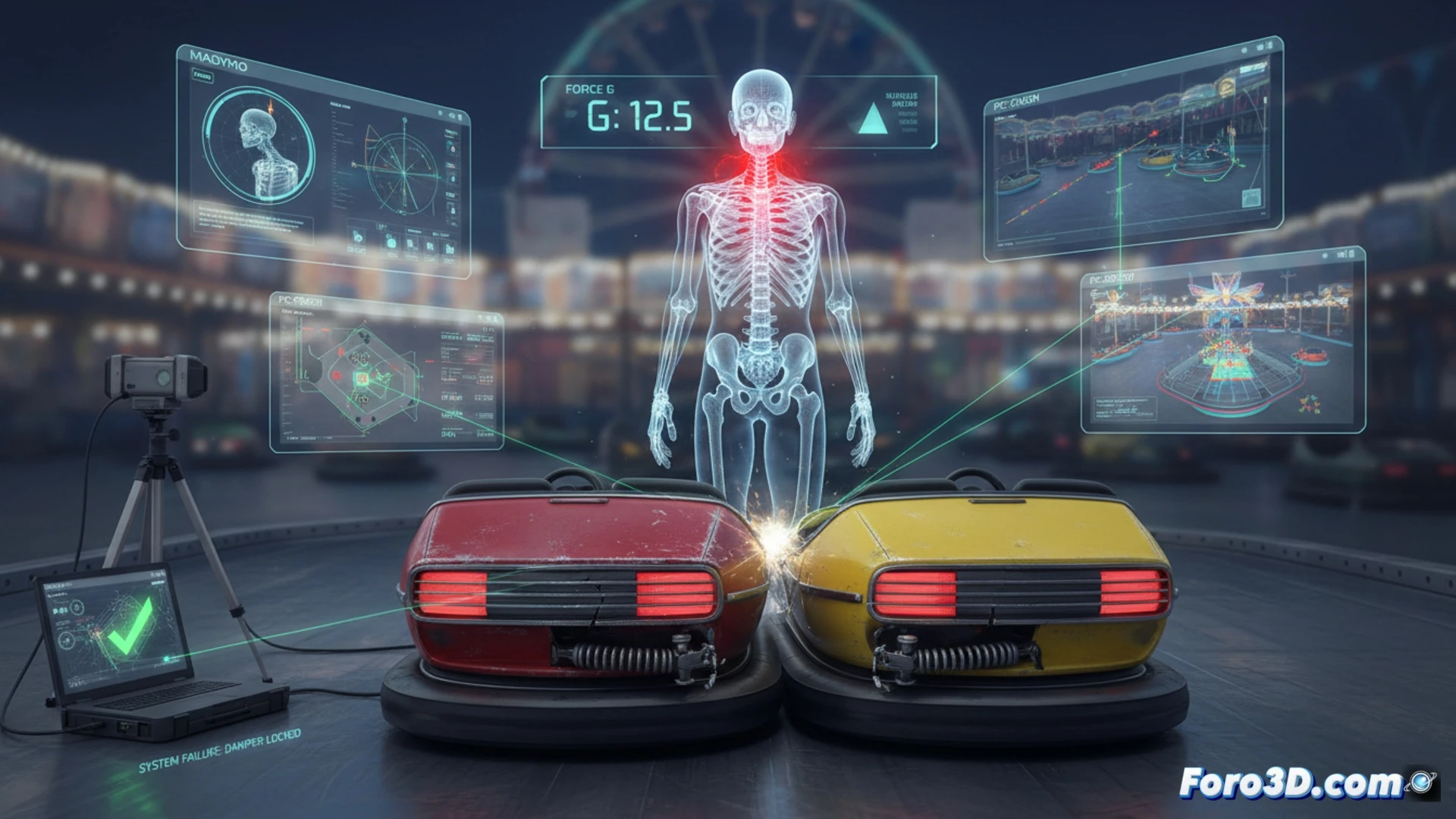
Technical Pipeline: Scanning, Simulation, and Animation 🛠️
The process began with the 3D scanning of the ride using FARO Scene, capturing the exact geometry of the car and the track. This model was imported into PC-Crash to recreate the impact dynamics, calculating relative velocities and force vectors. Subsequently, the kinematic data was transferred to Madymo, a biomechanical simulation software that modeled the occupant's torso and head. The simulation revealed that, due to the locked shock absorber, the G-force transmission to the neck exceeded 8G, well above the safety threshold of 5G. Finally, Blender was used to generate a visual animation of the accident, overlaying the cervical stress data onto the 3D model of the car, facilitating the jury's understanding.
Legal Conclusion and Value of Technical Data ⚖️
The analysis conclusively demonstrated that the mechanical failure of the shock absorption system was the direct cause of the injury. The combination of FARO Scene, PC-Crash, Madymo, and Blender not only confirmed the biomechanics of whiplash but also provided an irrefutable visual narrative. This case reinforces the importance of 3D documentation in the forensic pipeline, where simulation not only reconstructs the past but establishes clear technical and legal responsibilities.
Would you use a laser scanner or photogrammetry to document this case?