The European Space Agency's Euclid space telescope has completed the first part of the most extensive three-dimensional map of the universe to date. With millions of galaxies captured billions of light-years away, this atlas promises to shed light on dark energy, that invisible force accelerating cosmic expansion without us knowing exactly how it works.
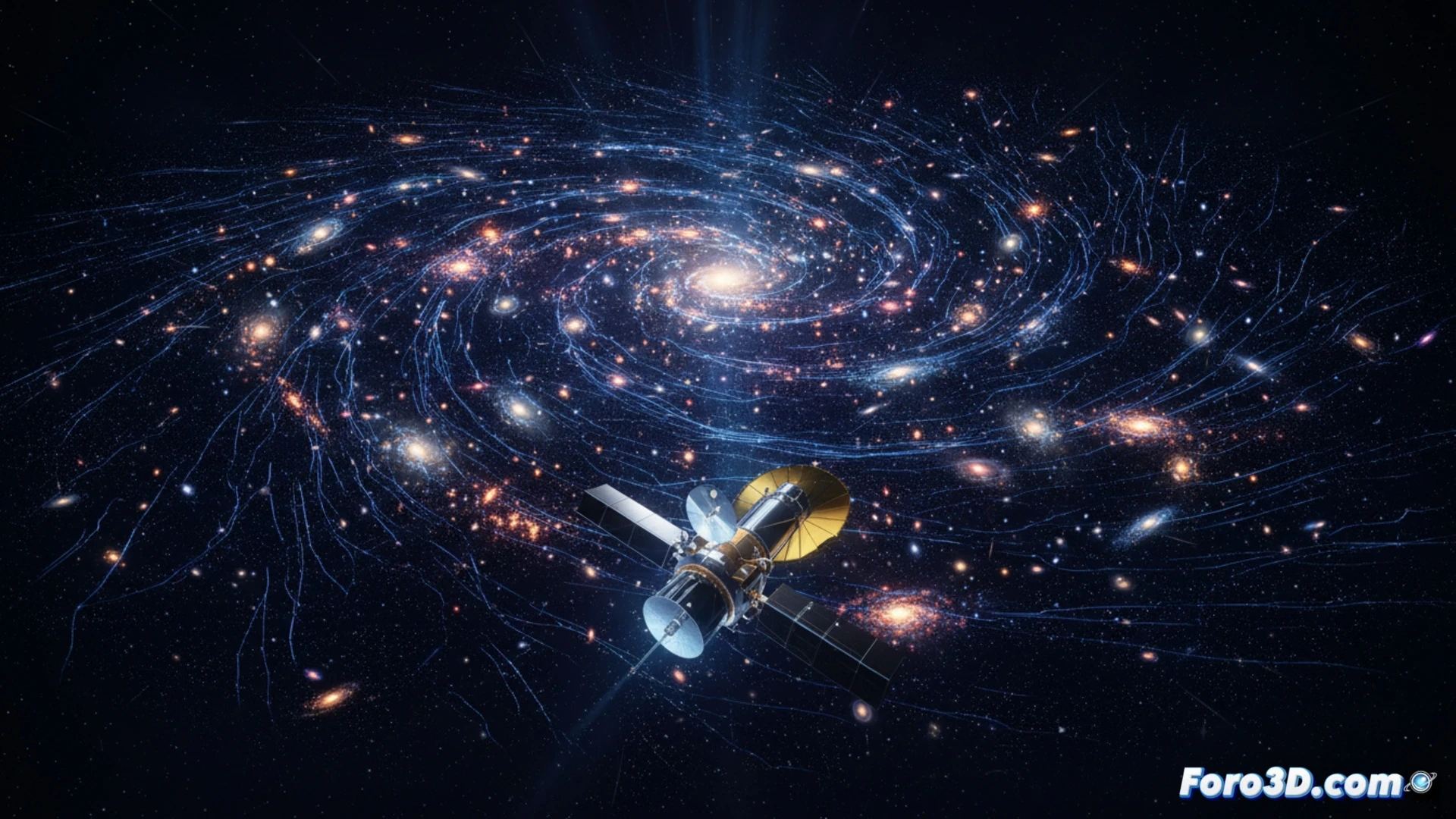
How Euclid's Galactic Atlas Was Built 🌌
The map is generated by combining high-resolution images with spectroscopic data from over 26 million galaxies. Euclid uses its VIS camera for visible light and the NISP instrument for infrared, measuring the redshift of each galaxy. This allows calculating its distance and exact position in three-dimensional space. The result is a cosmic web showing the distribution of dark matter and galactic clusters with unprecedented precision.
Dark Energy: The Stowaway Taking the Credit 👻
It turns out that 68% of the universe is dark energy, and no one knows what it is. It's as if your house had a ghost tenant occupying almost all the space, raising the rent (expansion), and not even paying. Euclid, with its new map, will try to put a face to this mysterious cosmic landlord. Meanwhile, astronomers settle for photos of galaxies that look like cotton candy.