In a refinery, a critical PLC-activated valve failed during an emergency test, ignoring control system commands. After ruling out electrical and software failures, the maintenance team suspected internal mechanical damage. The solution came through reverse engineering: 3D scanning of the actuator with a GOM ATOS Q captured the exact geometry of the suspected part. Subsequent analysis revealed a deliberate alteration that prevented the position sensor from reading correctly.
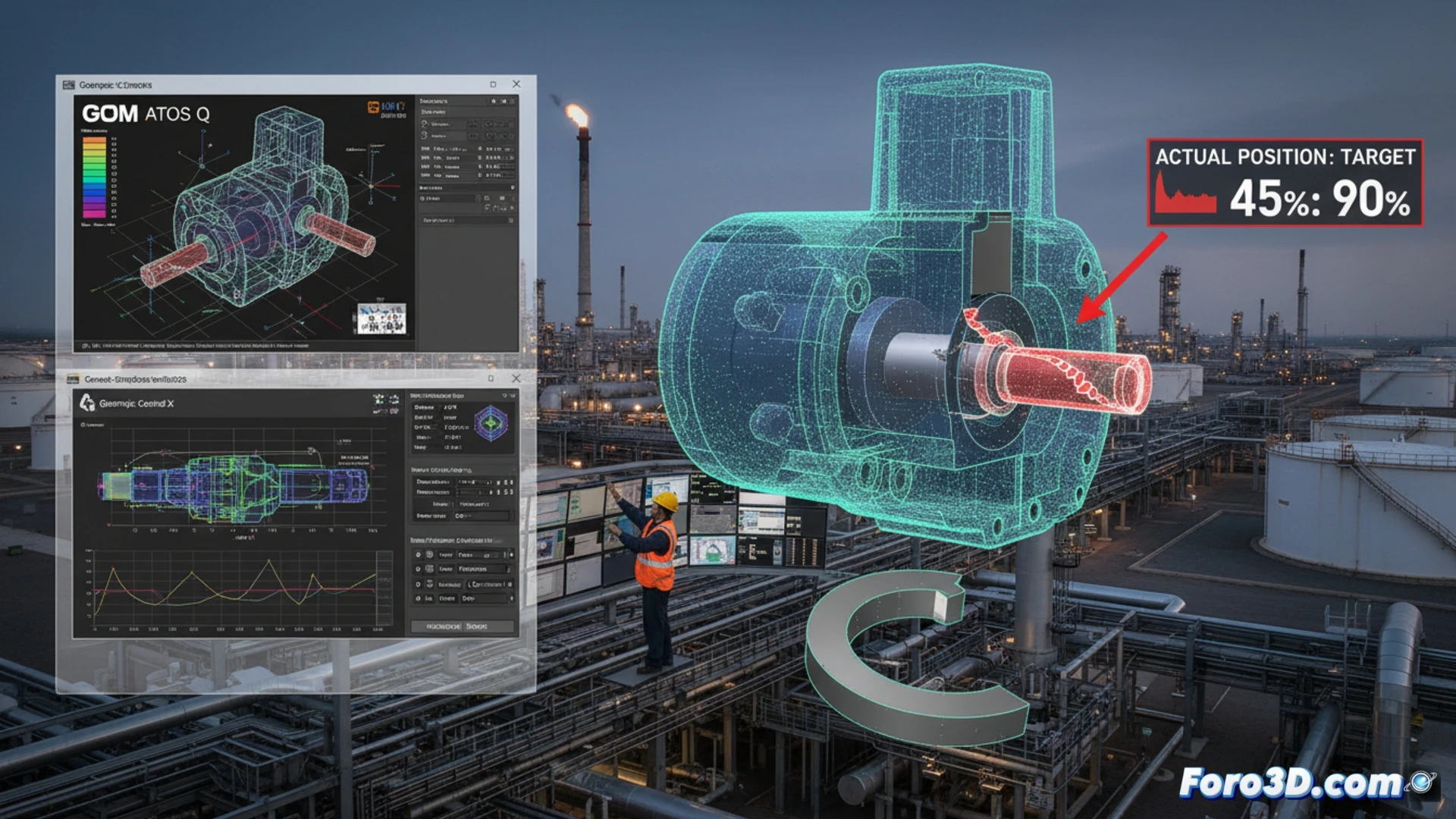
Workflow: from point cloud to CAD model 🔧
The process began with digitizing the complete actuator using the GOM ATOS Q structured light scanner, obtaining a high-density point cloud with sub-micron precision. This digital model was imported into Geomagic Control X to perform a deviation analysis against the original SolidWorks design. The comparison revealed a critical discrepancy in the profile of an internal cam: an area had been artificially filed down, reducing its thickness by 1.2 mm. This modification altered the mechanical coupling with the inductive proximity sensor, causing the PLC to interpret an incorrect valve position during emergency mode. With the deformation data, the correct part was modeled in SolidWorks, generating an STL file for immediate additive manufacturing.
The lesson hidden in the metal 🔍
This case demonstrates that reverse engineering is not only useful for replicating obsolete parts but also as a forensic tool to detect intentional manipulations or abnormal wear. The combination of high-precision optical scanning and geometric comparison software made it possible to identify a failure that no electrical or visual analysis would have uncovered. For plant engineers, this workflow becomes an indispensable protocol for intermittent failures in critical safety systems, where a filed-down part can mean the difference between a controlled shutdown and a major incident.
As a reverse engineer, what specific anomalies in the point cloud of the scanned PLC valve would indicate deliberate physical manipulation rather than mechanical wear or a common electronic failure?
(PS: if the CAD model doesn't fit, you can always say it's industrial tolerance)