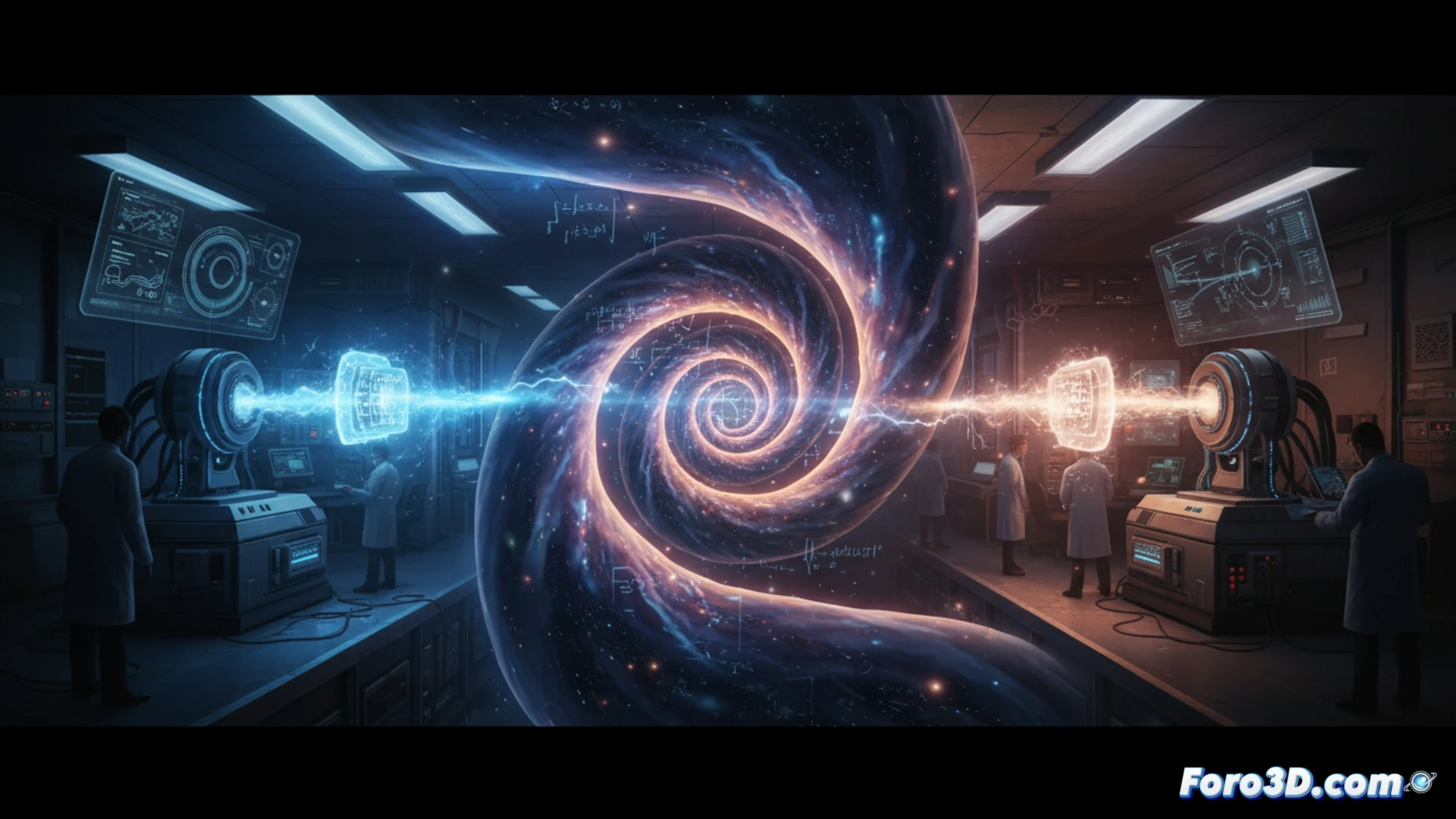
Inspired by general relativity and the movie Interstellar, researchers at MIT have explored a new way to communicate into the past using closed timelike curves (CTCs). Although building a real CTC would require impossible energy, quantum entanglement offers a shortcut. In 2010, Seth Lloyd simulated a quantum CTC by sending a photon nanoseconds back in time. Now, his team has gone further: communication into the past works even with noise, outperforming a normal telephone line in the opposite temporal direction.
Photons traveling back in time with quantum help 🌀
Lloyd's team used entangled photons to simulate a CTC, a time loop where the effect precedes the cause. In their new experiment, they introduced controlled noise into the system, mimicking the imperfections of a real telephone line. The result was counterintuitive: communication into the past was not only possible, but showed higher fidelity than communication into the future under the same noise level. This suggests that quantum CTCs could be more robust than previously thought, although their practical implementation remains a distant challenge.
The bright side: at least the noise arrives before the message 📡
Now, if you manage to communicate with your past self, get ready to hear them complain about the background noise before you tell them anything useful. MIT physicists have shown that, in this strange temporal channel, static travels better than the signal. In other words, you could warn yourself not to buy shares in a company, but the message will arrive so distorted that you will end up investing anyway. At least, when the future is a disaster, you will know it is not your fault, but the quantum noise.