Before 1977, filming convincing space battles was a huge technical challenge. For Star Wars, John Dykstra and his team at ILM built a solution from scratch: the Dykstraflex. This motion-control system allowed for precise, repetitive filming of complex miniature spacecraft maneuvers, creating the iconic combat sequences. Its impact was immediate and transformative for the visual effects industry.
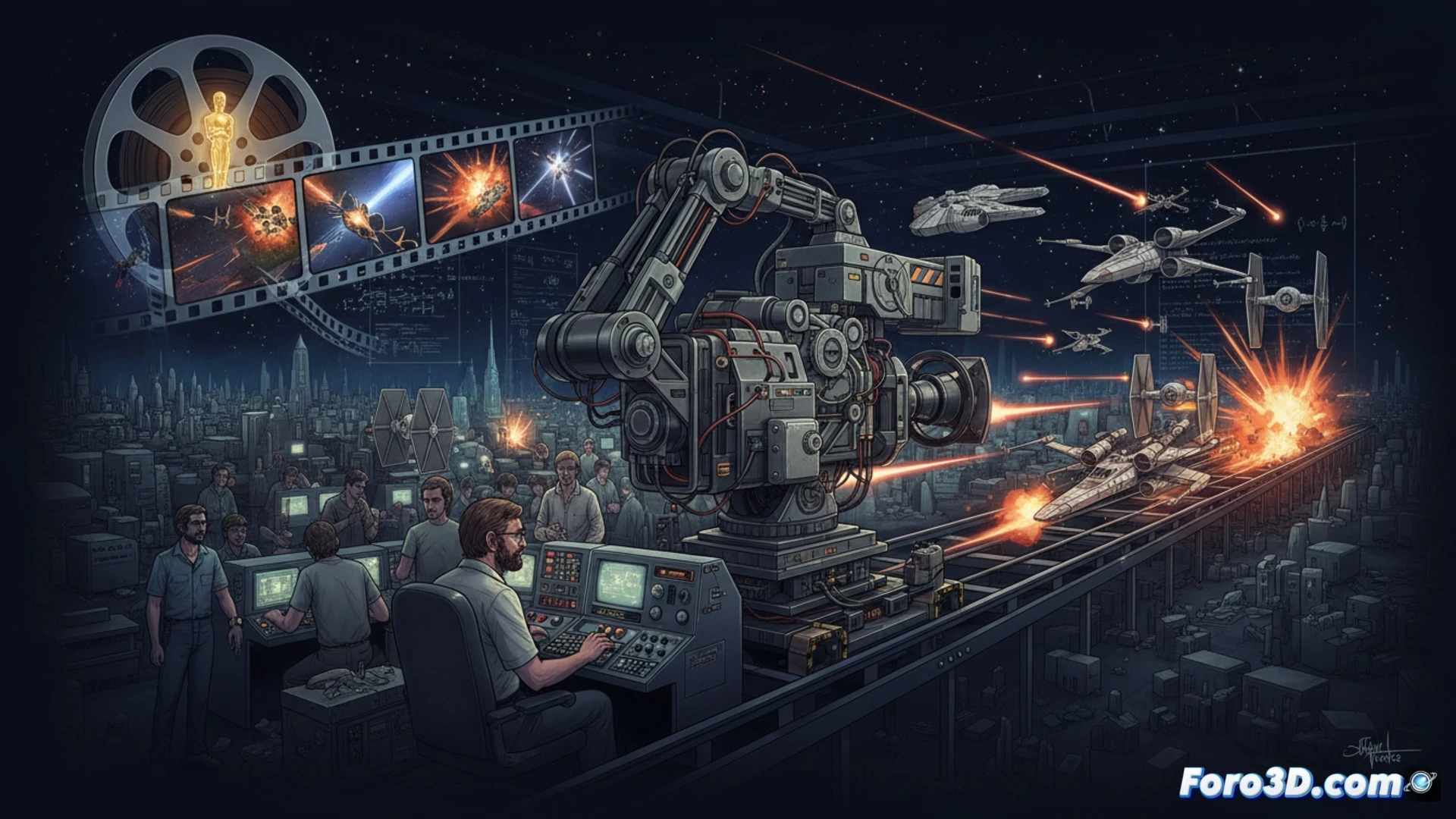
Handcrafted Engineering for Millimeter-Precision Control 🛠️
The Dykstraflex was a motorized camera platform controlled by a computer. This machine guided the camera through pre-programmed movements with an accuracy that allowed for filming multiple passes of the same shot. Each model ship, independently lit, was filmed separately against a black background. Then, all the layers were combined optically into a single image, creating the illusion of a three-dimensional space populated by dozens of TIE fighters and X-wings.
When Success Depended on a Bunch of Projector Motors 🎞️
It's curious to think that one of the most relevant technical innovations in cinema was assembled from spare parts. The system relied on recycled movie projector motors, attached to a rail structure and governed by a computer that now seems like a relic. Basically, the future of visual effects was built with the cinematic equivalent of a collage of technological scrap. And it worked wonderfully, proving that ingenuity often surpasses budget.