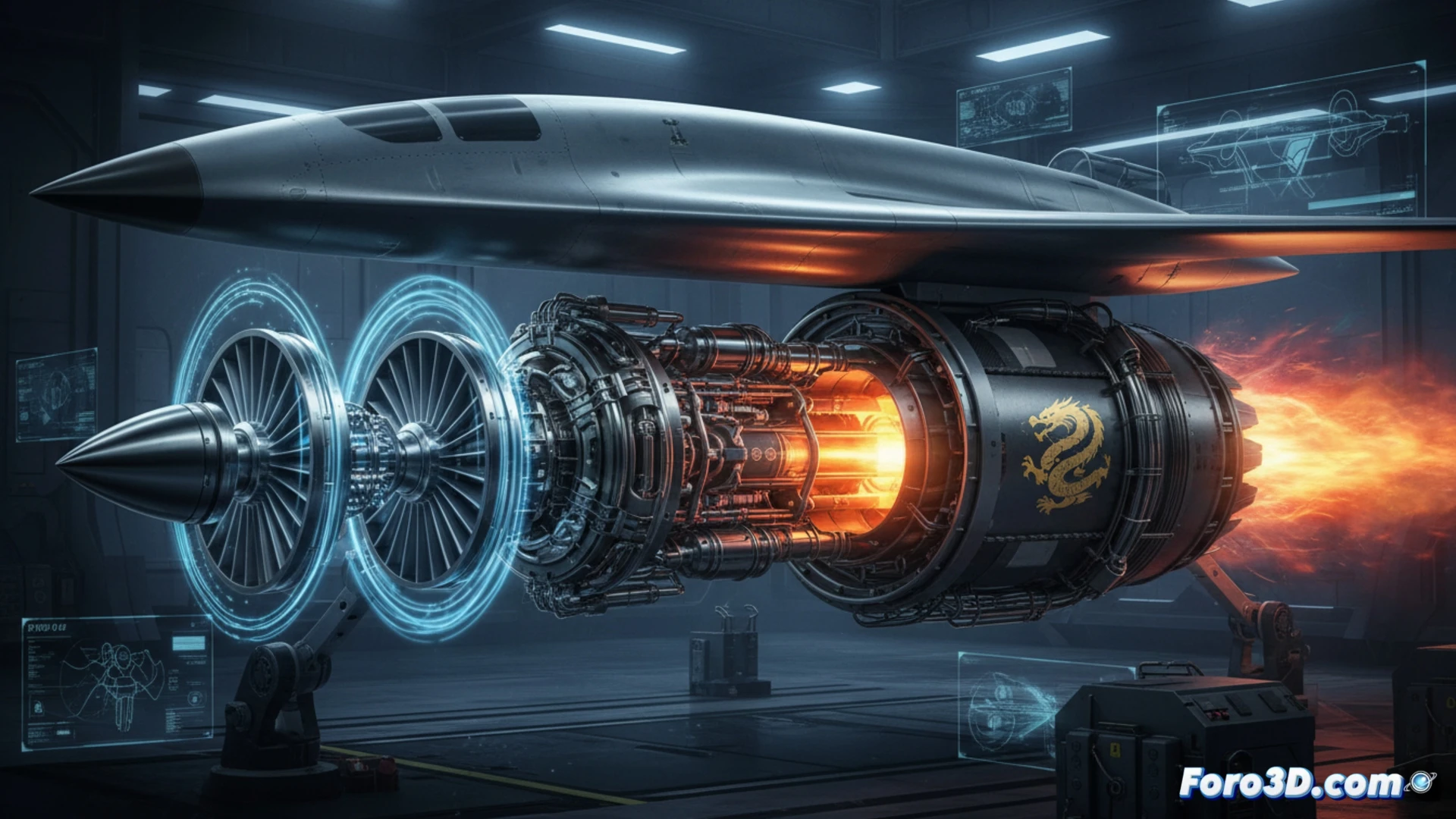
A Chinese propulsion development claims to overcome a classic technical barrier. It is a jet engine that, according to its creators, can operate from takeoff to hypersonic speeds, around Mach 6, without requiring a mechanical mode change. This contrasts with historical solutions like the SR-71 engine, which had to transition between turbojet and ramjet. The concept, a contra-rotary ramjet, is in the prototype phase.🚀
The Principle of the Counter-Rotating Compressor⚙️
The key to the design is a compressor system with turbines that spin in opposite directions. This counter-rotating scheme allows for efficiently slowing down the airflow when it enters at extreme supersonic speeds, a necessary condition for stable combustion in ramjet mode. By maintaining this capability from low speed, the engine avoids the complex transition that limits hybrid designs. Experimental verification comes after decades of theoretical work.
And the Air Conditioning Problem, Who Pays for It?🔥
Achieving the airflow is one thing, but managing the resulting heat is another story. Sustained flight at Mach 6 generates temperatures that would melt most known materials. Arguably, the project's greatest challenge is not the engine itself, but designing a cooling system that doesn't weigh like a tank and take up more space than the cockpit. Perhaps the real breakthrough lies in the heat-resistant materials section, a field where there's a lot to sweat about, literally.