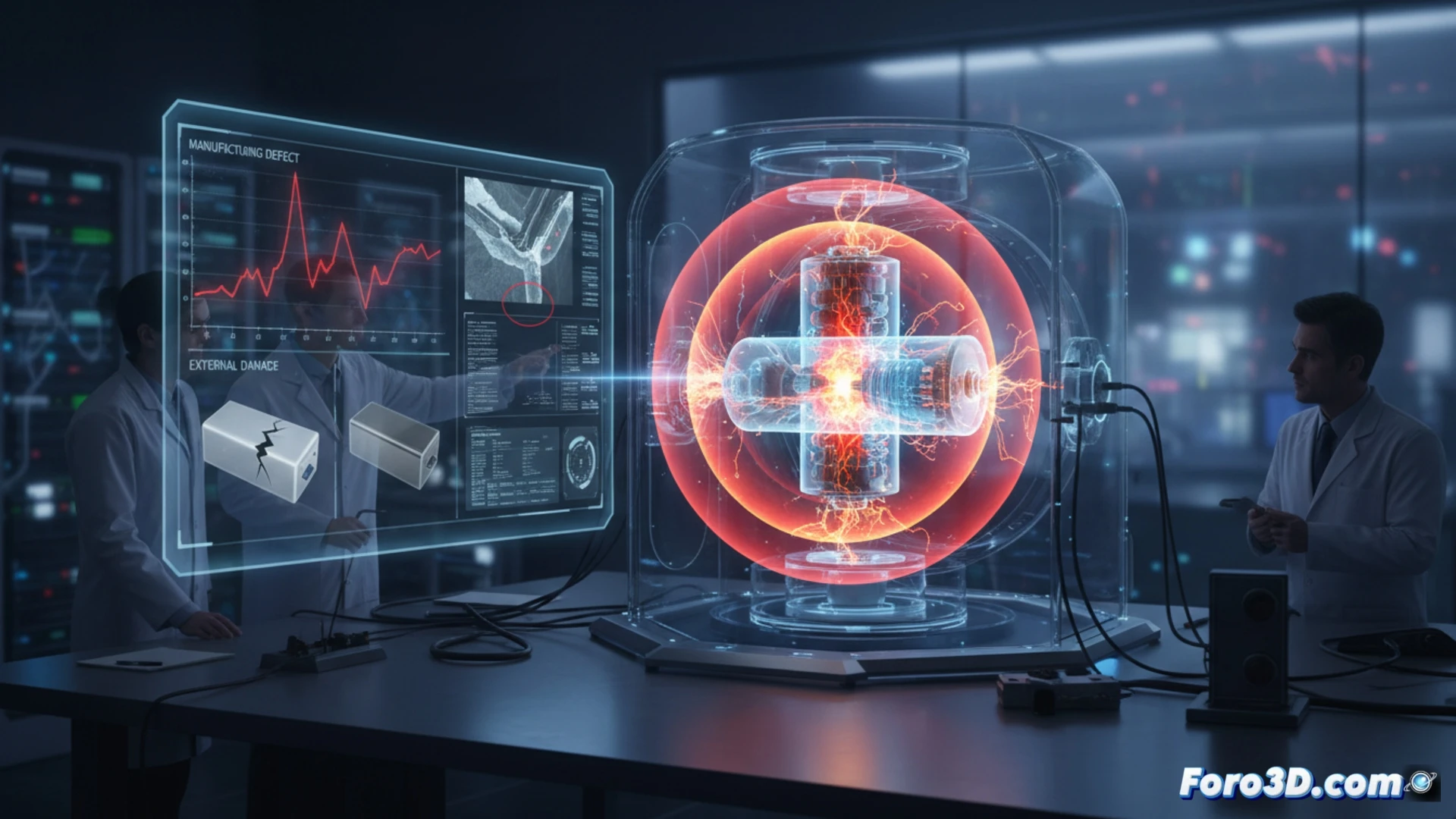
A fire in an office, originating from a backpack with a laptop, triggers a high-level forensic investigation. The goal: to determine the root cause of the catastrophic failure of the lithium-ion battery. Through a workflow combining computed tomography, 3D segmentation, and thermo-fluid simulation, the internal thermal runaway process is reconstructed to discern between a manufacturing defect and external physical damage.
From Charred Remains to a Simulable 3D Model 🔬
The process begins with the micro-CT scanning of the damaged cells using Nikon CT, obtaining high-resolution volumetric data. In Dragonfly, the internal components are segmented, reconstructing the geometry of the electrodes and the separator even in their degraded state. This 3D model is exported to Ansys Fluent to simulate heat transfer and gas flow during thermal runaway. Finally, Blender is used to visualize and communicate the findings clearly, creating understandable representations of the progressive failure.
The Incident Scene Lives in the Digital Space 💻
This case demonstrates how digital reverse engineering transforms charred physical evidence into a dynamic causal model. The forensic conclusion, whether lithium dendrites or crushing, is supported by objective data visualized in 3D. This methodology sets a standard for failure investigation, where the virtual reconstruction of the scene becomes the definitive tool for technical truth analysis.
How can the spread of a fire originating from a lithium battery be digitally reconstructed to determine the point of failure and the ignition sequence?
(PS: In scene analysis, every scale witness is a small anonymous hero.)