A serious accident, involving the fall of a freight elevator several floors, triggered a forensic investigation to determine the cause and assign responsibility. The approach was not limited to a traditional visual inspection. Instead, a workflow based on 3D digitization was employed to analyze the key physical evidence: the fractured ends of the steel cables. This methodology allowed for the discovery of critical defects not visible to the naked eye.
From 3D Scanning to Analysis of the Hidden Fracture 🔍
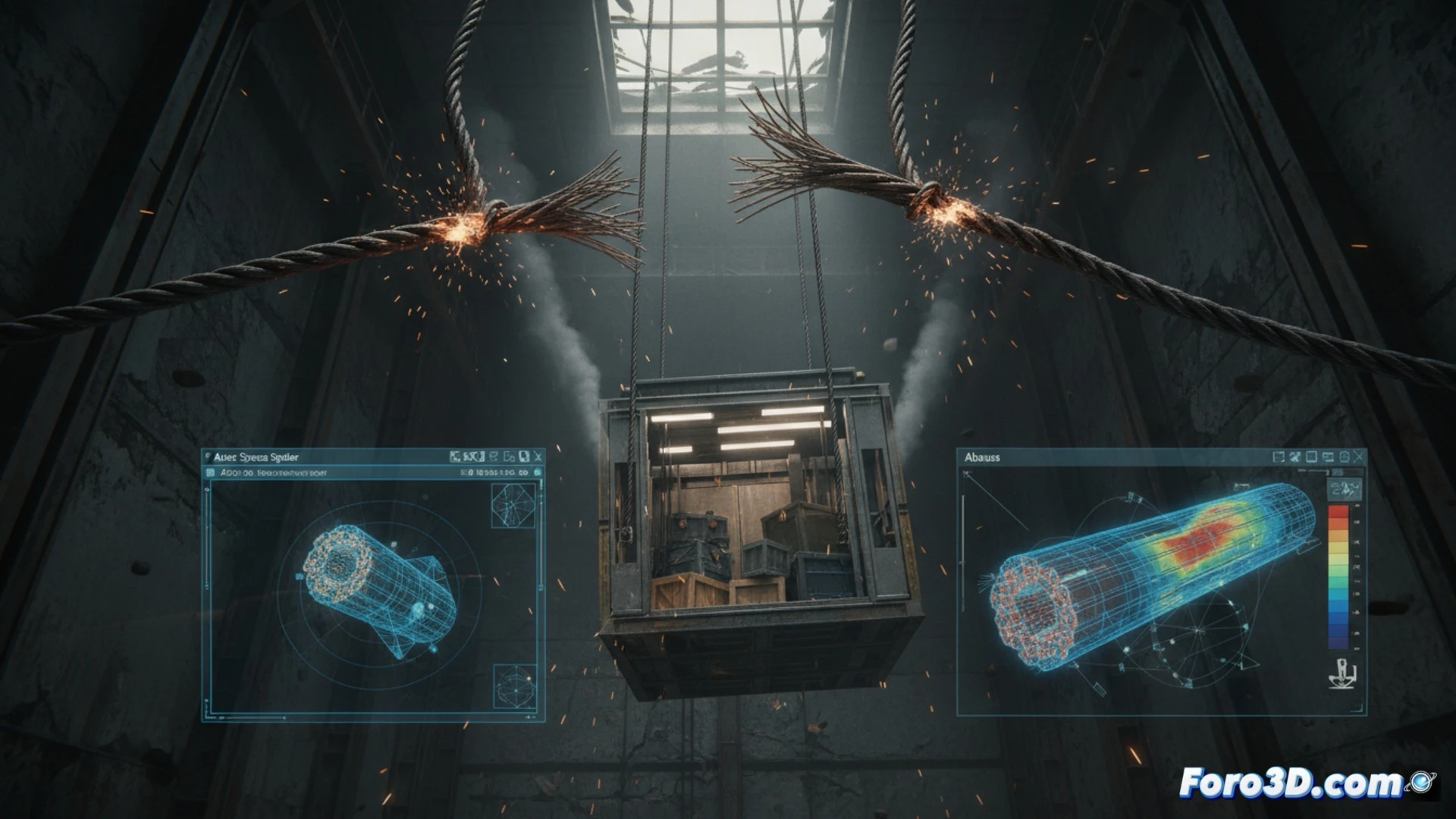
The process began with the high-precision scanning of the broken cables using an Artec Space Spider, capturing their geometry and surface texture with micrometric accuracy. The 3D models were imported into GOM Inspect, where detailed analysis of the fracture surface revealed characteristic patterns of stress corrosion cracking. This phenomenon, which weakens the steel from within under constant load, was invisible during routine external inspections. Integrating this data into software like Abaqus allowed for the simulation of fatigue stresses and validation of the failure point, establishing an irrefutable chain of technical evidence regarding the origin of the failure.
Digital Reconstruction as Definitive Proof ⚖️
The investigation culminated with the presentation of the evidence. The digital reconstruction of the accident and, especially, the interactive visualization of the analyzed 3D models, possibly in an environment like Unreal Engine, proved decisive. This ability to clearly and incontestably show the hidden internal corrosion and its failure mechanism was fundamental in assigning responsibility to the inadequate maintenance program, which failed to detect this latent defect in time.
How can 3D forensic analysis and finite element simulation determine if the cable break was due to material fatigue, overload, or a manufacturing defect?
(PS: In scene analysis, every scale witness is a small anonymous hero.)