Off the coast of Japan, at a depth of 25 meters, the Yonaguni Monument features stepped terraces, right angles, and perfect edges that challenge marine geology. This enigma, which divides archaeologists and geologists, finds its best ally in 3D modeling to determine whether it is an ancient human work or a tectonic quirk. Underwater photogrammetry now allows us to dissect each block without moving a single stone.
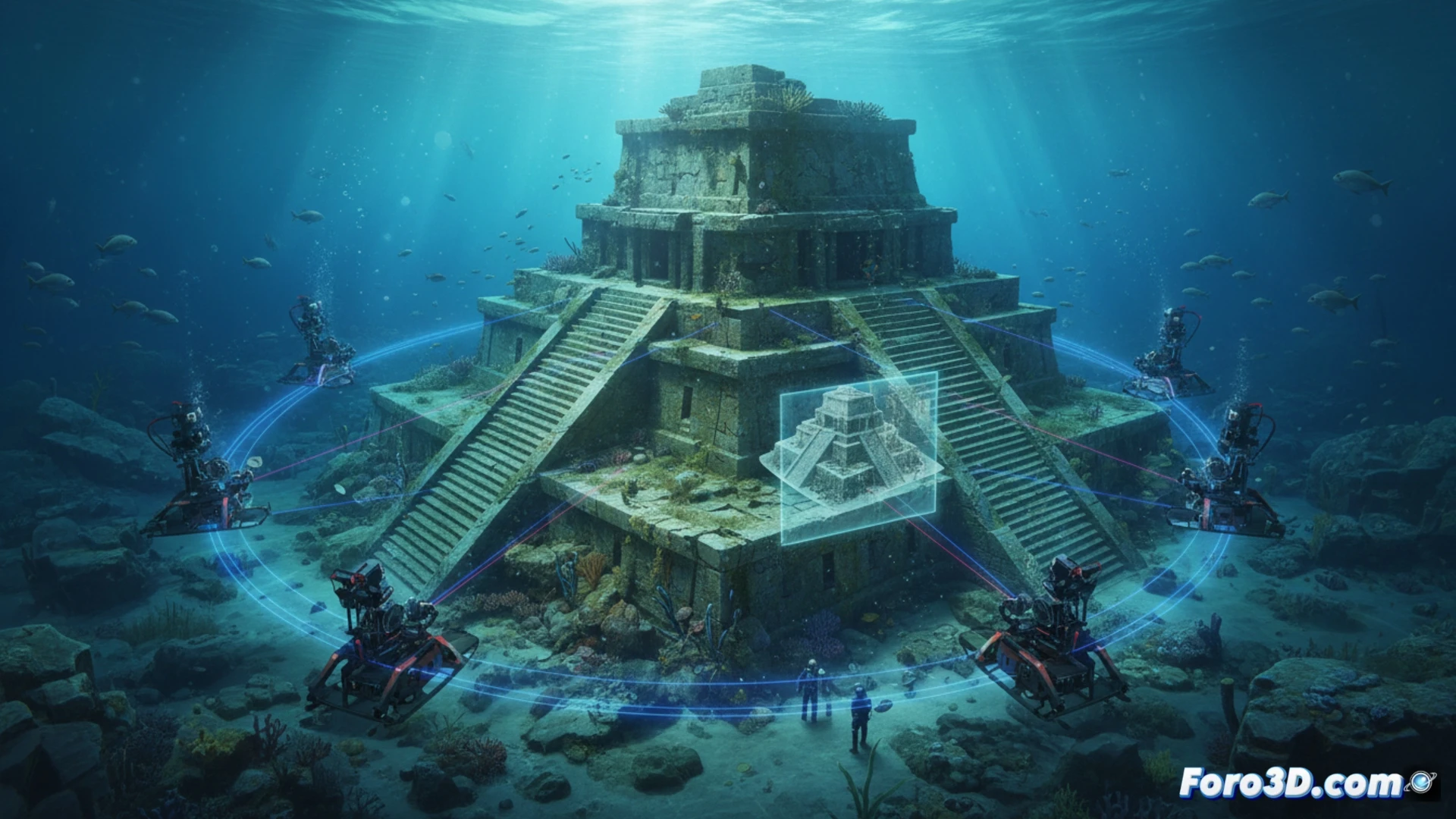
Underwater photogrammetry and differential erosion simulation 🧊
Digital archaeology teams have generated point clouds of the monolith using hundreds of images taken by divers and ROVs. By importing this data into software such as Blender or Agisoft Metashape, simulated erosion algorithms can be applied to compare the wear of the Yonaguni terraces with that of known basalt formations, such as the Giant's Causeway. The metric analysis of the right angles, with tolerances of less than 2 degrees of deviation, allows researchers to contrast the hypothesis of human carving against natural fracturing by joints. The overlay of digital models reveals symmetry patterns that, according to proponents of an anthropogenic origin, are statistically improbable in nature.
The dilemma of interpretation without physical evidence 🤔
The great advantage of 3D analysis is that it allows hypotheses to be formulated without the need to excavate or extract samples, preserving the heritage. However, technology cannot date the rock or detect cutting tools if they have been erased by millennia of currents. The Yonaguni Monument reminds us that, even with the best digital models, the line between the natural and the artificial remains blurred. The final answer may not lie in the software, but in the decision to go down and touch the stone.
What 3D scanning or underwater photogrammetry techniques would allow us to conclusively differentiate whether the stepped terraces of Yonaguni are natural geological formations or the product of human intervention or an ancient civilization?
(PS: and remember: if you can't find a bone, you can always model it yourself)