Independent development has found a creative goldmine in nostalgia, but few titles manage to capture the technical essence of 90s hardware like Yellow Taxi Goes Vroom. This platformer not only imitates the art of the Nintendo 64, but replicates its limitations: low-polygon models, stretched pixelated textures, and a camera that evokes the awkward angles of the era. We analyze the workflow between Blender and Unity that makes this retro illusion possible. 🕹️
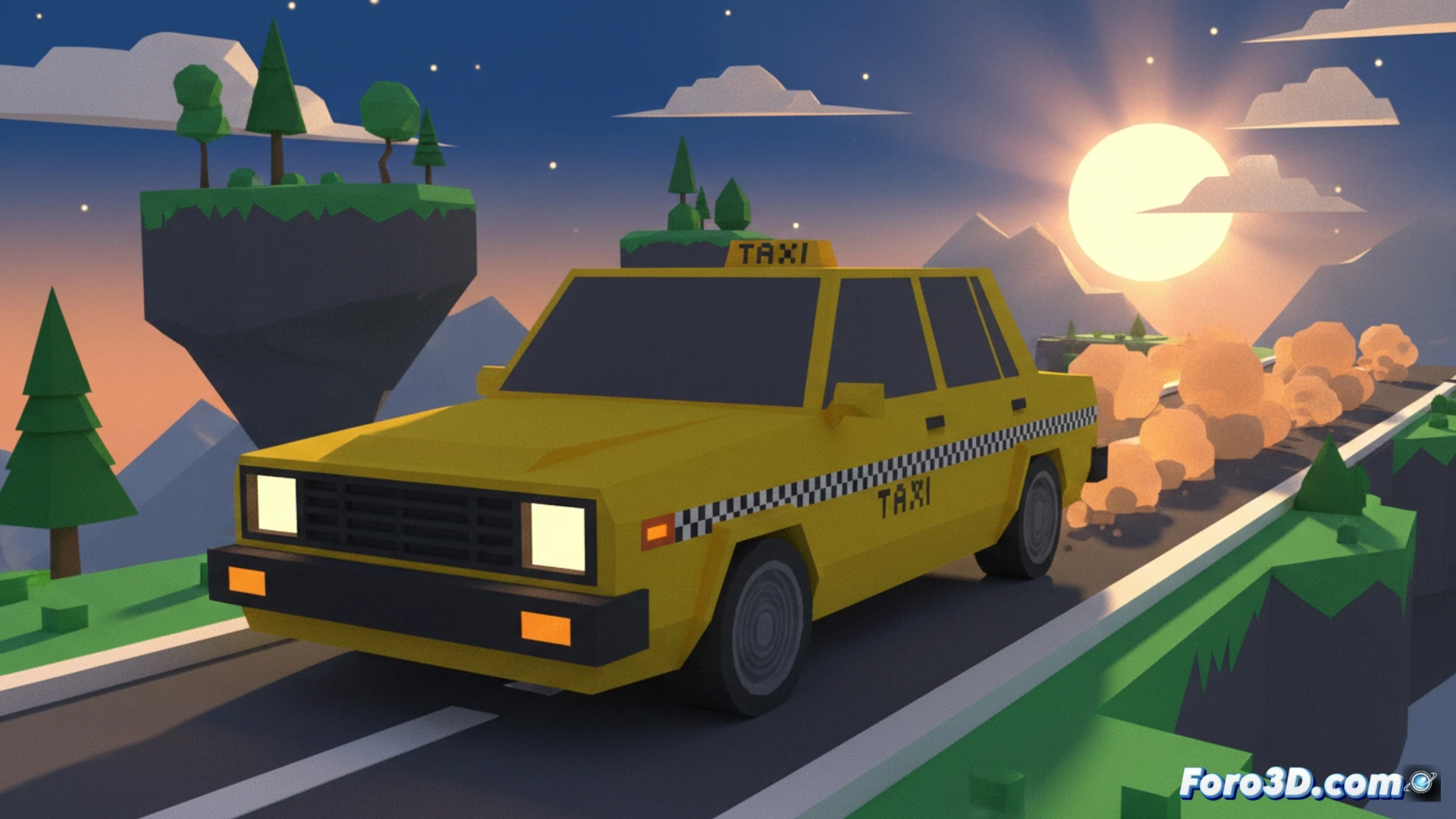
Technical Pipeline: Low-poly Modeling and Stretched UV Mapping 🎨
The team behind Yellow Taxi Goes Vroom uses Blender to sculpt models that deliberately avoid modern smoothness. The key lies in the polygon count: each character and scene is built with the minimum necessary geometry, mimicking the memory constraints of the N64. Textures are painted at low resolutions (32x32 or 64x64 pixels) and mapped with stretched UVs, a technical flaw of the era that here becomes an artistic hallmark. In Unity, bilinear filtering and mipmapping are disabled, forcing point sampling so that pixels appear hard and square. The camera is programmed with rigid movement and no smooth interpolation, recreating the characteristic bobbing of titles like Banjo-Kazooie.
Functional Nostalgia: How Limitations Improve Gameplay 🎮
Beyond aesthetics, Yellow Taxi Goes Vroom demonstrates that technical nostalgia should not sacrifice gameplay. By reducing visual fidelity, the player focuses on the clarity of shapes and controller response. Pixelated textures and angular polygons avoid detail saturation, allowing jumps and platforms to be read instantly. The retro camera, far from being a gimmick, forces the designer to create more open and predictable levels, where the fixed angle guides the player without disorienting them. It is a reminder that sometimes, fewer polygons mean more fun.
What are the key techniques in Blender and Unity to replicate the technical limitations of the Nintendo 64, such as texture distortion and lack of anti-aliasing, without falling into a simple retro filter?
(PS: optimizing for mobile is like trying to fit an elephant into a Mini Cooper)