The release of The Legend of Heroes: Trails through Daybreak II has put Nihon Falcom's proprietary Yamaneko Engine under the technical microscope. This second iteration not only consolidates the saga's transition towards real-time rendering with an anime aesthetic but also introduces critical improvements in shaders, texture management, and state transitions. For developers, it represents a case study on how to optimize an artistic pipeline without abandoning a low-polygon visual identity.
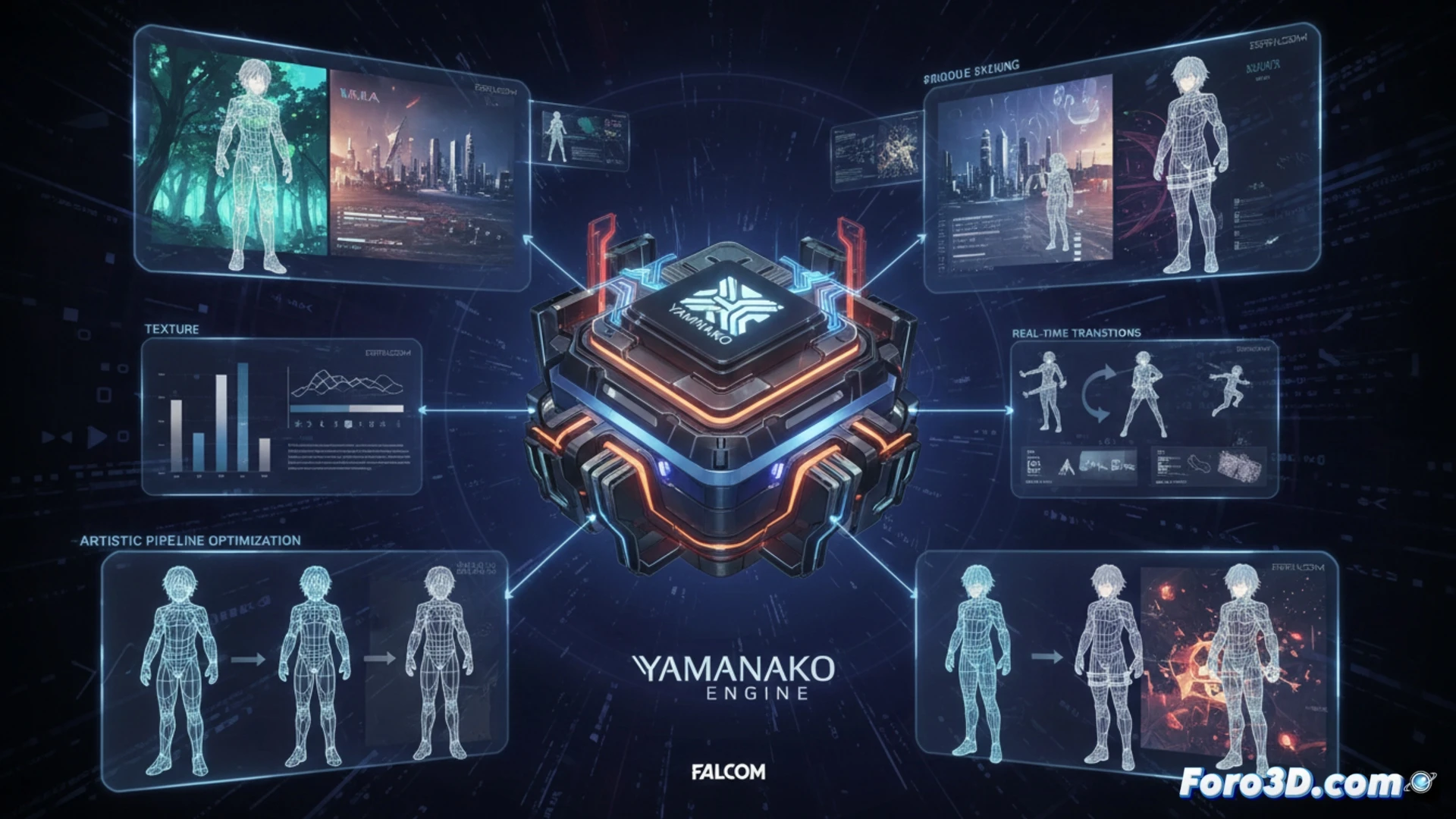
Toon shaders and real-time transitions 🎨
The greatest technical achievement of the Yamaneko Engine in this installment lies in its toon shaders. Falcom has implemented a diffuse lighting system with softer color bands and precise control over specular, eliminating the plastic-like appearance that plagued previous titles. In practice, characters feature dynamic lighting that respects 2D lineart without resorting to heavy post-processing. Furthermore, the transition between exploration mode and combat has been reduced to less than a second thanks to an asynchronous asset loading system. The engine keeps scene data in memory while swapping only the combat shaders, achieving a fluidity that other turn-based RPGs fail to reach even with Unreal Engine.
Urban textures and the challenge of scale 🏙️
The city of Edith, the game's central setting, showcases the most visible improvement: PBR (physically based rendering) textures applied to urban surfaces such as cobblestones, awnings, and brick facades. Although the engine remains limited by its PlayStation 4 heritage, Falcom has doubled the resolution of normal maps and ambient occlusion. This allows directional lighting to react credibly on materials, a qualitative leap compared to Trails into Reverie. For independent developers, the Yamaneko Engine demonstrates that a proprietary engine can compete in visual fidelity if memory management is optimized and shading consistency is prioritized over polygon count.
What specific rendering techniques does the Yamaneko Engine use to achieve the real-time anime aesthetic in Trails through Daybreak II, and how do they compare to methods like traditional cel shading or the use of post-processing shaders?
(PS: optimizing for mobile is like trying to fit an elephant into a Mini Cooper)